What is Regularization?
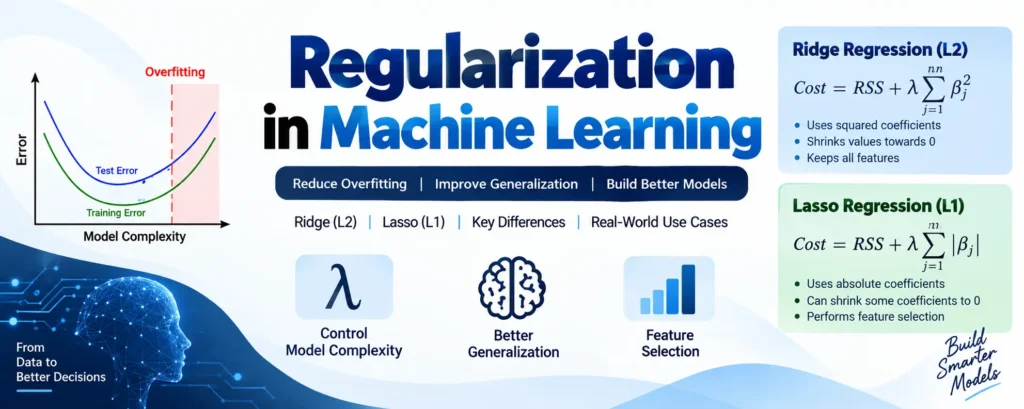
Regularization in Machine Learning is an important technique in machine learning that helps improve a model’s performance on unseen data. It primarily works by reducing overfitting and controlling the complexity of the model.
Imagine a model that performs extremely well on training data but produces poor predictions when given new, real-world data. This is known as overfitting, where the model learns not only useful patterns but also noise from the training dataset.
Regularization helps prevent this by adding constraints to the learning process. Instead of allowing the model to rely too heavily on particular features, it encourages the model to learn patterns that are more generalizable.
The basic idea is simple: reduce the magnitude or influence of model features without necessarily removing them. This allows the model to maintain a good balance between accuracy and generalization.
Complete Advance AI Topics: Click Here
SQL Tutorial: Click Here
How Does Regularization Work?
To understand regularization, let’s consider a linear regression model. A basic linear regression equation can be represented as:
y = β0 + β1x1 + β2x2 + … + βnxn + b
Here:
- y is the predicted output.
- x1, x2, …, xn are the input features.
- β0, β1, …, βn are the model weights or coefficients.
- b represents the intercept.
In standard linear regression, the model tries to find the best coefficients by minimizing a cost function, commonly based on the Residual Sum of Squares (RSS).
Regularization changes this approach by adding an additional penalty term to the cost function. This penalty discourages the model from assigning unnecessarily large values to its coefficients and helps control model complexity.
Types of Regularization Techniques
Regularization is mainly applied using two popular techniques:
1. Ridge Regression (L2 Regularization)
Ridge Regression, also known as L2 Regularization, adds a penalty based on the squared values of the model coefficients.
The modified cost function can be represented as:
Cost = RSS + λ Σj=1n βj2
Here, λ (lambda) is the regularization parameter that controls the strength of the penalty.
- When λ → 0, the model approaches standard linear regression.
- As λ increases, the coefficients are increasingly pushed toward zero.
- Ridge generally keeps all features in the model while reducing their influence.
Use Case: Ridge Regression is useful when most or all features contribute to the prediction, but their influence needs to be controlled.
Benefits: It helps handle multicollinearity and can work effectively when the number of features is large compared with the number of training samples.
2. Lasso Regression (L1 Regularization)
Lasso Regression, short for Least Absolute Shrinkage and Selection Operator, uses the absolute values of the coefficients as its penalty.
Its cost function can be represented as:
Cost = RSS + λ Σj=1n |βj|
One of the major differences between Lasso and Ridge is that Lasso can shrink some coefficients exactly to zero. As a result, it can automatically perform feature selection.
Use Case: Lasso is useful when you believe that only a smaller number of features are actually important for making predictions.
Benefits: It helps reduce overfitting while automatically removing less important features by setting their coefficients to zero.
Key Differences: Ridge vs Lasso
| Feature | Ridge Regression | Lasso Regression |
|---|---|---|
| Regularization | L2 (squared weights) | L1 (absolute weights) |
| Feature Selection | No | Yes, some coefficients can become 0 |
| Use Case | When most features contribute to the model | When only a smaller set of features is relevant |
| Coefficient Impact | Shrinks coefficients toward 0 | Can shrink some coefficients exactly to 0 |
Download New Real Time Projects :- Click here
Conclusion
Regularization is an important technique for building robust and reliable machine learning models. It helps control model complexity and reduces the risk of overfitting, allowing models to perform better on unseen data.
Ridge Regression is useful when you want to reduce the influence of features while keeping them in the model, whereas Lasso Regression can also eliminate less important features by reducing their coefficients to zero.
By using the right regularization technique, machine learning models can achieve a better balance between fitting the training data and generalizing to new data.
Pro Tip: Regularization should be treated as an important part of the machine learning workflow. Try evaluating your model both with and without regularization to understand its effect on performance and generalization.
Stay tuned for more hands-on machine learning tutorials and practical tips!
Keywords: Regularization in Machine Learning, L1 and L2 Regularization in Machine Learning, Ridge Regression, Lasso Regression, L1 Regularization, L2 Regularization, Regularization Formula, Regularization Example, Regularization in Neural Networks, Overfitting in Machine Learning, Difference Between L1 and L2 Regularization, Machine Learning Regularization