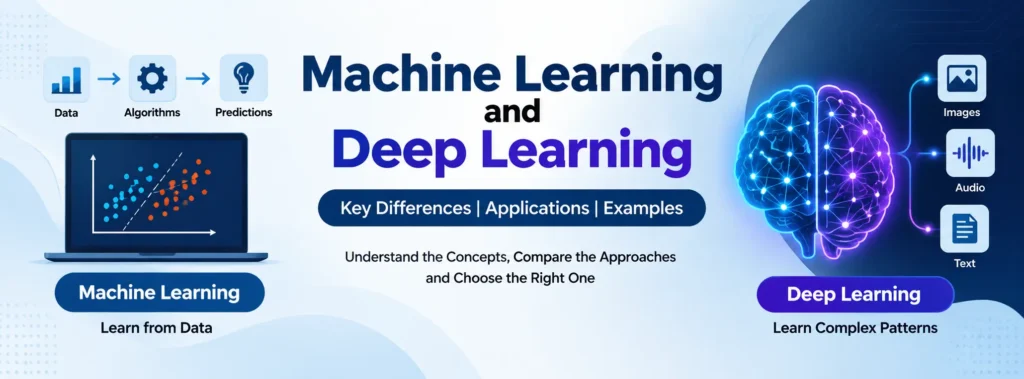
Machine Learning and Deep Learning
In the field of Data Science, Machine Learning (ML) and Deep Learning (DL) are two important concepts that are often confused with each other. Both are part of Artificial Intelligence (AI), but they differ in how they learn from data, process information, and solve problems.
Understanding the difference between Machine Learning and Deep Learning helps you choose the right approach based on the type of data, problem complexity, available resources, and expected results. In this article, we will explore both concepts and compare their major differences.
Complete Advance AI Topics: Click Here
SQL Tutorial: Click Here
What is Machine Learning?
Machine Learning is a subset of Artificial Intelligence that enables computers to learn from data, identify patterns, and make predictions or decisions without being explicitly programmed for every task.
The basic idea behind Machine Learning is that a system learns from previous data and uses that knowledge to make predictions or decisions on new data. As more useful data becomes available, the model can be trained and improved.
Popular Applications of Machine Learning
- Email Spam Filtering
- Product Recommendations
- Online Fraud Detection
Common Machine Learning Algorithms
- Decision Trees
- Naïve Bayes
- Random Forest
- K-means Clustering
- K-Nearest Neighbors (KNN)
- Apriori Algorithm
How Does Machine Learning Work?
Consider a simple example of classifying images of cats and dogs. A Machine Learning model can be trained using labeled images of both animals.
During the process, relevant features such as shape, size, eyes, nose, and other characteristics can be extracted from the images. The selected Machine Learning algorithm then uses these features to learn patterns and classify a new image as either a cat or a dog.
In traditional Machine Learning, selecting and preparing useful features can be an important part of building an effective model.
What is Deep Learning?
Deep Learning is a subset of Machine Learning that uses artificial neural networks with multiple layers to learn complex patterns from data. These networks are loosely inspired by the way the human brain processes information.
Deep Learning models can learn useful features automatically from large amounts of data. This makes them particularly effective for complex tasks involving images, audio, video, and natural language.
Popular Applications of Deep Learning
- Self-Driving Cars
- Language Translation
- Natural Language Processing (NLP)
Key Deep Learning Models
- Convolutional Neural Networks (CNN)
- Recurrent Neural Networks (RNN)
- Autoencoders
- Deep Neural Networks (DNN)
How Does Deep Learning Work?
Deep Learning models can receive raw data such as images, audio, or text and process it through multiple layers of a neural network. Each layer can learn different representations of the input data.
Unlike many traditional Machine Learning approaches, Deep Learning can automatically learn important features from raw data. For example, in image recognition, earlier layers may learn simple patterns such as edges, while deeper layers can learn more complex shapes and objects.
This ability to learn features automatically makes Deep Learning useful for complex tasks such as image recognition, speech processing, and language understanding.
Difference Between Machine Learning and Deep Learning
Although Machine Learning and Deep Learning are closely related, there are several important differences between them.
| Parameter | Machine Learning | Deep Learning |
|---|---|---|
| Data Dependency | Can work effectively with smaller datasets. | Generally performs better with large amounts of data. |
| Training Time | Usually requires less training time. | Usually requires more training time because of complex neural networks. |
| Hardware Dependency | Can often run effectively on standard hardware. | Often benefits from powerful hardware such as GPUs. |
| Feature Engineering | Feature extraction and selection may need to be performed manually. | Can automatically learn useful features through multiple neural-network layers. |
| Problem-Solving Approach | Often uses selected features and a specific algorithm to solve a problem. | Can learn complex representations and solve tasks using an end-to-end approach. |
| Interpretation | Many ML models are comparatively easier to interpret. | Deep Learning models can be difficult to interpret because of their complexity. |
| Type of Data | Works especially well with structured and prepared data. | Particularly powerful for unstructured data such as images, audio, and text. |
| Suitability | Suitable for simple to moderately complex problems. | Suitable for complex problems involving large datasets and high-dimensional data. |
Machine Learning vs Deep Learning with Examples
A simple way to understand the difference is through an image-classification example.
In a traditional Machine Learning system, developers may first identify and extract useful image features, such as edges, shapes, size, or other characteristics. These features are then provided to a Machine Learning algorithm for classification.
In a Deep Learning system, a neural network can learn useful features directly from the images. Multiple layers gradually learn increasingly complex representations and use them to make the final classification.
Choosing Between Machine Learning and Deep Learning
The choice between Machine Learning and Deep Learning depends mainly on the available data, problem complexity, and computing resources.
- Choose Deep Learning when you have a large dataset, sufficient computing resources, and a complex problem involving data such as images, audio, video, or text.
- Choose Machine Learning when you have a smaller dataset, limited computing resources, or a problem that can be effectively solved using traditional ML algorithms.
Download New Real-Time Projects: Click here
Conclusion
Machine Learning and Deep Learning are both important areas of Artificial Intelligence, but they use different approaches to learn from data. Machine Learning often relies on selected features and traditional algorithms, while Deep Learning uses multi-layer neural networks that can automatically learn complex features from data.
Deep Learning can be considered a specialized and more data-intensive branch of Machine Learning. The right choice depends on the problem, amount and type of data, computing resources, and required level of complexity.
Keywords: difference between machine learning and deep learning with examples, difference between machine learning and deep learning class 10, difference between machine learning and deep learning class 9, difference between machine learning and deep learning and artificial intelligence, difference between machine learning and deep learning pdf, difference between machine learning and artificial intelligence, difference between machine learning and deep learning geeksforgeeks, difference between machine learning and deep learning in tabular form