Association Rule Learning
Association Rule Learning is a powerful unsupervised machine learning technique used to discover interesting relationships and dependencies among items in large datasets. Its main goal is to understand how the occurrence of one item is related to the occurrence of another, helping businesses and researchers make better data-driven decisions.
This technique is commonly used in Market Basket Analysis, Web Usage Mining, Inventory Management, and Healthcare Analytics. For example, in retail, association rules can reveal products that customers frequently purchase together. Businesses can then use these insights for better product placement and personalized recommendations.
Complete Advance AI Topics: Click Here
SQL Tutorial: Click Here
What is Association Rule Learning?
Association Rule Learning focuses on finding hidden patterns and relationships among variables in large datasets. It uses logical rules to identify frequent itemsets and determine the strength of associations between them.
Let’s understand it with a simple retail example.
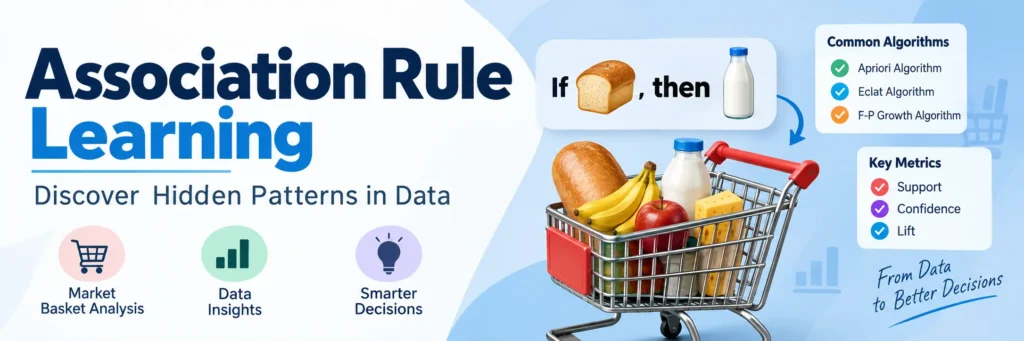
Imagine you are shopping at a supermarket. Many customers who purchase bread also buy milk or butter. By identifying this pattern, retailers can place these products closer together or recommend them to customers, making shopping more convenient and potentially increasing sales.
Types of Association Rule Learning Algorithms
There are three primary algorithms commonly used for Association Rule Learning:
- Apriori Algorithm
- Eclat Algorithm
- F-P Growth Algorithm
We will explore each of these algorithms in detail in upcoming chapters.
How Does Association Rule Learning Work?
Association Rule Learning generally uses an If-Then format:
If A, then B
Where:
- A is called the Antecedent.
- B is called the Consequent.
This concept can be used for simple relationships where one item leads to another. As the number of items in an itemset increases, more complex associations can be discovered.
To measure and validate these relationships, several important metrics are used.
Key Metrics in Association Rule Learning
Support
Support represents how frequently an item or itemset appears in a dataset. It is the fraction of total transactions that contain the particular itemset.
Formula:
Support(X) = Number of transactions containing X / Total number of transactions
Confidence
Confidence measures the reliability of an association rule. It tells us how frequently Y appears in transactions that already contain X.
Formula:
Confidence(X → Y) = Support(X and Y) / Support(X)
Lift
Lift measures the strength of an association compared with what would be expected by chance. It helps determine whether the occurrence of item Y is actually related to item X.
Formula:
Lift(X → Y) = Confidence(X → Y) / Support(Y)
Interpretation:
- Lift = 1: No relationship; the items are independent.
- Lift > 1: Positive correlation; the items are associated.
- Lift < 1: Negative correlation; the items have a substitute-like relationship.
Typical Algorithms for Learning Association Rules
1. Apriori Algorithm
The Apriori algorithm is a classic approach for identifying frequent itemsets. It uses a breadth-first search strategy and removes itemsets that do not satisfy the minimum support threshold before generating strong association rules.
It is widely used in areas such as retail and healthcare to identify purchasing patterns and relationships within data.
2. Eclat Algorithm
Eclat (Equivalence Class Transformation) uses a depth-first search approach and represents data vertically. This approach can provide better performance than Apriori for certain types of datasets, particularly dense datasets.
3. F-P Growth Algorithm
The Frequent Pattern Growth (F-P Growth) algorithm is an efficient alternative to Apriori. It creates a compact tree structure called an FP-Tree to mine frequent itemsets while reducing the need for repeated scans of the database.
Applications of Association Rule Learning
Association Rule Learning has applications across many industries and domains:
- Market Basket Analysis: Understand which products are frequently purchased together to improve store layouts and marketing strategies.
- Medical Diagnosis: Identify potential relationships between diseases, symptoms, and historical patient data.
- Protein Sequencing: Discover meaningful patterns in protein structures and biological data.
- Catalog Design: Determine product arrangements and recommendations based on customer purchasing patterns.
- Loss-leader Analysis: Identify product combinations where a discount on one product may influence the sales of another.
Download New Real Time Projects :- Click here
Final Thoughts from Updategadh
Association Rule Learning is not just a theoretical concept. It plays an important role in areas such as fraud detection, recommendation systems, and healthcare applications. Understanding these algorithms can help organizations discover useful patterns, make smarter decisions, and improve user experiences.
Whether you are a data analyst, a machine learning enthusiast, or simply curious about data science, learning Association Rule Learning can open up many possibilities in the field of machine learning and data mining.
Stay tuned to Updategadh for detailed guides on Apriori, Eclat, and F-P Growth algorithms, coming up soon!