What Is Digital Twin AI
Digital Twin AI is becoming an important technology in modern artificial intelligence, manufacturing, engineering, smart cities, healthcare, energy, and other industries. It combines the concept of a digital twin with Artificial Intelligence (AI), Machine Learning (ML), real-time data, sensors, and simulation technologies.
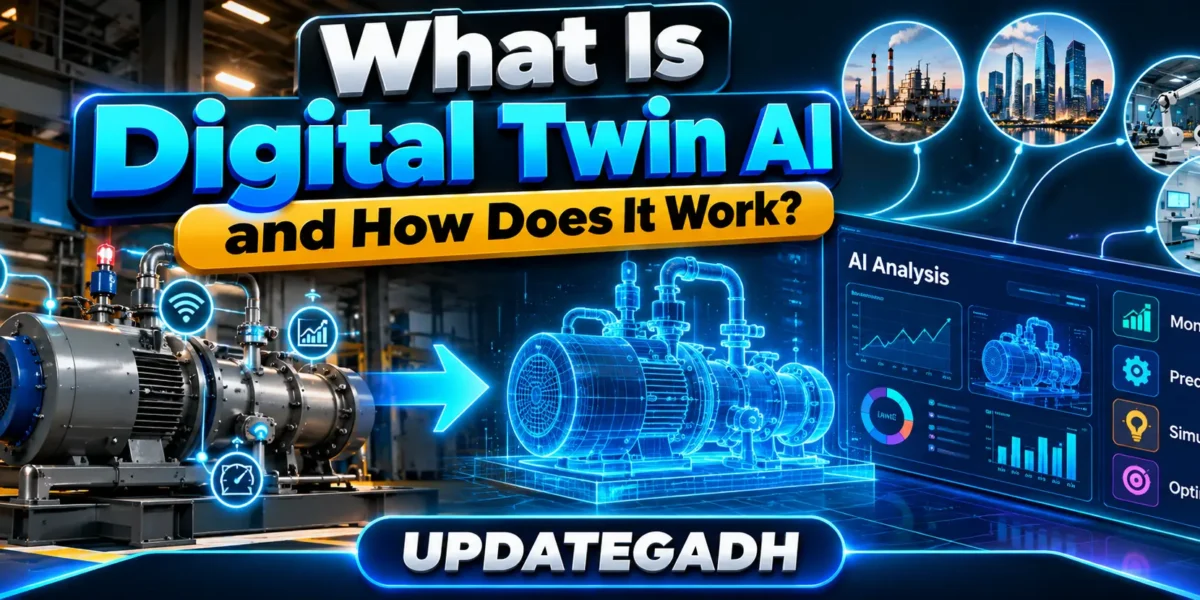
A digital twin is a virtual representation of a real-world object, machine, process, building, or system. It continuously uses information from its physical counterpart to represent its current condition and behavior. When AI is added, the digital twin can go beyond simply showing what is happening. It can analyze patterns, predict possible problems, simulate different situations, and help organizations make better decisions.
Complete Advance AI Topics: Click Here
Real Time Projects on YouTube:- DecodeIT
What Is Digital Twin AI?
Digital Twin AI refers to a digital twin enhanced with artificial intelligence and machine learning capabilities. The physical system produces data through sensors, connected devices, machines, databases, cameras, or other sources. This information is transferred to its virtual representation, where AI models can analyze the data.
The basic idea is simple:
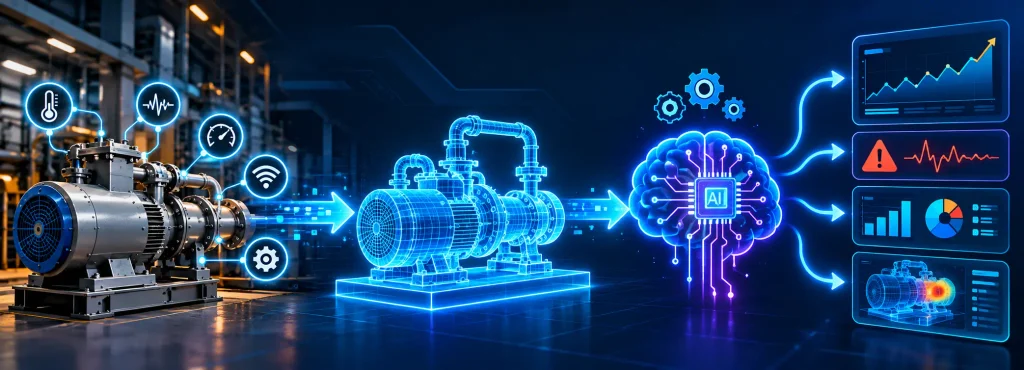
Real-World Object → Data Collection → Digital Twin → AI Analysis → Prediction/Simulation → Decision or Action
For example, imagine a manufacturing machine equipped with temperature, vibration, pressure, and performance sensors. A digital twin can represent that machine virtually. AI can analyze the incoming data and identify unusual patterns that may indicate a future component failure. Engineers can then investigate the issue before the physical machine experiences serious downtime.
This combination is particularly useful because organizations can test scenarios digitally before making changes in the physical environment. NVIDIA describes digital twins as virtual representations used for designing, simulating, and operating physical products, processes, and facilities.
How Does Digital Twin AI Work?
Digital Twin AI generally works through several connected stages. The exact architecture depends on the industry and application, but the core process remains similar.
1. Data Collection
The first step is collecting information from the physical object or system. Sensors and Internet of Things (IoT) devices can capture information such as temperature, pressure, speed, location, energy consumption, vibration, movement, and operating status.
Other sources may include databases, cameras, enterprise applications, CAD models, 3D models, maintenance records, and historical operational data.
The quality and availability of this data are important because the digital twin needs reliable information to represent the physical system accurately.
2. Creating the Digital Twin
The collected information is used to create a virtual representation of the physical object or system. Depending on the use case, the representation can be a simple data model, a dashboard, a 3D environment, or a detailed simulation model.
Modern digital twins can combine different forms of information, including tabular data and 2D or 3D data. This makes it possible to represent not only the appearance of an asset but also its operational behavior.
3. Connecting Real-Time Data
A major characteristic of a digital twin is its connection with the physical system. New data can continuously update the virtual model so that it remains synchronized with the real-world asset.
For example, if the temperature of a machine increases in the physical world, the corresponding information can appear in the digital twin. This allows engineers and operators to monitor the system without relying only on manual inspections.
4. Applying Artificial Intelligence
AI and machine learning provide the intelligence layer. Instead of simply displaying data, AI can identify patterns and relationships within historical and real-time information.
Depending on the application, AI can be used for:
- Predictive maintenance
- Anomaly detection
- Performance prediction
- Failure prediction
- Process optimization
- Demand forecasting
- Computer vision
- Scenario analysis
- Automated decision support
IBM notes that modern digital twin systems can use AI and machine learning for predictive analysis, pattern detection, future scenario simulation, and asset tracking.
5. Simulation and What-If Analysis
One of the most useful capabilities of Digital Twin AI is simulation. Organizations can create virtual scenarios and observe how a system could behave under different conditions.
For example, a factory could simulate a change in production layout before physically moving equipment. An energy company could analyze how a power system might respond to changing conditions. Engineers could test different product designs virtually before producing physical prototypes.
This approach can reduce the need for repeated physical testing and can help teams identify potential problems earlier.
6. Insights and Actions
The final stage is turning AI-generated insights into useful decisions. A dashboard can display warnings, predictions, recommendations, performance indicators, or simulation results.
In more advanced systems, AI can also work with automation technologies to recommend or perform certain operational changes, depending on the level of control permitted by the organization.
Key Technologies Behind Digital Twin AI
Digital Twin AI is not based on a single technology. It usually combines several technologies into one connected architecture.
- Artificial Intelligence: Used for intelligent analysis, prediction, and decision support.
- Machine Learning: Helps identify patterns and predict future behavior from data.
- Internet of Things: Connects physical devices and sensors with digital systems.
- Cloud Computing: Provides scalable infrastructure for storing and processing large amounts of data.
- Edge Computing: Allows some data processing to happen closer to physical devices.
- 3D Modeling: Creates detailed virtual representations of objects, buildings, factories, and environments.
- Simulation: Allows organizations to test different scenarios in a virtual environment.
- Data Analytics: Converts operational and historical data into useful information.
- Computer Vision: Can analyze camera or visual data for inspection, monitoring, and safety applications.
Current industrial digital twin platforms increasingly combine real-time data, simulation, AI, computer vision, robotics, and 3D environments. NVIDIA, for example, describes industrial digital twins as environments that can support facility simulation, operational optimization, and AI model testing.
Applications of Digital Twin AI
1. Manufacturing
Manufacturing is one of the major areas where digital twins are being applied. Companies can create virtual representations of machines, production lines, factories, and manufacturing processes.
AI can analyze equipment data to identify abnormal behavior, support predictive maintenance, and help optimize production processes. Virtual environments can also be used to test layouts and operational changes before implementing them in a real facility.
2. Smart Cities
Digital twins can represent roads, buildings, traffic systems, infrastructure, and other components of a city. AI can analyze information from sensors, cameras, and other data sources to help understand traffic patterns, infrastructure conditions, and operational changes.
3. Energy and Power Systems
Digital twins can represent power grids, solar farms, wind turbines, batteries, and other energy infrastructure. AI can analyze real-time information and help operators understand performance, detect unusual behavior, and evaluate possible operating scenarios.
IBM describes AI-powered digital twins in renewable energy as virtual representations that can continuously ingest real-time data and support simulation, analysis, and optimization of power systems.
4. Healthcare
Digital twin concepts are also being explored in healthcare for modeling biological systems, medical equipment, facilities, and treatment-related scenarios. AI can help analyze complex datasets and support simulation and research.
However, healthcare applications require careful validation, privacy protection, and appropriate clinical oversight because decisions can directly affect patients.
5. Automotive and Aerospace
Automotive and aerospace organizations can use digital twins to represent vehicles, aircraft components, production systems, and engineering processes. Engineers can analyze designs, simulate operating conditions, and study potential problems before physical testing.
6. Robotics and Physical AI
Digital twins are becoming particularly important for robotics and physical AI. Robots can be tested in virtual environments before being deployed in real facilities.
Virtual environments can help developers train and validate AI systems, generate synthetic data, and test robot behavior under different conditions. NVIDIA identifies digital twins as environments for testing and validating AI and autonomous systems before real-world deployment.
Benefits of Digital Twin AI
Digital Twin AI can provide several practical advantages when implemented with reliable data and appropriate models.
- Predictive Maintenance: Potential equipment problems can be identified before major failures occur.
- Better Decision-Making: Teams can use real-time information and AI-generated insights.
- Reduced Physical Testing: Some scenarios can be tested virtually before making physical changes.
- Improved Efficiency: AI can identify opportunities to optimize processes and resource usage.
- Faster Problem Detection: Continuous monitoring can help identify abnormal behavior earlier.
- Risk Reduction: Potential changes can be evaluated in a virtual environment before implementation.
- Better Collaboration: Shared digital models can help different teams understand complex systems.
Challenges of Digital Twin AI
Despite its advantages, Digital Twin AI also has several challenges. Creating an accurate digital twin can require significant amounts of data, specialized software, sensors, computing resources, and technical expertise.
Data quality is another important factor. If sensor data is incomplete or inaccurate, the digital twin may not correctly represent the physical system. Security and privacy are also important because digital twins can contain sensitive operational information.
Organizations may also face integration challenges when connecting legacy equipment, IoT systems, databases, AI models, and visualization platforms.
Digital Twin AI vs Traditional Digital Twin
| Feature | Traditional Digital Twin | Digital Twin AI |
|---|---|---|
| Virtual Representation | Yes | Yes |
| Real-Time Data | Commonly used | Commonly used |
| AI/ML Analysis | May be limited | Core capability |
| Prediction | Possible | Advanced predictive capabilities |
| Scenario Simulation | Yes | AI-enhanced simulation and analysis |
| Automated Insights | Limited depending on implementation | Strong focus |
The Future of Digital Twin AI
The future of Digital Twin AI is closely connected with advances in generative AI, physical AI, robotics, simulation, IoT, and high-performance computing.
Modern systems are moving beyond static virtual models toward dynamic environments that can continuously combine real-world data, simulation, AI models, and automated reasoning. Berkeley Lab describes this direction as combining real-time data, physics-based models, and AI to create dynamic simulations that can predict performance, identify patterns, and optimize complex systems.
Another emerging direction is the combination of digital twins with AI agents. Instead of simply showing information on a dashboard, AI systems can analyze the digital environment, identify issues, evaluate possible actions, and assist operators with complex workflows.
As physical AI and robotics continue to develop, digital twins can also provide controlled environments where intelligent machines can be trained and tested before interacting with the real world.
Final Thoughts
Digital Twin AI represents the combination of virtual models, real-time data, artificial intelligence, machine learning, and simulation. Its main purpose is to create a digital representation of a real-world system that can be monitored, analyzed, simulated, and optimized.
Keywords: What Is Digital Twin AI and How Does It Work?, Digital Twin AI, Digital Twin Technology, AI Digital Twin, How Digital Twins Work, Artificial Intelligence, Machine Learning, IoT, Digital Twin Applications, Digital Twin in AI, Future of Digital Twins