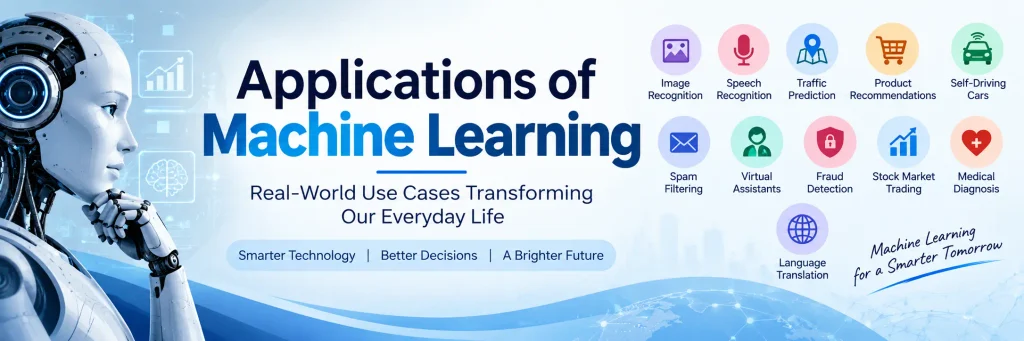
Applications of Machine Learning
Machine learning is one of the most widely discussed technologies today, and its rapid development is transforming industries across the world. Many of us use machine learning every day without even realizing it, whether through Google Maps, virtual assistants such as Alexa and Google Assistant, or recommendation systems on platforms like Netflix and Amazon.
Machine learning enables computers to learn from data, identify patterns, and make predictions or decisions with minimal human intervention. Below are some of the most important real-world applications of machine learning that are changing the digital landscape.
Complete Advance AI Topics: Click Here
SQL Tutorial: Click Here
1. Image Recognition
Image recognition is one of the most common applications of machine learning. It helps computers identify objects, people, places, and other elements within digital images.
A well-known example is Facebook’s automatic friend-tagging suggestion feature. When users upload a photo, Facebook can suggest people to tag based on its facial recognition technology. This type of technology uses machine learning algorithms to recognize and identify faces in images.
2. Speech Recognition
Speech recognition is another popular application of machine learning. Google’s Search by Voice feature is a simple example of this technology.
Speech recognition converts spoken words into text and is also commonly referred to as speech-to-text or voice recognition. Virtual assistants such as Google Assistant, Siri, Cortana, and Alexa use speech recognition to understand voice commands and respond to users.
3. Traffic Prediction
Google Maps uses machine learning to provide real-time traffic information and recommend suitable routes. Machine learning helps analyze traffic conditions using important data sources such as:
- Live location data from Google Maps users and sensors
- Historical traffic patterns and trends
By analyzing these data sources, machine learning models can predict congestion and recommend routes that may have less traffic. Continuous data collection and user activity help improve the accuracy of these predictions.
4. Product Recommendations
E-commerce platforms such as Amazon and entertainment services such as Netflix use machine learning to provide personalized recommendations.
When users search for products, watch videos, or interact with content, machine learning algorithms can analyze their behavior and interests. Based on previous interactions, these systems recommend products, movies, shows, or other content that users may find relevant.
5. Self-Driving Cars
Self-driving and autonomous vehicles are among the most advanced applications of machine learning. Companies working on autonomous driving use machine learning and deep learning techniques to help vehicles understand their surroundings.
Machine learning models can help detect obstacles, recognize road signs and traffic signals, identify objects, and support AI-powered navigation. These capabilities allow autonomous vehicles to make decisions based on information collected from cameras, sensors, and other systems.
6. Email Spam and Malware Filtering
Email services such as Gmail use machine learning to classify and organize incoming messages into categories such as Inbox, Spam, and Promotions.
Machine learning models can analyze different characteristics of an email to determine whether it is legitimate or potentially harmful. Techniques and models such as Multi-Layer Perceptrons, Decision Trees, and Naïve Bayes classifiers can be used for email classification.
Some common factors considered during email filtering include:
- Content filtering
- Header analysis
- Blacklist detection
- Rule-based filtering
7. Virtual Personal Assistants
Virtual personal assistants such as Google Assistant, Alexa, and Siri use machine learning and related AI technologies to understand user commands and perform different tasks.
These systems can improve their responses by analyzing interactions and understanding user preferences. Common tasks performed by virtual assistants include:
- Playing music
- Making phone calls
- Sending emails
- Scheduling meetings
8. Online Fraud Detection
With the increasing use of online banking and digital transactions, detecting fraudulent activities has become extremely important. Machine learning can analyze transaction patterns and identify activities that appear unusual or suspicious.
For example, neural network-based models can analyze transaction behavior and help distinguish between legitimate and potentially fraudulent transactions. When an unusual pattern is detected, the system can flag the transaction or alert the user, helping reduce the risk of financial fraud.
9. Stock Market Trading
Machine learning is also used in stock market analysis and trading. Machine learning models can analyze historical market data, price movements, and other patterns to identify potential trends.
Long Short-Term Memory (LSTM) neural networks are one example of a deep learning technique that can be applied to time-series data. Such models can assist investors and analysts in studying market behavior and making more informed decisions.
10. Medical Diagnosis
Healthcare is another important area where machine learning is being applied. Machine learning-based diagnostic systems can assist healthcare professionals by analyzing medical images, patient information, and historical data.
AI-powered systems can help identify signs associated with diseases such as cancer and brain tumors. By supporting early detection and analysis, machine learning has the potential to improve diagnostic processes and treatment outcomes.
11. Automatic Language Translation
Machine learning has significantly improved automatic language translation. Services such as Google Neural Machine Translation (GNMT) use neural machine translation techniques to translate text between different languages.
Machine learning-based translation systems can process large amounts of language data and learn relationships between words, phrases, and sentences. When combined with image recognition, these technologies can also help translate written text in real time through applications such as Google Lens.
YT:- DecodeIT
Conclusion
Machine learning is transforming industries and making many aspects of our daily lives more convenient, secure, and efficient. From image recognition and self-driving cars to fraud detection, virtual assistants, healthcare, and language translation, machine learning has become an important part of modern technology.
As machine learning continues to evolve, its applications are expected to expand into even more areas. Understanding these real-world applications helps us see how machine learning is influencing the way we work, communicate, travel, shop, and interact with technology.
Keywords: applications of machine learning, applications of machine learning in real life, real world applications of machine learning, applications of machine learning in healthcare, uses of machine learning, machine learning applications in data science, applications of machine learning in industry, applications of machine learning PDF, applications of machine learning PPT, goals and applications of machine learning