Association Rule Learning Explained
In the vast field of machine learning, Association Rule Learning is a powerful unsupervised learning technique used to discover interesting relationships, patterns, and associations within large datasets.
From analyzing customer purchasing behavior in retail to identifying relationships between symptoms in healthcare, association rule learning helps uncover patterns that may otherwise remain hidden.
Let’s explore the fundamentals of association rule learning and understand how it supports intelligent, data-driven decision-making.
Complete Advance AI Topics: Click Here
SQL Tutorial: Click Here
What is Association Rule Learning?
Association Rule Learning is a machine learning and data mining technique used to discover dependencies and relationships between variables or items in a dataset.
For example, an association rule might identify that customers who purchase bread are also likely to purchase butter. Such insights can be especially useful for businesses in areas such as:
- Market Basket Analysis
- Web Usage Mining
- Medical Diagnostics
- Inventory Management
Example Scenario:
Consider a grocery store where customers frequently purchase milk and butter along with bread. After discovering this pattern, the store may place these products closer together on the shelves to encourage additional purchases. This is a practical example of how association rule learning can support business decisions.
How Does Association Rule Learning Work?
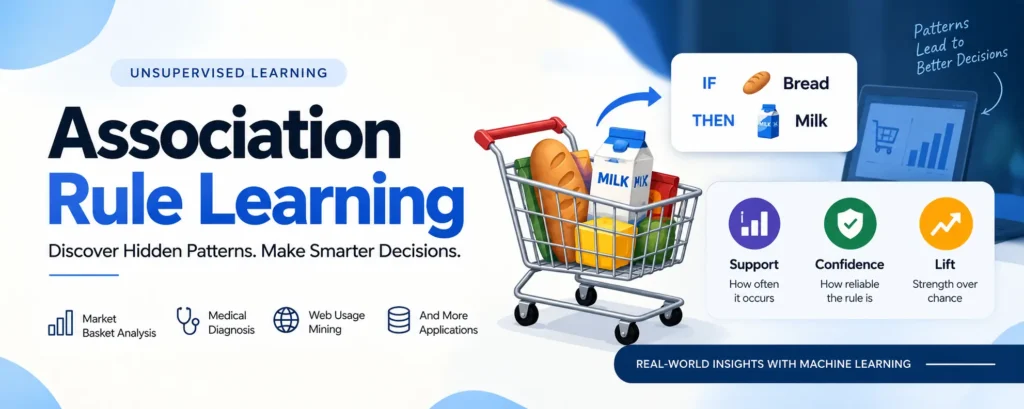
Association Rule Learning generally works through IF-THEN rules that describe relationships between items.
IF A (antecedent), THEN B (consequent)
For example:
IF a customer buys a smartphone, THEN they are likely to buy a phone case.
In this rule, the smartphone is the antecedent, while the phone case is the consequent.
Association rules can involve one or multiple items. To determine how useful and reliable these rules are, several important metrics are used.
Key Metrics in Association Rule Learning
1. Support
Support measures how frequently an item or itemset appears in the entire dataset.
Formula:
Support(X) = Number of transactions containing X / Total number of transactions
A higher support value indicates that the item or itemset occurs frequently in the dataset.
2. Confidence
Confidence measures how often the consequent occurs when the antecedent is present.
Formula:
Confidence(X → Y) = Support(X → Y) / Support(X)
In simple terms, confidence indicates how reliable an association rule is when the antecedent occurs.
3. Lift
Lift measures how much stronger an association between two items is compared with what would be expected if the items were independent.
Formula:
Lift(X → Y) = Confidence(X → Y) / Support(Y)
- If Lift = 1, X and Y are independent.
- If Lift > 1, X and Y have a positive association.
- If Lift < 1, X and Y have a negative association.
Lift is particularly useful for identifying associations that may be interesting and actionable.
Types of Association Rule Learning Algorithms
There are three commonly used algorithms for association rule mining:
1. Apriori Algorithm
- Identifies frequent itemsets from transactional datasets.
- Uses a breadth-first search approach to generate and evaluate candidate itemsets.
- It is commonly applied in areas such as market basket analysis and healthcare data analysis.
2. Eclat Algorithm
- Eclat stands for Equivalence Class Transformation.
- It uses a depth-first search strategy and intersection-based techniques to identify frequent itemsets.
- It can be useful for working with large and complex transactional datasets.
3. FP-Growth Algorithm
- FP-Growth stands for Frequent Pattern Growth.
- It builds a Frequent Pattern Tree (FP-Tree) to represent transactional data.
- Unlike Apriori, it avoids generating large numbers of candidate itemsets, making it more efficient for many large datasets.
Real-World Applications of Association Rule Learning
Market Basket Analysis:Retail businesses use association rules to identify products that customers frequently purchase together and improve product placement or recommendations.
Medical Diagnosis:Association rules can help identify relationships between symptoms, conditions, and other medical data to support diagnosis and treatment analysis.
Protein Sequence Analysis:Association rule learning can be applied to identify relationships among amino acids and patterns in protein sequences.
Catalog Design:Companies can analyze customer preferences and purchasing patterns to organize product catalogs more effectively.
Loss-Leader Analysis:Businesses can identify low-profit products that attract customers and determine which other products customers are likely to purchase along with them.
Download New Real Time Projects:- Click here
Conclusion
Association Rule Learning is an important technique in machine learning and data mining that helps uncover meaningful relationships and hidden patterns within large datasets.
Its applications range from improving retail sales and product recommendations to analyzing healthcare data and customer preferences. By using metrics such as support, confidence, and lift, organizations can evaluate the strength and usefulness of discovered associations.
Understanding association rule learning and algorithms such as Apriori, Eclat, and FP-Growth provides a strong foundation for anyone interested in machine learning and data science.
Stay tuned for the next post, where we will explore Apriori, Eclat, and FP-Growth in greater detail.
Keywords: association rule learning in machine learning, association rule learning example, association rule mining, association rule learning Python, association rule learning algorithms, association rule mining example, association rule learning Apriori algorithm