Career Opportunities in Data Science
In today’s digitally driven world, Data Science has become one of the most important and rapidly growing fields. Organizations across industries use data to make better decisions, improve business strategies, understand customers, and develop innovative solutions.
From healthcare and finance to sports and entertainment, the demand for professionals who can analyze large datasets and generate meaningful insights continues to grow. As businesses increasingly recognize the value of data, Data Science has emerged as one of the most promising career paths for students, freshers, and experienced professionals.
In this article, we’ll explore the major career opportunities in Data Science, the skills required to build a successful career, and the future of this rapidly evolving field.
Complete Advance AI Topics: Click Here
SQL Tutorial: Click Here
The Data Science Ecosystem
Before exploring different career options, it is important to understand the Data Science lifecycle. Data Science combines programming, mathematics, statistics, and domain knowledge to transform raw data into useful insights and business decisions.
The major stages of the Data Science pipeline include:
- Data Collection: Gathering data from sources such as databases, APIs, IoT devices, logs, sensors, and web scraping.
- Data Preprocessing: Cleaning, transforming, and organizing data so that it can be used for analysis. This includes handling missing values, duplicates, and outliers.
- Exploratory Data Analysis (EDA): Examining data to identify patterns, distributions, trends, and anomalies using statistical methods and visualization techniques.
- Feature Engineering: Creating new variables or modifying existing features to improve machine learning model performance.
- Machine Learning: Applying techniques such as regression, classification, clustering, and deep learning to identify patterns and make predictions.
- Model Evaluation: Measuring model performance using metrics such as accuracy, precision, recall, AUC, and F1-score.
- Data Visualization: Presenting complex information through charts, graphs, and dashboards so that stakeholders can understand insights easily.
- Deployment: Integrating machine learning models into applications or systems for real-world use.
Data Science Career Opportunities
Data Science offers a wide range of career paths. Depending on your interests and skills, you can specialize in analytics, machine learning, engineering, research, business intelligence, or a specific industry.
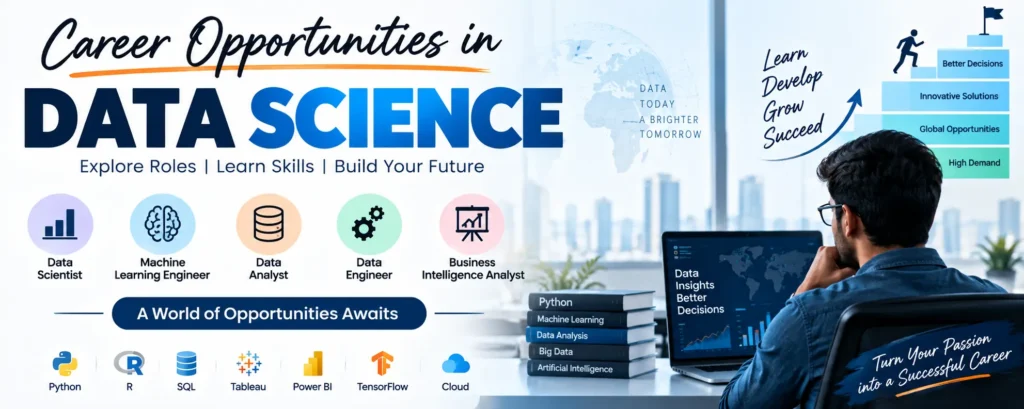
1. Data Scientist
A Data Scientist analyzes complex datasets, develops predictive models, and generates insights that help organizations make informed decisions.
Data Scientists commonly work with Python, R, TensorFlow, and Jupyter Notebooks. The role combines programming, statistics, machine learning, and business understanding.
2. Machine Learning Engineer
Machine Learning Engineers design and implement AI and machine learning algorithms. They are also responsible for deploying models at scale and optimizing them for performance.
Knowledge of model serving, cloud platforms, and MLOps tools is important for this career path.
3. Data Analyst
Data Analysts analyze data to answer business questions and support decision-making. They prepare reports, identify trends, and create dashboards for management.
Commonly used tools include SQL, Excel, Power BI, and Tableau.
4. Big Data Engineer
Big Data Engineers design and manage systems capable of processing large volumes of data. They work with technologies such as Hadoop, Spark, Kafka, and NoSQL databases including MongoDB and Cassandra.
5. Business Intelligence (BI) Analyst
Business Intelligence Analysts transform raw data into meaningful business insights through interactive dashboards and reports.
They may work with BI platforms such as Looker, QlikView, and Power BI to support strategic planning and business decisions.
6. Data Engineer
A Data Engineer builds and maintains data pipelines that allow information to move efficiently between different systems.
They commonly work with ETL frameworks to ensure that data remains accessible, reliable, and timely for analytics and data science teams.
7. Statistician
Statisticians use statistical models and techniques to interpret data, conduct surveys, design experiments, and support research.
They play important roles in areas such as healthcare, academia, and public policy.
8. AI Research Scientist
AI Research Scientists focus on advancing artificial intelligence through research in areas such as deep learning, natural language processing (NLP), computer vision, and reinforcement learning.
They often work in academic institutions, research organizations, and R&D laboratories.
9. Data Science Consultant
Data Science Consultants help organizations solve specific business and technical problems using data-driven approaches.
They may work independently or as part of consulting firms, helping organizations develop strategies and implement data science solutions.
10. Quantitative Analyst (Quant)
Quantitative Analysts, commonly known as Quants, develop mathematical and statistical models to analyze financial markets, predict trends, and assess risk.
This career requires strong knowledge of mathematics, statistics, and machine learning algorithms.
11. Healthcare Data Analyst
Healthcare Data Analysts work with patient records, clinical information, and public health datasets to support better healthcare decisions.
Their work can help improve treatment planning, operational efficiency, and patient care outcomes.
12. Environmental Data Scientist
Environmental Data Scientists analyze data related to climate, pollution, sustainability, and natural resources.
Their work can support climate modeling, pollution control, sustainability initiatives, and resource management.
13. Sports Data Analyst
Sports Data Analysts use data to evaluate player performance, improve team strategies, and analyze real-time statistics.
Data-driven insights can also be used to improve fan engagement and support decision-making in professional sports.
14. Government Data Analyst
Government Data Analysts analyze public-sector information such as economic data, census results, and policy-related datasets.
Their insights can help government organizations evaluate policies and develop more effective governance strategies.
15. Cybersecurity Data Scientist
Cybersecurity Data Scientists apply data science and artificial intelligence techniques to identify unusual patterns, detect threats, and help protect organizations from cyber-attacks, breaches, and fraud.
Skills Required for a Data Science Career
Building a successful career in Data Science requires a combination of technical knowledge, analytical thinking, and communication skills.
- Programming Languages: Python and R are widely used in Data Science. Python libraries such as NumPy, Pandas, Scikit-learn, and TensorFlow are important tools.
- Statistics and Mathematics: Knowledge of probability, linear algebra, calculus, and hypothesis testing is important for data analysis and machine learning.
- Data Handling: Data wrangling and manipulation skills using tools such as Pandas, SQL, and Spark are valuable.
- Machine Learning: Understanding supervised, unsupervised, and reinforcement learning is essential. Experience with Keras, XGBoost, or PyTorch can also be beneficial.
- Data Visualization: Tools such as Seaborn, Matplotlib, Plotly, and Tableau help create meaningful visualizations.
- Database Management: Understanding relational and non-relational databases and writing efficient SQL queries is important.
- Domain Knowledge: Knowledge of the industry in which you work can improve the quality and relevance of your analysis.
- Communication: Data professionals need to explain technical findings clearly to stakeholders who may not have a technical background.
- Problem Solving and Critical Thinking: The ability to approach complex data problems creatively is an important part of Data Science.
- Business Acumen: Understanding business goals helps ensure that data models and insights address real-world requirements.
Future of Data Science
The future of Data Science is expected to bring continued innovation and new career opportunities. Several important trends are shaping the field.
- Automation and No-Code Tools: Tools such as AutoML are automating repetitive tasks and allowing data professionals to focus more on complex problems and innovation.
- Ethical AI and Responsible Data Usage: Privacy, transparency, and bias mitigation are becoming increasingly important as organizations work with larger amounts of data.
- Explainable AI (XAI): Making machine learning models easier to understand is important for building trust and supporting compliance.
- Edge Computing: IoT and real-time analytics are encouraging models to run closer to data sources, enabling faster decision-making.
- Quantum Computing: Although still developing, quantum computing has the potential to address certain complex problems beyond the capabilities of traditional computing systems.
- Cross-Disciplinary Collaboration: Data Science is increasingly being applied alongside fields such as genomics, linguistics, and climate science.
- Role Specialization: Specialized careers such as MLOps Engineer, Data Governance Officer, and AI Ethicist demonstrate the growing maturity of the field.
- Lifelong Learning: Continuous learning through platforms such as Coursera, Updategadh, Udacity, and Kaggle can help professionals keep their skills relevant.
Download New Real-Time Projects: Click here
Conclusion
Data Science is not just about working with numbers; it is about using data to solve problems and create meaningful impact. Whether you want to become a Machine Learning Engineer, Data Analyst, Healthcare Data Analyst, AI Research Scientist, or another type of data professional, there are numerous career opportunities available.
As the demand for skilled data professionals continues to grow, developing the right skills, mindset, and practical experience can help you build a successful career in this field.
Keep learning, practice with real-world datasets, and continue developing your technical and analytical abilities to stay prepared for the evolving world of Data Science.
Keywords: career opportunities in data science for freshers, career opportunities in data science in India, career opportunities in data science salary, data science jobs salary, data scientist career opportunities, data science scope and salary, how to become a data scientist, is data science a good career, career opportunities in data science, data science and analytics careers,