
The ReLU activation function is one of the most important concepts in modern deep learning, and understanding it is essential for any BCA, MCA, or B. Tech CS/IT student working on neural network projects. Short for Rectified Linear Unit, ReLU has become the default choice in nearly every deep learning architecture — from image classifiers to natural language processing models. In this post, you will learn exactly what ReLU is, why it replaced older activation functions, how to implement it in Python, and why it matters for your final year project or viva preparation.
Complete Advance AI Topics: Click Here
SQL Tutorial: Click Here
What Is the ReLU Activation Function?
An activation function determines whether a neuron in a neural network should fire or remain silent based on the weighted sum of its inputs. Before ReLU gained popularity, sigmoid and tanh were the standard choices. While both introduced the nonlinearity needed for complex pattern learning, they suffered from a critical problem called the vanishing gradient — where gradients became so small during backpropagation that weight updates effectively stopped, making it nearly impossible to train deep networks with many layers.
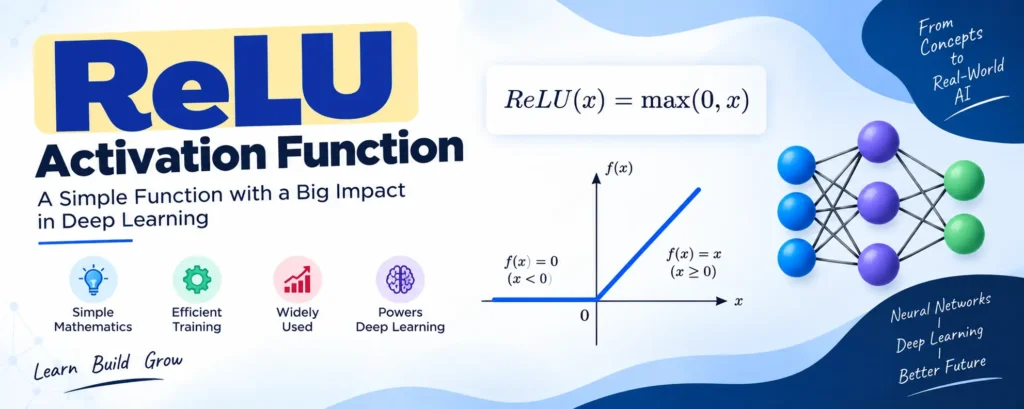
ReLU solves this by applying a deceptively simple rule: return the input if it is positive, and return zero otherwise. This means gradients for positive activations are always 1, allowing information to flow cleanly through even very deep architectures. The result is faster training, more stable learning, and the ability to build networks with tens or even hundreds of layers — something that was impractical with sigmoid or tanh.
| Detail | Information |
|---|---|
| Topic | ReLU Activation Function |
| Full Form | Rectified Linear Unit |
| Category | Deep Learning / Artificial Intelligence |
| Language Used | Python |
| Libraries | NumPy, Matplotlib, TensorFlow / Keras (optional) |
| Formula | f(x) = max(0, x) |
Key Characteristics of ReLU
- Simple Formula: Defined as f(x) = max(0, x), ReLU involves no exponentials or complex computations, making it extremely fast to evaluate during both forward and backward passes.
- Non-Negative Output: ReLU always outputs values in the range [0, +infinity), which means it never produces negative activations.
- Sparse Activation: Because all negative inputs are mapped to zero, at any given time only a subset of neurons are active. Sparse networks are computationally efficient and tend to generalise better.
- No Vanishing Gradient for Positive Inputs: The derivative of ReLU for any positive input is 1, ensuring that gradients do not shrink as they are propagated back through the network.
- Piecewise Linear Behaviour: Despite being linear in two pieces, stacking ReLU units with unique weights and biases creates highly nonlinear transformations across the full network.
- Bias Shift: A learned bias term shifts the activation boundary, allowing each neuron to independently decide its threshold for firing.
- Differentiable Almost Everywhere: ReLU is non-differentiable at exactly x = 0, but in practice this edge case has no significant impact on training.
Technologies and Tools Used
| Layer | Technology | Purpose |
|---|---|---|
| Programming Language | Python 3.x | Core implementation and scripting |
| Visualisation | Matplotlib | Plotting the ReLU activation graph |
| Numerical Computing | NumPy | Efficient array-level ReLU computation |
| Deep Learning Framework | TensorFlow / Keras | Using ReLU as a built-in layer activation |
| Development Environment | Jupyter Notebook / VS Code | Interactive code execution and experimentation |
How the ReLU Activation Function Works
- Input Received: A neuron receives a weighted sum of its inputs plus a bias term, producing a single scalar value.
- Threshold Check: ReLU checks whether this value is greater than zero.
- Positive Input: If the value is positive, ReLU passes it through unchanged. The neuron “fires” with that exact value.
- Negative Input: If the value is zero or negative, ReLU outputs zero. The neuron remains inactive for this input.
- Gradient During Backpropagation: For positive activations, the gradient is 1, meaning errors flow back cleanly. For zero outputs, the gradient is 0 — meaning those neurons do not contribute to weight updates in this pass.
- Network-Level Effect: Across many neurons and layers, this selective activation creates a sparse, efficient representation of the input data, enabling the network to learn complex, nonlinear patterns.
Python Implementation of ReLU
Step 1: Basic Implementation from Scratch
The simplest way to implement ReLU in Python requires no external libraries:
def relu(x):
    return max(0.0, x)

# Example outputs
print(relu(1.0))       # Output: 1.0
print(relu(1000.0))    # Output: 1000.0
print(relu(0.0))       # Output: 0.0
print(relu(-1.0))      # Output: 0.0
print(relu(-1000.0))   # Output: 0.0
Step 2: Visualising the ReLU Function
Use Matplotlib to plot the characteristic shape of ReLU — flat at zero for negative inputs, linear for positive inputs:
from matplotlib import pyplot as plt

def relu(x):
    return max(0.0, x)

inputs = list(range(-10, 11))
outputs = [relu(x) for x in inputs]

plt.plot(inputs, outputs)
plt.title("ReLU Activation Function")
plt.xlabel("Input")
plt.ylabel("Output")
plt.grid(True)
plt.show()
Step 3: NumPy-Optimised ReLU for Arrays
When working with real neural network layers, you need ReLU applied across entire arrays efficiently:
import numpy as np

def relu_numpy(x):
    return np.maximum(0, x)

x = np.array([-3, -1, 0, 1, 5])
print(relu_numpy(x))  # Output: [0 0 0 1 5]
Step 4: Using ReLU in Keras
In practice, you rarely implement ReLU manually. Deep learning frameworks like Keras provide it as a built-in activation for any layer:
from tensorflow import keras
from tensorflow.keras import layers

model = keras.Sequential([
    layers.Dense(128, activation='relu', input_shape=(784,)),
    layers.Dense(64, activation='relu'),
    layers.Dense(10, activation='softmax')
])

model.summary()
Step 5: Computing the Derivative of ReLU
For custom backpropagation implementations, you need the derivative of ReLU:
import numpy as np

def relu_derivative(x):
    return np.where(x > 0, 1.0, 0.0)

x = np.array([-2, -1, 0, 1, 3])
print(relu_derivative(x))  # Output: [0. 0. 0. 1. 1.]
Why Understanding ReLU Matters for Your Academic Career
- Core Viva Topic: Activation functions, particularly ReLU, are among the most frequently asked questions in AI/ML viva examinations for BCA, MCA, and B.Tech final year students.
- Foundation for Deep Learning Projects: Any final year project involving image classification, sentiment analysis, or recommendation systems will use ReLU internally — knowing the theory gives you an edge in explaining your architecture.
- Placement Interviews: Product-based companies and AI startups regularly ask candidates to explain ReLU, its advantages over sigmoid/tanh, and the dying ReLU problem in technical rounds.
- Hands-On Python Skills: Implementing ReLU from scratch and using it inside Keras demonstrates practical Python and deep learning proficiency that stands out on your resume.
- Bridges Theory and Practice: Understanding the vanishing gradient problem and how ReLU addresses it shows examiners that you grasp not just syntax but the mathematical reasoning behind modern AI.
- Applicable Across Domains: Whether your project is in computer vision, NLP, or tabular data, ReLU knowledge applies directly — making it one of the most versatile topics you can master.
Variants and Extensions of ReLU
- Leaky ReLU: Instead of outputting zero for negative inputs, Leaky ReLU allows a small, fixed slope (e.g. 0.01x), preventing the dying ReLU problem where neurons become permanently inactive.
- Parametric ReLU (PReLU): Similar to Leaky ReLU, but the negative slope is a learnable parameter updated during training rather than a fixed constant.
- ELU (Exponential Linear Unit): Uses an exponential curve for negative inputs, producing smoother gradients and mean activations closer to zero.
- SELU (Scaled ELU): A self-normalising variant designed to maintain stable mean and variance across layers without batch normalisation.
- GELU (Gaussian Error Linear Unit): Used in transformer architectures like BERT and GPT, GELU applies a smooth, probabilistic gating that outperforms ReLU on many NLP tasks.
- Swish: Developed by Google, Swish (x * sigmoid(x)) has shown improvements over ReLU in deep networks on image classification benchmarks.
- Maxout Networks: A generalisation that computes the maximum across multiple linear functions, with ReLU as a special case.
Watch More Deep Learning Tutorials on YouTube
Subscribe to the DecodeIT2 channel for step-by-step Python, AI, and deep learning tutorials designed specifically for final year students:
Subscribe to DecodeIT2 on YouTube
Frequently Asked Questions
What is the ReLU activation function in simple terms?
ReLU stands for Rectified Linear Unit. It is a mathematical function used inside neural networks that outputs the input value if it is positive, and outputs zero if it is negative or zero. The formula is simply f(x) = max(0, x). Its simplicity and effectiveness have made it the most widely used activation function in deep learning.
Why is ReLU better than sigmoid and tanh?
Sigmoid and tanh both suffer from the vanishing gradient problem — their gradients become extremely small for large positive or negative inputs, slowing down or stopping training in deep networks. ReLU avoids this for positive inputs because its gradient is always 1, allowing weight updates to flow cleanly through many layers. It is also computationally faster since it involves no exponential calculations.
What is the dying ReLU problem?
If a neuron consistently receives negative inputs, its output is always zero and its gradient is also zero. This means the neuron never updates its weights and effectively becomes “dead” — it stops contributing to the network permanently. Variants such as Leaky ReLU and Parametric ReLU address this by allowing a small non-zero gradient for negative inputs.
Is ReLU suitable for BCA and MCA final year AI projects?
Yes, absolutely. Any final year project involving neural networks — such as image classification, text sentiment analysis, handwritten digit recognition, or fake news detection — will benefit from ReLU in its hidden layers. Understanding and explaining ReLU during your viva demonstrates strong foundational knowledge of deep learning and will impress your examiners.
relu activation function graph relu activation function formula relu activation function in deep learning relu activation function in neural network relu activation function derivative ReLU Activation Function, ReLU function, ReLU activation function in deep learning, ReLU in machine learning, ReLU neural network, Rectified Linear Unit, ReLU formula, ReLU function in Python, ReLU activation function explained, deep learning activation functions, neural network activation function, machine learning activation functions, ReLU vs sigmoid, ReLU vs tanh, advantages of ReLU, disadvantages of ReLU, dying ReLU, Leaky ReLU, ReLU derivative, how ReLU works ReLU Activation Function