
Introduction to Dimensionality Reduction Technique
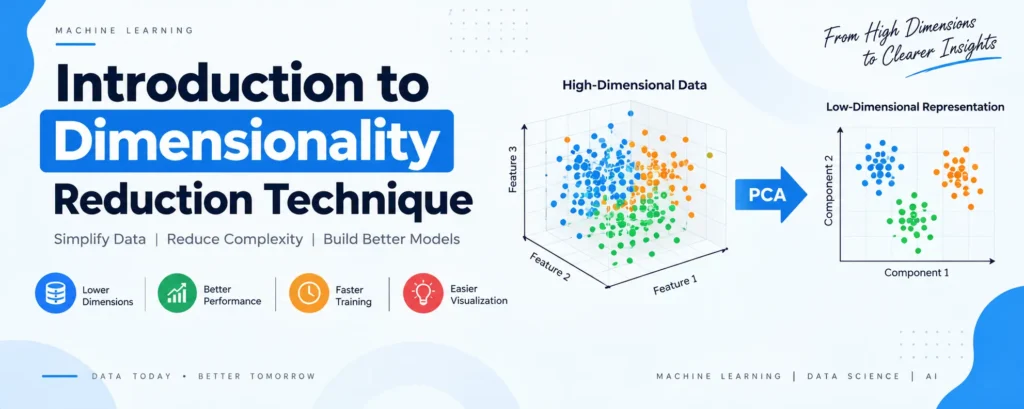
In data science, dimensionality refers to the number of input variables or features present in a dataset. An excessive number of features can make a dataset complicated, difficult to visualize, and computationally expensive to analyze or model. This is where dimensionality reduction becomes important.
Complete Advance AI Topics: Click Here
SQL Tutorial: Click Here
What is Dimensionality Reduction?
The practice of reducing the number of input variables while preserving the key information in a dataset is known as dimensionality reduction.
In simple terms, it helps convert a dataset with higher dimensions (more features) into a dataset with fewer dimensions, with minimal information loss. This technique is widely used in machine learning and deep learning to improve data visualization, reduce training time, and improve model performance.
Fields such as bioinformatics, speech recognition, signal processing, and image analysis rely heavily on dimensionality reduction methods.
Understanding the Curse of Dimensionality
Handling datasets with high dimensions is a well-known problem in machine learning, often referred to as the “Curse of Dimensionality.”
As the number of features increases, the model becomes more complex and prone to overfitting, which can negatively affect its ability to generalize to new data. High-dimensional data may also require larger sample sizes, more computational resources, and longer processing times.
Dimensionality reduction helps address this problem by eliminating irrelevant or redundant features and simplifying the model.
Benefits of Dimensionality Reduction
Implementing dimensionality reduction offers several advantages:
- Reduced Storage Space: A lower number of features means less memory usage.
- Faster Training Time: Smaller datasets allow machine learning algorithms to train more efficiently.
- Improved Model Performance: Removing unnecessary features and noise can help reduce overfitting.
- Better Data Visualization: High-dimensional datasets can be represented more easily in 2D or 3D space.
- Removes Multicollinearity: It can reduce redundancy caused by highly correlated variables.
Limitations of Dimensionality Reduction
Despite its benefits, dimensionality reduction also has some limitations:
- Information Loss: Some relevant information may be lost during the reduction process.
- Complexity in Component Selection: Techniques such as PCA may not always clearly indicate how many components should be retained.
- Computational Cost: Some dimensionality reduction techniques can themselves require significant processing, especially when working with massive datasets.
Techniques of Dimensionality Reduction
Dimensionality reduction can broadly be classified into two main methodologies:
1. Feature Selection
Feature selection involves identifying and keeping the most important and relevant features from a dataset. It helps reduce training time and model complexity.
Filter Methods
Filter methods select features based on statistical measures such as:
- Correlation Coefficient
- Chi-Square Test
- ANOVA (Analysis of Variance)
- Information Gain
Wrapper Methods
Wrapper methods evaluate different feature subsets using a machine learning model.
- Forward Selection
- Backward Elimination
- Bidirectional Elimination
These methods can provide accurate results but are generally computationally expensive.
Embedded Methods
Embedded methods perform feature selection during the model training process.
- LASSO (Least Absolute Shrinkage and Selection Operator)
- Ridge Regression
- Elastic Net
2. Feature Extraction
Feature extraction creates new features by transforming the original data into a lower-dimensional representation instead of simply selecting existing features.
Common Feature Extraction Techniques
- Principal Component Analysis (PCA)
- Linear Discriminant Analysis (LDA)
- Kernel PCA
- Quadratic Discriminant Analysis (QDA)
Popular Dimensionality Reduction Techniques
Let’s explore some commonly used dimensionality reduction techniques.
Principal Component Analysis (PCA)
Principal Component Analysis (PCA) transforms correlated features into a smaller set of uncorrelated variables known as principal components.
PCA attempts to preserve the variance in the data, allowing the most important information to be retained while reducing dimensionality.
Used in: Image compression, recommender systems, bioinformatics, and other applications.
Backward Feature Elimination
Backward feature elimination is a stepwise regression approach commonly used with linear or logistic regression.
- Start with all features.
- Evaluate model performance.
- Remove one feature at a time.
- Drop the feature that has the least impact.
- Repeat the process until no further improvement is achieved.
Forward Feature Selection
Forward feature selection works in the opposite way to backward elimination.
- Start with no features.
- Add features one by one.
- Choose the feature that improves performance the most.
- Continue until adding additional features does not improve performance.
Missing Value Ratio
If a feature contains a high percentage of missing values based on a predefined threshold, it can be removed. This helps clean the dataset while retaining useful features.
Low Variance Filter
Features with very low variance generally provide limited useful information. Removing such features can help reduce noise and simplify the dataset.
High Correlation Filter
If two features are highly correlated and provide similar information, one of them can be removed to reduce redundancy. This can also help address multicollinearity in regression models.
Random Forest for Feature Selection
Random Forest provides an in-built feature importance score for variables. These scores can be used to select important features based on their contribution to prediction.
Note: Random Forest requires numeric input, so categorical variables need to be encoded before using them in the model.
YT:- DecodeIT
Factor Analysis
Factor analysis groups features based on their correlation.
- Variables belonging to the same group or factor have a strong association.
- Variables belonging to different groups generally have lower correlation.
- The number of factors is smaller than the original number of features.
Example: Income and spending might belong to the same factor because they can have a strong relationship.
Auto-Encoders
Auto-encoders are neural networks used for unsupervised learning. Their goal is to learn an effective representation of the input data.
- Encoder: Compresses the input data into a lower-dimensional representation.
- Decoder: Reconstructs the original input from the compressed representation.
Auto-encoders are particularly useful for deep learning models and high-dimensional data such as images.
Final Thoughts
In today’s world of big data, working with high-dimensional datasets has become common but challenging. Dimensionality reduction plays an important role in simplifying models, reducing overfitting, and improving overall performance.
Whether through feature selection or feature extraction, choosing the right dimensionality reduction technique can help simplify datasets and make machine learning models more efficient.
Stay tuned for more practical and insightful content on machine learning, data science, and AI.
Keywords: dimensionality reduction techniques, dimensionality reduction techniques in machine learning, dimensionality reduction example, PCA dimensionality reduction, what is dimensionality reduction, LDA dimensionality reduction, dimensionality reduction in data mining, dimensionality reduction meaning, dimensionality reduction in machine learning examples, projection in dimensionality reduction dimensionality reduction techniques
dimensionality reduction techniques in machine learning
dimensionality reductions example
pca dimensionality reduction
what is dimensionality reduction class 10
lda dimensionality reduction
dimensionality reductions in data mining
projection in dimensionality reduction
dimensionality reduction techniques in machine learning
dimensionality reduction example
pca dimensionality reduction
what is dimensionality reduction class 10
dimensionality reductions in data mining
dimensionality reductions meaning
dimensionality reduction in machine learning examples
dimensionality reduction example in real life