Types of Machine Learning
Machine Learning (ML) is one of the most powerful branches of Artificial Intelligence (AI). It enables systems to learn from data, adapt to new situations, and make decisions or predictions without being explicitly programmed for every task. Machine learning models use data and algorithms to identify patterns, improve performance, and solve real-world problems with greater accuracy.
From personalized recommendations and fraud detection to image recognition and robotics, machine learning is transforming industries across the globe. But how do machines actually learn, and what are the different approaches used to train them?
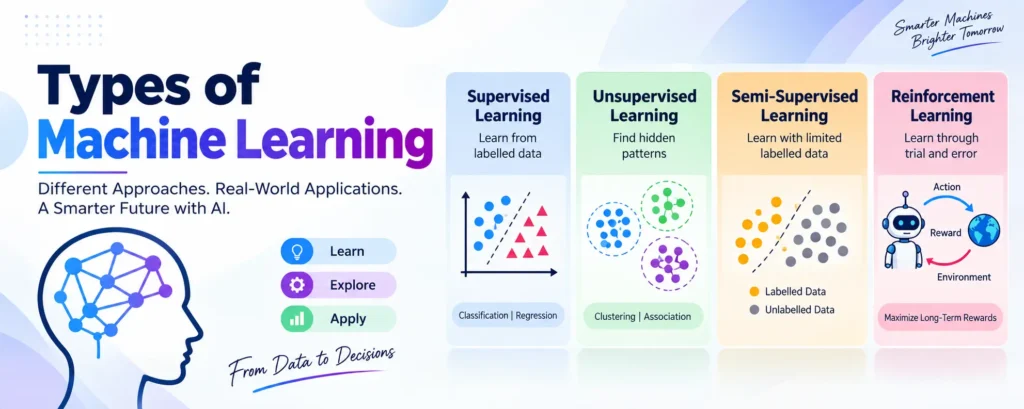
In this post, we will explore the four main types of machine learning: Supervised Learning, Unsupervised Learning, Semi-Supervised Learning, and Reinforcement Learning. We will also look at their characteristics, algorithms, advantages, disadvantages, and applications.
Complete Advance AI Topics: Click Here
SQL Tutorial: Click Here
1. Supervised Machine Learning
Supervised learning is similar to teaching a student using answer keys. The machine is trained using a labelled dataset, where both the input data and the correct output are provided.
The objective is to learn the relationship between inputs (features) and outputs (labels) so that the model can make accurate predictions when it receives new, unseen data.
Example
Imagine training a model to distinguish between cats and dogs using a collection of images. Each image is labelled as either “cat” or “dog”. The model learns patterns such as fur type, ear shape, size, and color. After training, it can use these learned patterns to classify new images.
Applications
- Email spam filtering
- Credit risk evaluation
- Disease diagnosis
- Image classification
- Speech recognition
Categories of Supervised Learning
a) Classification
Classification is used when the model needs to predict a categorical output, such as “spam” or “not spam”.
Common algorithms:
- Logistic Regression
- Decision Trees
- Random Forest
- Support Vector Machine (SVM)
b) Regression
Regression is used to predict continuous numerical values, such as house prices, sales, or other measurable quantities.
Common algorithms:
- Linear Regression
- Lasso Regression
- Multivariate Regression
- Decision Trees
Advantages
- Produces clear and measurable outputs
- Can achieve high accuracy with sufficient quality data
- Well-suited for many real-world prediction and classification tasks
Disadvantages
- Requires labelled training data
- Performance may decrease when new data differs significantly from the training data
- Training can be computationally expensive for large and complex datasets
2. Unsupervised Machine Learning
Unsupervised learning focuses on discovering patterns and structures in data without predefined labels. The model receives unlabelled data and attempts to identify meaningful relationships, groups, or patterns on its own.
Example
Suppose you provide a machine with images of different fruits without telling it their names. The model can analyze characteristics such as shape, size, and color and group similar images together, even though it does not know whether they represent apples, oranges, or bananas.
Applications
- Customer segmentation
- Recommendation systems
- Market basket analysis
- Network analysis
- Anomaly detection
Categories of Unsupervised Learning
a) Clustering
Clustering groups similar data points together based on their characteristics.
Popular algorithms and techniques:
- K-Means
- DBSCAN
- Mean Shift
- Principal Component Analysis (PCA)
b) Association
Association learning identifies relationships and patterns between variables in large datasets.
Popular algorithms:
- Apriori
- Eclat
- FP-Growth
Advantages
- Works with unlabelled data
- Can uncover hidden patterns and relationships
- Useful for exploratory data analysis
Disadvantages
- Results can be difficult to interpret
- There is often no predefined ground truth for evaluation
- Poorly tuned models may produce meaningless or incorrect groupings
3. Semi-Supervised Machine Learning
Semi-supervised learning combines elements of supervised and unsupervised learning. It uses a small amount of labelled data along with a large amount of unlabelled data during training.
This approach can be useful when obtaining labelled data is expensive, difficult, or time-consuming. The labelled examples provide guidance to the model, while the larger collection of unlabelled data helps it learn additional patterns.
Example
Think of a student who attends a few lectures with a teacher and then spends most of their time studying independently. The initial guidance helps the student understand and interpret the material they encounter during self-study.
Applications
- Web content classification
- Speech analysis
- Bioinformatics
- Fraud detection
Advantages
- Reduces the need for large labelled datasets
- Can be more cost-effective than fully supervised learning
- Can improve model performance by taking advantage of unlabelled data
Disadvantages
- Results can be inconsistent depending on the quality of the unlabelled data
- Not suitable for every type of machine learning problem
- Performance may suffer when there are too few reliable labelled examples
4. Reinforcement Learning
Reinforcement Learning (RL) is inspired by learning through trial and error. In reinforcement learning, an agent interacts with an environment by taking actions and receiving feedback in the form of rewards or penalties.
Over time, the agent learns which actions are more likely to produce desirable outcomes. The primary goal is to maximize the cumulative reward it receives.
Example
Consider a robot learning how to walk. Initially, it may stumble or make incorrect movements. Through repeated interaction with its environment and feedback about its actions, the robot gradually learns which movements help it move forward successfully.
Applications
- Robotics
- Game playing
- Traffic signal control
- Resource management
- Natural Language Processing (NLP) and related optimization tasks
Categories of Reinforcement Learning
a) Positive Reinforcement
Positive reinforcement strengthens desirable behavior by providing a reward when the desired action is performed.
b) Negative Reinforcement
Negative reinforcement encourages desired behavior by removing or reducing an undesirable condition after the desired action occurs. It is different from punishment, which is used to discourage behavior.
Advantages
- Suitable for complex and dynamic environments
- Can learn strategies involving long-term consequences
- Useful for sequential decision-making problems
Disadvantages
- Can require significant computational resources
- Training may take considerable time
- Performance can be highly dependent on the environment and reward design
Download New Real-Time Projects: Click here
Final Thoughts
Understanding the types of machine learning is essential when choosing the right approach for a particular problem. Supervised, unsupervised, semi-supervised, and reinforcement learning each have different strengths, limitations, and use cases.
Whether you are building a recommendation system, detecting fraud, analyzing customer behavior, or developing intelligent robots, understanding these machine learning approaches provides a strong foundation for working with AI and data-driven applications.
Keep learning and exploring more topics in AI, Data Science, and Machine Learning.
Keywords
types of machine learning, types of machine learning with examples, types of machine learning algorithms, types of machine learning pdf, types of machine learning models, types of machine learning ppt, supervised machine learning, unsupervised machine learning, semi-supervised machine learning, reinforcement learning, applications of machine learning, 3 types of machine learning, what is machine learning