What is Data Analytics
In today’s digital-first world, data analytics has become an important part of informed decision-making. From understanding business performance to solving real-world problems, data analytics combines statistics, mathematics, and programming to transform raw data into meaningful insights.
It helps organizations reduce risks, improve operational efficiency, understand customer behavior, and make better business decisions.
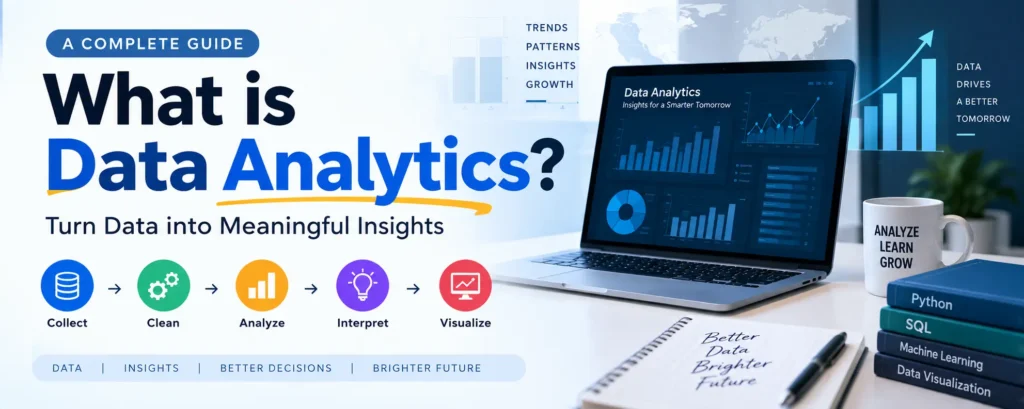
The data analytics process generally includes data collection, data cleaning, analysis, interpretation, and visualization. In this guide, we will understand what data analytics is, how it works, its types, methods, required skills, career opportunities, and its future.
Complete Advance AI Topics: Click Here
SQL Tutorial: Click Here
What is Data Analytics?
Data analytics is the process of examining data to discover useful patterns, trends, relationships, and insights. Specialized tools and technologies are used to process large amounts of data and convert it into information that can support better decisions.
The major steps involved in data analytics include:
- Collecting raw data from different sources
- Cleaning and transforming the data
- Analyzing and modeling the information
- Interpreting the results
- Visualizing insights through charts and dashboards
Data analytics is used across industries such as finance, healthcare, agriculture, retail, and government to improve performance and support data-driven decisions.
The Data Analytics Process
1. Data Collection
Data collection is the first step in the analytics process. Data can be gathered from databases, websites, social media platforms, sensors, applications, surveys, and internal business systems.
Data from multiple sources can then be integrated into a single dataset for further processing and analysis.
2. Data Cleansing
Collected data may contain duplicate records, missing values, incorrect information, or irrelevant entries. Data cleansing involves identifying and correcting these problems to improve the quality and accuracy of the dataset.
3. Data Analysis and Interpretation
After cleaning the data, analysts use tools and programming languages such as Python, R, Excel, SQL, and Scala to examine the information and identify useful patterns.
Statistical techniques and analytical models can be used to test assumptions, identify relationships, and generate meaningful insights that can support business decisions.
4. Data Visualization
The results of data analysis are often presented through graphs, charts, dashboards, and infographics. Data visualization makes complex information easier to understand and helps decision-makers quickly identify important trends and patterns.
Types of Data Analytics
1. Descriptive Analytics
Descriptive analytics focuses on understanding what has happened in the past. It summarizes historical data to identify trends, patterns, and unusual changes.
For example, a company may analyze previous monthly sales data to understand its past business performance.
2. Diagnostic Analytics
Diagnostic analytics focuses on understanding why something happened. It examines data in greater detail to identify relationships and possible root causes.
Techniques such as regression analysis and correlation analysis can be used to investigate the reasons behind particular outcomes.
3. Predictive Analytics
Predictive analytics uses historical and current data to estimate what may happen in the future. It can combine statistical models and machine learning algorithms to generate forecasts.
Common applications include sales forecasting, demand prediction, and risk prediction.
4. Prescriptive Analytics
Prescriptive analytics goes beyond predicting future outcomes by suggesting possible actions. It can evaluate different scenarios and help organizations determine which action may produce a better result.
It can be used for areas such as pricing strategies and automated decision-making.
5. Real-Time Analytics
Real-time analytics involves analyzing data as it is generated or received. It is useful when organizations need to make decisions quickly based on current information.
Examples include fraud detection, live customer interactions, and dynamic pricing.
Methods of Data Analytics
Qualitative Analysis
Qualitative analysis focuses on non-numerical information such as text, images, videos, interviews, and other forms of descriptive data.
Common approaches include:
- Content analysis
- Narrative analysis
- Grounded theory
Quantitative Analysis
Quantitative analysis focuses on numerical data and statistical techniques. It is commonly used to measure relationships, compare results, and test hypotheses.
Common techniques include:
- Hypothesis testing
- Mean and median calculation
- Statistical analysis
- Sample size determination
Core Skills and Tools for a Data Analyst
A successful data analyst needs a combination of technical, analytical, and communication skills. Some of the important skills and tools include:
Programming Languages
- Python and R for data manipulation and statistical analysis
- Pandas and NumPy for data processing
- Matplotlib for data visualization
- Scikit-learn for machine learning tasks
Database Management
- Knowledge of SQL
- Understanding of database architecture
- Experience with relational databases
- Basic understanding of non-relational databases
Machine Learning
Knowledge of machine learning can help analysts work with more advanced analytical problems.
- Supervised learning
- Unsupervised learning
- Deep learning
- Ensemble models
- Neural networks
Statistical Modeling
Statistical knowledge is important for analyzing relationships and making reliable conclusions from data.
- Regression analysis
- Time-series forecasting
- Multivariate statistics
Big Data Tools
Professionals working with large datasets may also work with technologies such as Apache Hadoop, Apache Spark, and distributed computing frameworks.
Ethics and Data Governance
Data professionals must understand responsible data usage. Important areas include data privacy, data protection, security, bias mitigation, and ethical use of information.
Communication Skills
Technical analysis is valuable only when its findings can be clearly communicated. Data analysts should be able to explain complex findings through simple reports, presentations, dashboards, and data visualizations.
Career Opportunities in Data Analytics
Data analytics provides career opportunities across different industries and experience levels.
Entry-Level Roles
- Junior Data Analyst: Works with data preparation, basic analysis, and reporting.
- Junior Data Scientist: Supports exploratory analysis and model development.
- Associate Analyst: Helps with reporting and data-related business initiatives.
Mid-Level and Senior Roles
- Data Analyst: Analyzes information and provides actionable business insights.
- Data Engineer: Develops data pipelines and data infrastructure.
- Data Architect: Designs scalable and secure data systems.
- Data Scientist: Works on advanced analytics and machine learning models.
- Marketing Analyst: Studies market trends and customer behavior.
- Business Analyst: Connects data insights with business strategies.
The Future of Data Analytics
The integration of artificial intelligence, machine learning, and the Internet of Things (IoT) is changing the way organizations use data. Data analytics is increasingly being used not only for optimization but also for real-time decision-making and innovation.
Organizations are using analytics to:
- Build predictive systems that anticipate market changes
- Automate certain decision-making processes
- Create personalized services based on customer and business data
As data usage increases, organizations must also focus on privacy, security, transparency, and ethical data practices. Analysts and other data professionals need to ensure that data is handled responsibly and that analytical results are not unfairly influenced by bias.
Why is Data Analytics Important?
Data analytics helps organizations turn large amounts of raw information into useful insights. By understanding historical performance and current trends, businesses can make more informed decisions.
Some important benefits of data analytics include:
- Better decision-making
- Improved operational efficiency
- Reduced business risks
- Better understanding of customers
- Improved forecasting
- Identification of business opportunities
- More effective business strategies
YT:- DecodeIT
Conclusion
Data analytics has become more than a supporting business function. It is an important part of modern decision-making and digital transformation. By collecting, cleaning, analyzing, interpreting, and visualizing data, organizations can discover valuable insights and improve their performance.
As businesses continue to generate and use more data, the demand for professionals with strong analytical, technical, and communication skills is expected to remain important.
Whether you are a student exploring a career in technology or a professional interested in working with data, learning data analytics can provide a strong foundation for understanding and solving data-driven problems.
Keywords
what is data analytics, what is data analytics job, what is data analytics course, what is data analytics in simple words, what is data analytics with example, types of data analytics, importance of data analytics, data analyst salary, what is data analytics in hindi, what is data science, what is data analysis, what is data analytics skills, what is data analytics used for, what is data analytics salary, what is data analytics in healthcare, what is data analytics in accounting, what is data analytics certification, what is data analytics degree