Regression vs Classification in Machine Learning Explained
In Machine Learning, supervised learning is one of the most commonly used approaches for solving prediction problems. Two of its most important concepts are Regression and Classification.
Although both techniques use labeled datasets and are designed to make predictions, they are used for different types of problems. Regression predicts continuous numerical values, while classification predicts categories or class labels.
Understanding the difference between Regression and Classification helps you choose the right machine learning approach based on the type of output you need to predict.
Complete Advance AI Topics: Click Here
SQL Tutorial: Click Here
What is Supervised Learning?
Supervised Learning is a type of machine learning in which a model is trained using labeled or historical data. Each training example contains input data along with its corresponding expected output.
By learning the relationship between the inputs and outputs, the model can make predictions when it receives new and unseen data.
Regression and Classification are two major branches of supervised learning.
What is Regression?
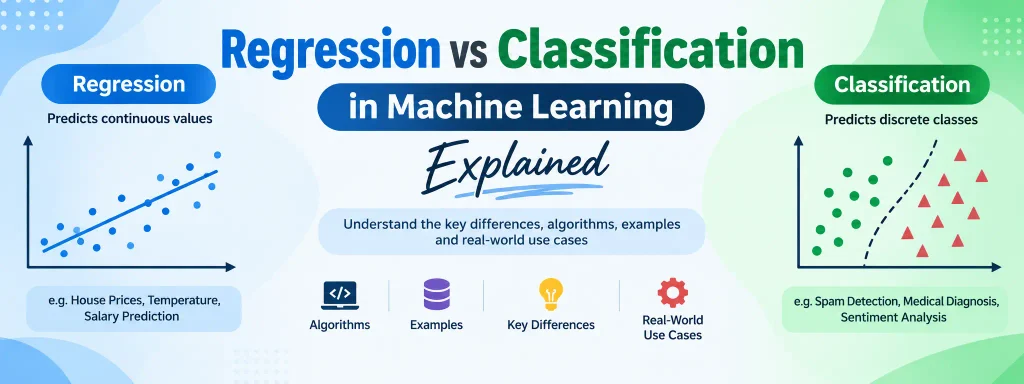
Regression is a supervised learning technique used to predict a continuous numerical value. It helps identify the relationship between dependent and independent variables and uses that relationship to estimate an output.
Examples of Regression
- Predicting house prices based on location, size, and number of rooms.
- Forecasting temperature for the upcoming week.
- Estimating salary based on years of experience and education level.
Objective of Regression
The main objective of regression is to find a mapping function that connects the input variables X with a continuous output variable Y.
Common Regression Algorithms
- Simple Linear Regression
- Multiple Linear Regression
- Polynomial Regression
- Support Vector Regression (SVR)
- Decision Tree Regression
- Random Forest Regression
What is Classification?
Classification is a supervised learning technique used to predict a discrete class or category. The model learns patterns from labeled training data and assigns new data points to one of the predefined classes.
Examples of Classification
- Email Spam Detection: Identifying whether an email is Spam or Not Spam.
- Medical Diagnosis: Classifying tumors as Benign or Malignant.
- Sentiment Analysis: Classifying a review as Positive or Negative.
Objective of Classification
The primary objective of classification is to find a function that maps input variables X to a categorical output variable Y.
Download New Real-Time Projects: Click here
Common Classification Algorithms
- Logistic Regression
- K-Nearest Neighbours (KNN)
- Support Vector Machines (SVM)
- Kernel SVM
- Naïve Bayes
- Decision Tree Classifier
- Random Forest Classifier
Regression vs Classification: Key Differences
| Feature | Regression | Classification |
|---|---|---|
| Output Type | Continuous value, such as age or price | Discrete category, such as Yes/No |
| Objective | Predict a numerical value | Predict a class label |
| Prediction Type | Real-valued output, such as 43.2 or 67.5 | Class or category, such as 0 or 1 |
| Model Representation | Often represented using a line or curve of best fit | Often represented using a decision boundary |
| Examples | House price prediction, weather forecasting | Spam detection, cancer diagnosis |
| Types | Linear and Non-linear Regression | Binary and Multi-class Classification |
Visual Understanding
A simple way to understand the difference between regression and classification is to imagine a scatter plot containing different data points.
- In Regression, the model attempts to draw a line or curve that best represents the relationship between the data points.
- In Classification, the model attempts to create a decision boundary that separates data points into different classes.
Real-World Use Cases
Regression Use Cases
- Stock market trend prediction
- Predicting patient stay duration in hospitals
- Energy consumption forecasting
Classification Use Cases
- Fraud detection in banking
- Customer churn prediction
- Handwriting and speech recognition
Regression vs Classification: Which One to Choose?
The choice between Regression and Classification mainly depends on the type of target variable you want to predict.
- If the target is a numerical value, use Regression.
- If the target is a label or category, use Classification.
Both Regression and Classification are essential parts of supervised machine learning. While regression focuses on predicting numerical values, classification focuses on assigning data to predefined categories.
Understanding these two concepts is an important step for anyone learning machine learning and working toward building intelligent, data-driven systems.
Stay updated with more Machine Learning insights and tutorials on your trusted guide for technology and learning.
Keywords: regression vs classification, regression vs classification examples, regression vs classification models, regression vs classification difference, regression vs classification problems, regression vs classification in machine learning, regression vs classification in AI, regression vs classification Python, classification and regression examples