Unsupervised Machine Learning
In our previous topic, we discussed Supervised Machine Learning, where models learn from labeled data with clear guidance. However, in many real-world situations, labeled datasets are not available. So, how can we discover patterns and useful insights from data when there are no predefined labels?
This is where Unsupervised Machine Learning comes into play.
Complete Advance AI Topics: Click Here
SQL Tutorial: Click Here
What is Unsupervised Learning?
As the name suggests, Unsupervised Learning is a type of machine learning in which models are trained without labeled data. Instead, the algorithm works with the available input data and tries to find hidden patterns, relationships, and structures without any direct supervision.
It is similar to the way humans explore and understand unfamiliar information through experience and observation.
Definition:
Unsupervised Learning is a machine learning technique in which models are trained using unlabeled data and work on that data without guidance to discover hidden patterns and groupings.
Unlike supervised learning, unsupervised learning does not directly fit into regression or classification problems because predefined outputs are not available. Its main objectives are to:
- Discover the underlying structure of the data.
- Group data according to similarities.
- Possibly represent the dataset in a compressed or summarized form.
Real-World Example
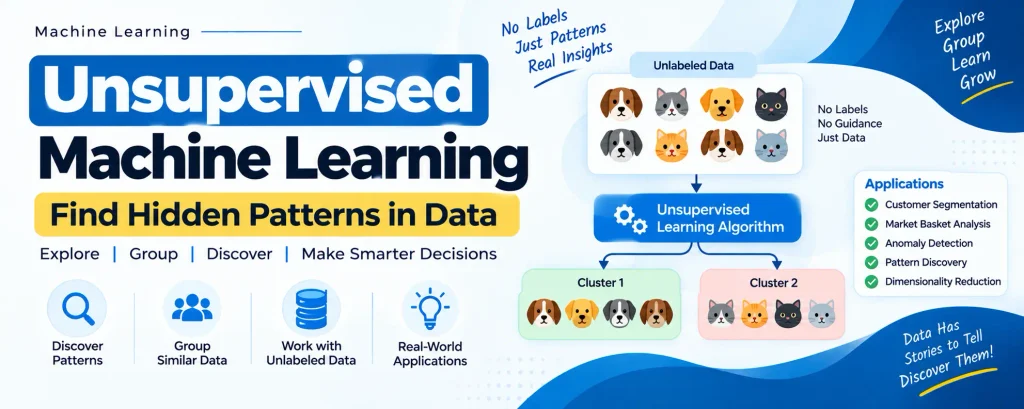
Imagine providing an unsupervised learning algorithm with a dataset containing images of different cat and dog breeds. The model has no prior information about which images represent cats or dogs. Instead, it analyzes the available features and tries to group similar images together on its own.
This is the basic idea behind clustering, which is one of the popular techniques used in unsupervised learning.
Why Use Unsupervised Learning?
Unsupervised learning is useful in many practical situations. Some important reasons for using it include:
- It helps discover useful insights that may not be obvious beforehand.
- It reflects a form of human-like learning without direct instruction.
- It works with unlabeled and uncategorized data, which is common in real-world situations.
- It is valuable for real-life problems where manually labeling data can be expensive or difficult.
How Unsupervised Learning Works
Let’s break the process down into a few simple steps:
- Input Data: The model receives raw, unlabeled data.
- Pattern Discovery: The algorithm looks for underlying patterns and trends.
- Algorithm Application: Techniques such as K-Means Clustering or Decision Trees are applied.
- Data Grouping: Similar data points are grouped together based on the features identified by the algorithm.
           +----------------------+
           |  Unlabeled Input Data |
           +----------------------+
                      |
                      v
     +------------------------------------+
     |  Feed data into ML Model           |
     |  (No labeled output provided)      |
     +------------------------------------+
                      |
                      v
       +-------------------------------+
       | Model detects patterns        |
       | and similarities automatically |
       +-------------------------------+
                      |
                      v
        +--------------------------+
        | Apply suitable algorithm |
        | (e.g., K-Means, PCA)     |
        +--------------------------+
                      |
                      v
     +------------------------------------+
     | Group similar data points together |
     | (e.g., Clusters or Associations)   |
     +------------------------------------+
Types of Unsupervised Learning Problems
Unsupervised learning is generally divided into two main categories:
1. Clustering
Clustering is used to group similar data points into different clusters. Each cluster contains items with common characteristics, while items belonging to different groups are more dissimilar.
Example: Grouping news articles according to their topics without knowing the topic labels.
2. Association
Association focuses on finding relationships or rules that explain how different variables in a dataset are connected. It is widely used in market basket analysis.
Example: Customers who purchase bread may also tend to purchase butter or jam.
Popular Unsupervised Learning Algorithms
Some widely used algorithms in unsupervised machine learning include:
- K-Means Clustering
- Hierarchical Clustering
- K-Nearest Neighbors (KNN)
- Anomaly Detection
- Principal Component Analysis (PCA)
- Independent Component Analysis (ICA)
- Neural Networks (Unsupervised models like Autoencoders)
- Apriori Algorithm
- Singular Value Decomposition (SVD)
Advantages of Unsupervised Learning
- Helps handle complex tasks where labeled data is not available.
- Works well with real-world datasets where manual labeling may not be practical.
- Useful for exploratory data analysis and pattern discovery.
- It is flexible and scalable for working with massive datasets.
Disadvantages of Unsupervised Learning
- It is generally more challenging than supervised learning because labeled outputs are not available.
- The results may be less accurate or harder to interpret.
- Evaluating model performance can be difficult when there is no ground truth for comparison.
Download New Real Time Projects :- Click here
Conclusion
Unsupervised Learning takes us one step closer to building intelligent systems that can learn and adapt independently, much like humans. From discovering customer groups and identifying anomalies to reducing the dimensions of a dataset, this area of machine learning provides a powerful tool for making data-driven decisions.
Stay tuned as we explore clustering, association algorithms, and their practical implementations in upcoming chapters.
unsupervised machine learning algorithms
unsupervised machine learning examples
reinforcement learning
unsupervised machine learning geeksforgeeks
unsupervised machine learning python
difference between supervised and unsupervised learning
unsupervised learning algorithms list
unsupervised learning applications