Design Principles in System Design
Introduction
In today’s fast-paced digital world, building robust, scalable, and maintainable systems is more important than ever. Whether you are designing a small application or a large-scale distributed system, fundamental system design principles provide a strong foundation for creating reliable architectures.
Principles such as abstraction, encapsulation, modularity, and separation of concerns help developers break complex problems into manageable components, reduce dependencies, improve flexibility, and make systems easier to maintain.
By applying these design principles effectively, developers can create systems that are easier to understand, test, scale, and adapt as requirements change.
Complete Advance AI Topics: Click Here
SQL Tutorial: Click Here
Embrace Simplicity with Managed Services
One of the most important yet often overlooked system design principles is simplicity. A complex architecture is not only difficult to build but can also be harder to maintain, monitor, and troubleshoot.
Whenever possible, using fully managed services can reduce unnecessary operational complexity. Managed services can handle tasks such as patching, scaling, backups, and failover, allowing development teams to focus more on application functionality and business requirements.
When developing a new system, start with a Minimum Viable Product (MVP) instead of over-engineering the architecture from the beginning. As real-world usage increases, the system can be improved and expanded based on actual performance and business requirements.
The goal should be to introduce additional complexity only when it provides a clear and measurable benefit.
Decouple Your System for Flexibility
Decoupling is another important strategy in modern system design. It involves designing components so that they have minimal dependencies on one another.
A loosely coupled architecture allows individual components to be developed, deployed, scaled, and maintained independently. This can improve flexibility, scalability, and fault isolation.
Some major benefits of a decoupled architecture include:
- Independent deployment and scaling of services
- Clear separation of responsibilities
- Better control over performance and resource costs
- Improved fault isolation and recovery
- Ability to apply security policies to individual components
Whether you use microservices, event-driven architecture, or service-oriented architecture, decoupling allows individual parts of a system to evolve without unnecessarily affecting the entire application.
Core Design Principles in System Design
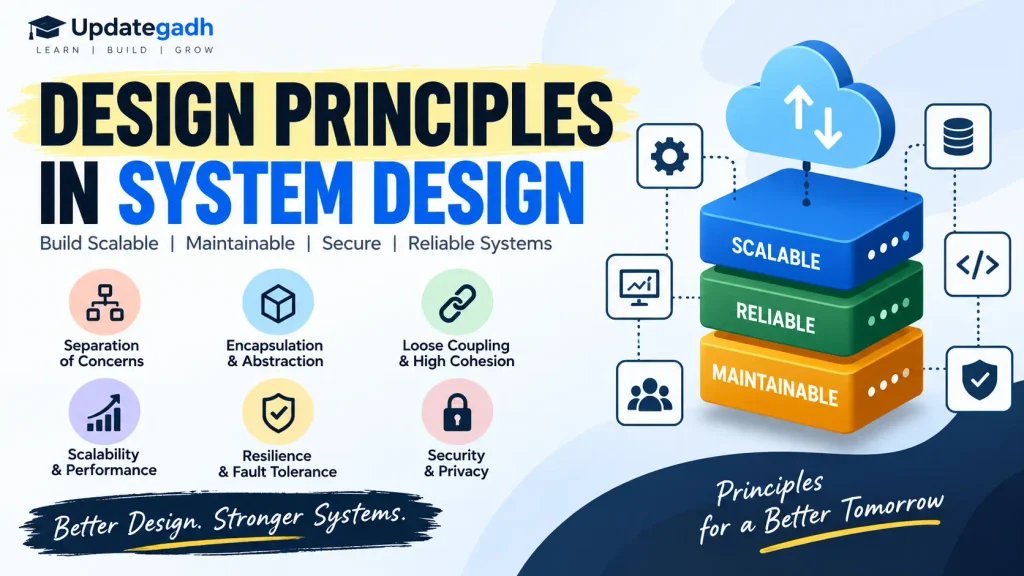
1. Separation of Concerns (SoC)
Separation of Concerns (SoC) is the principle of dividing a system into distinct components, with each component responsible for a specific functionality.
This approach makes applications more modular, easier to understand, and simpler to maintain.
A common example is the Model-View-Controller (MVC) architectural pattern used in web development:
- Model: Manages application data and business logic.
- View: Handles the presentation and user interface.
- Controller: Processes user input and coordinates communication between the model and view.
Separating these responsibilities allows developers to work on different parts of an application independently while reducing complexity and making the codebase easier to manage.
2. Encapsulation and Abstraction
Encapsulation and abstraction are fundamental object-oriented design principles that help improve system organization and maintainability.
- Encapsulation: Combines data and the methods that operate on that data within a defined unit, such as a class. It also limits direct access to internal implementation details.
- Abstraction: Hides unnecessary implementation details and exposes only the essential functionality through well-defined interfaces.
Together, these principles reduce unnecessary complexity and allow developers to interact with systems at a higher level without needing to understand every internal implementation detail.
They also encourage the development of well-defined interfaces, making systems easier to modify and extend.
3. Loose Coupling and High Cohesion
Loose coupling and high cohesion work together to create maintainable and flexible software architectures.
- Loose Coupling: Components have minimal dependencies on other components, making them easier to test, modify, replace, and scale.
- High Cohesion: Each module focuses on a closely related set of responsibilities, improving organization and maintainability.
A well-designed system aims to keep dependencies between components low while ensuring that each component has a clear and focused responsibility.
This makes the system more adaptable when business requirements or technical requirements change.
4. Scalability and Performance
As the number of users, requests, and data increases, a system must be capable of handling additional workloads without significant performance degradation.
Two common approaches to scaling are:
- Vertical Scaling: Increasing the CPU, RAM, storage, or other resources of an existing server.
- Horizontal Scaling: Adding more servers or instances and distributing the workload among them.
Several techniques can also be used to improve system performance, including:
- Caching frequently accessed data
- Load balancing incoming requests
- Database indexing
- Asynchronous processing
Effective system design requires balancing performance, scalability, cost, and complexity so that the application remains responsive as demand increases.
5. Resilience and Fault Tolerance
System failures can occur because of hardware problems, network interruptions, software errors, or unexpected traffic. For this reason, resilience and fault tolerance are important parts of reliable system design.
- Resilience: The ability of a system to recover quickly from failures or interruptions.
- Fault Tolerance: The ability of a system to continue operating even when one or more components fail.
Common strategies for improving resilience and fault tolerance include:
- Redundant components
- Failover mechanisms
- Health checks
- Retry mechanisms
- Circuit breakers
These techniques help prevent individual component failures from bringing down the entire system.
YT:- DecodeIT
6. Security and Privacy
Security should be considered from the beginning of the system design process rather than being added after development is complete. Protecting application data and maintaining user trust are essential requirements of modern software systems.
Important security practices include:
- Encryption: Protecting data both in transit and at rest.
- Role-Based Access Control (RBAC): Providing users with permissions based on their roles.
- Authentication and Authorization: Verifying user identities and controlling access to resources.
- Input Validation and Sanitization: Preventing invalid or potentially harmful input from reaching application components.
- Security Audits: Regularly reviewing systems for vulnerabilities and compliance requirements.
Privacy is also an important consideration. Practices such as data minimization and anonymization can reduce unnecessary exposure of personal information and help organizations meet applicable privacy requirements.
Conclusion
Effective system design involves much more than simply connecting different components. A well-designed system should be scalable, maintainable, secure, reliable, and adaptable.
Principles such as abstraction, encapsulation, separation of concerns, loose coupling, high cohesion, scalability, fault tolerance, security, and privacy provide a strong foundation for developing sustainable software systems.
By applying these principles thoughtfully, developers and system architects can build applications that are easier to maintain, adapt, and scale as requirements evolve.
At Updategadh, we believe that understanding fundamental system design principles helps developers build better software and develop a stronger foundation for modern architecture and engineering.
Keep learning, keep building, and continue exploring modern system design and software architecture.
Keywords
system design principles in software engineering, design principles in software engineering pdf, system design patterns, design principles of windows operating system, system design example, principles of computer design in computer architecture, types of system design in software engineering, system design architecture, software design principles examples, design principles in operating system, software design principles and patterns, design principles in java