Bootstrap Method
Introduction
In the world of statistics and data science, the Bootstrap Method is a flexible, powerful, and practical technique for estimating population parameters when traditional assumptions and analytical approaches are not enough. Introduced by Bradley Efron in 1979, the bootstrap method has become an important tool for statisticians, researchers, and data scientists.
This resampling-based technique helps us understand the distribution of a statistic, such as the mean or variance, by repeatedly taking samples with replacement from an existing dataset. The main advantage of bootstrapping is its simplicity, computational flexibility, and reduced dependence on strict theoretical distribution assumptions.
Complete Advance AI Topics: Click Here
SQL Tutorial: Click Here
What is the Bootstrap Method or Bootstrapping?
At its core, bootstrapping means creating multiple simulated datasets, known as bootstrap samples, from an existing dataset. This is done through sampling with replacement, which means the same data point can appear more than once in a sample, while some data points may not appear at all.
The main purpose is to calculate statistical measures such as standard errors and confidence intervals from these resampled datasets. This allows analysts to make conclusions about the underlying population without depending on complicated formulas or strict assumptions about the distribution of the data.
Key Uses of Bootstrapping:
- Estimating standard errors and confidence intervals.
- Performing hypothesis tests.
- Validating machine learning models.
- Working with small datasets where traditional inference can be difficult.
How Bootstrapping Works
Let’s go through the basic steps involved in the bootstrapping procedure:
Choose Sample Size:Decide the size of each resampled dataset. In most cases, it is the same as the size of the original sample.
Random Sampling with Replacement:Randomly select data points from the original dataset while allowing the same data point to be selected more than once.
Generate Multiple Samples:Repeat the sampling process m times, commonly between 1,000 and 10,000 times, to create multiple bootstrap samples.
Calculate Statistics:For every bootstrap sample, calculate the statistic you are interested in, such as the mean.
Build Empirical Distribution:Use the calculated results to create a distribution of the statistic. This can then be used to estimate confidence intervals or perform hypothesis tests.
Example: Estimating the Mean Using Bootstrapping
Consider the following dataset:
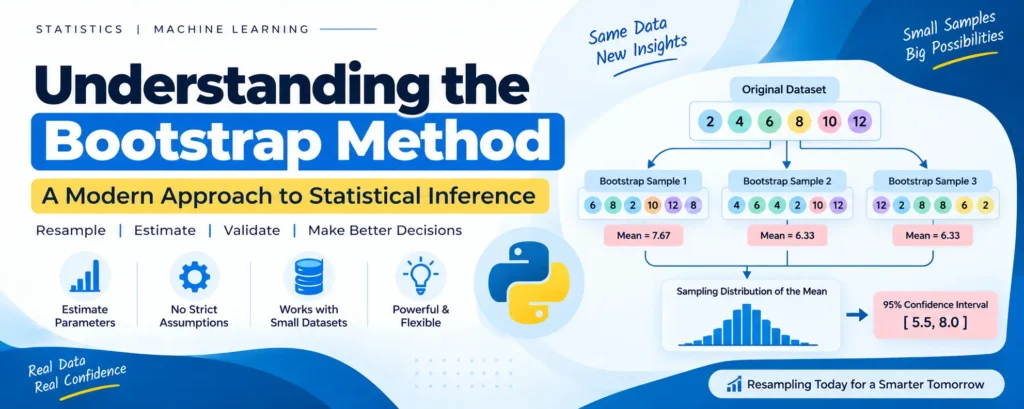
Original Data: 2, 4, 6, 8, 10, 12
Now, let’s create three bootstrap samples, each containing 6 values:
- Bootstrap Sample 1: 6, 8, 2, 10, 12, 8 — Mean = 7.67
- Bootstrap Sample 2: 4, 6, 4, 2, 10, 12 — Mean = 6.33
- Bootstrap Sample 3: 12, 2, 8, 8, 6, 2 — Mean = 6.33
If we repeat this process 10,000 times, we can obtain an empirical sampling distribution of the mean. From this distribution, we can calculate a confidence interval.
- 2.5th percentile: 5.5
- 97.5th percentile: 8.0
95% Confidence Interval for the Mean = [5.5, 8.0]
Real-World Example: Bootstrapping Confidence Interval for Mean Weight
Suppose we have a dataset containing 8 weights:
Weights (lbs): 150.2, 152.5, 155.8, 160.3, 162.7, 165.1, 168.9, 172.4
Sample Mean:Mean = (Sum of weights) / 8 = 160.98 lbs
Generate 5,000 Bootstrap Samples:Each sample contains 8 weights selected with replacement.
Calculate Mean of Each Sample:After generating the samples, we have 5,000 calculated means.
95% Confidence Interval:- 2.5th percentile = 157.4
- 97.5th percentile = 164.6
CI = [157.4, 164.6]
This interval provides an estimate of the true population mean without assuming that the data follows a normal distribution.
Bootstrapping vs Traditional Hypothesis Testing
| Feature | Traditional Hypothesis Testing | Bootstrapping |
|---|---|---|
| Assumptions | Assumes normality or a known distribution | No distributional assumptions |
| Method | Uses theoretical distributions such as t, z, and F | Uses resampling from the actual data |
| Flexibility | Limited to standard tests and models | Can adapt to complex models and small samples |
| Output | p-values and confidence intervals | Empirical confidence intervals and standard errors |
| Robustness | Can be sensitive to assumption violations | More robust to certain data irregularities |
Advantages of Bootstrapping
- It does not require assumptions about the population distribution.
- It can be applied to small samples.
- It is relatively simple to implement with modern computing.
- It can be useful for complex models or statistics.
- It is effective for estimating confidence intervals and model accuracy.
Limitations
- It can become computationally intensive with very large datasets.
- Its results depend on the quality of the original sample.
- It does not introduce new information beyond the original dataset.
- It can produce misleading results when the sample is not representative.
Download New Real Time Projects :- Click here
Conclusion
The Bootstrap Method has changed the way statistical inference can be approached by providing a practical alternative to traditional hypothesis testing. By generating thousands of resampled datasets from a single sample, bootstrapping helps estimate important statistics and understand uncertainty with greater flexibility.
Whether you are working on machine learning models, estimating uncertainty, or testing hypotheses, bootstrapping is a useful technique in the modern statistician’s toolkit. With its simple resampling approach, it continues to help analysts make better, data-driven decisions when dealing with complex problems.
bootstrap method example
bootstrap method in research
bootstrap method vs resampling
bootstrapping statistics
bootstrap sampling in machine learning
bootstrapping method in entrepreneurship
bootstrap methods in predictive analytics
bootstrap sampling method