
Overfitting and Underfitting
Machine Learning models are powerful tools, but they are not perfect. Two common problems that can affect a model’s performance are underfitting and overfitting. Understanding these problems is essential for building accurate, reliable, and robust machine learning solutions.
The main goal of any machine learning model is to generalize well. This means the model should not simply memorize the training data but should also perform effectively when it encounters unseen data.
But how can we determine whether a model is generalizing properly? This is where the concepts of underfitting and overfitting become important.
YT:- DecodeIT
Before We Dive In
Let’s understand a few key terms that are important for understanding the complete picture:
- Signal: The true underlying pattern in the data that the model should learn.
- Noise: Irrelevant or random variations in the data that the model should ideally ignore.
- Bias: Error caused by overly simple assumptions made by the learning algorithm.
- Variance: Error caused by the model being highly sensitive to small changes in the training data.
Maintaining a proper balance between bias and variance is important because both underfitting and overfitting can result from an unsuitable level of model complexity.
Overfitting: When Your Model Tries Too Hard
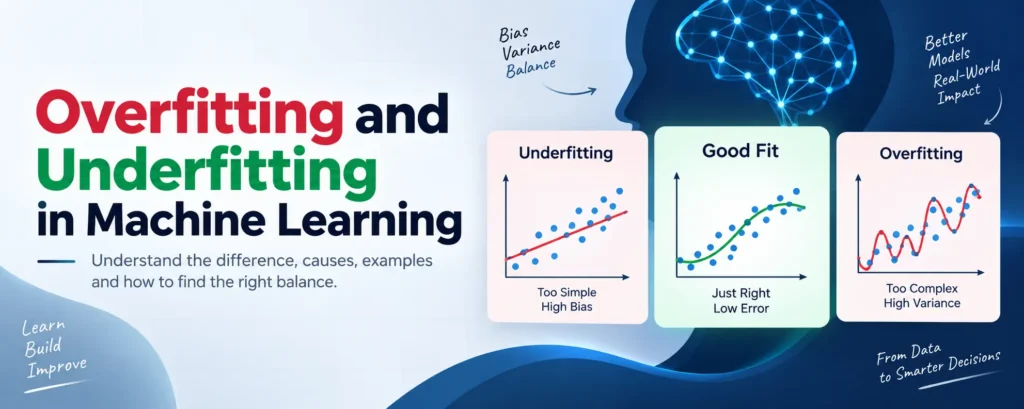
Overfitting occurs when a model learns too much from the training data, including noise and outliers. Instead of learning the underlying pattern, the model starts memorizing the details of the training dataset.
As a result, the model may perform exceptionally well on the training data but perform poorly on new, unseen data.
- High Variance, Low Bias
- Common in Supervised Learning
Example
Imagine a model trying to fit a curve through all the points in a scattered dataset. The curve may twist and turn so that it passes through almost every training point, but it may fail to represent the actual trend in the data.
This can result in inaccurate predictions when the model is tested on new data.
How to Avoid Overfitting?
- Cross-Validation: Tests the model using different splits of the dataset.
- Training with More Data: Additional data can reduce the influence of individual noisy observations.
- Removing Unnecessary Features: Reducing irrelevant features can help simplify the model.
- Early Stopping: Stops training before the model begins learning unnecessary noise.
- Regularization Techniques (L1 and L2): Add penalties that discourage overly complex models.
- Ensembling: Combines multiple models to help reduce variance.
Underfitting: When Your Model Doesn’t Try Enough
Underfitting occurs when a model fails to learn the underlying pattern in the data. The model is too simple to capture the relationships and complexity present in the dataset.
- High Bias, Low Variance
- Produces poor results on both training and testing datasets
Example
Imagine fitting a straight line to data that clearly follows a curved pattern. The model is unable to capture the actual trend, resulting in inaccurate predictions. This is a classic example of underfitting.
How to Avoid Underfitting?
- Increase Training Time: Give the model more time to learn meaningful patterns.
- Add More Features: Additional relevant features can help the model identify hidden trends.
- Choose Better Algorithms: A simple algorithm such as linear regression may not always be sufficient for complex relationships.
Complete Advance AI Topics: Click Here
SQL Tutorial: Click Here
Goodness of Fit: Striking the Right Balance
The ideal machine learning model lies between underfitting and overfitting. This state is commonly referred to as a good fit.
In statistical modeling, goodness of fit describes how closely a model’s predictions match the actual values in a dataset. In machine learning, a good fit means achieving low error on both the training and validation datasets while maintaining good performance on unseen data.
As training progresses:
- Training error generally decreases.
- Validation error decreases until the model reaches an appropriate level of learning.
- After a certain point, validation error can increase as the model starts overfitting.
This turning point can indicate where training should ideally be stopped or where model complexity should be adjusted.
How to Find the Best Fit?
- Validation Dataset: Use a separate validation dataset to monitor how well the model performs on data it has not trained on.
- Resampling Techniques: Techniques such as k-fold cross-validation can provide more reliable estimates of model performance.
Conclusion
Overfitting and underfitting are two common problems that can negatively affect machine learning model performance. Overfitting occurs when a model becomes too complex and learns noise, while underfitting occurs when a model is too simple to capture the underlying patterns.
The key is to find the right balance by selecting an appropriate level of model complexity, using proper validation techniques, and understanding the data carefully.
A well-trained machine learning model is not only about achieving high accuracy. It should also be adaptable, reliable, and capable of performing well on real-world, unseen data.
Keywords: Overfitting and Underfitting in Machine Learning, difference between overfitting and underfitting, bias and variance in machine learning, how to prevent overfitting, overfitting example, underfitting example, good fit in machine learning