Transformer Attention Mechanism
The Transformer model, introduced in the influential research paper “Attention Is All You Need” by Vaswani et al., has transformed the field of Natural Language Processing (NLP). Unlike traditional architectures such as RNNs and CNNs, Transformers are built around a powerful concept known as attention.
The attention mechanism is at the core of the Transformer architecture. It enables the model to focus on the most relevant parts of an input sequence while generating an output, even when important tokens are separated by long distances. This capability has made Transformers highly effective for NLP applications such as machine translation, text summarization, language modeling, and text generation.
Complete Advance AI Topics: Click Here
SQL Tutorial: Click Here
What Is Attention in Transformers?
At its core, the attention mechanism allows a model to assign different levels of importance to different parts of an input sequence while processing each token. Instead of treating every word equally, the model dynamically determines which tokens are most relevant to the current context.
This dynamic focus allows Transformers to understand relationships between words, even when those words are far apart in a sequence. It also helps overcome some of the long-range dependency challenges faced by earlier neural network architectures.
Let’s take a look at the major types of attention mechanisms used in Transformer architectures.
Types of Attention Mechanisms in Transformers
1. Scaled Dot-Product Attention
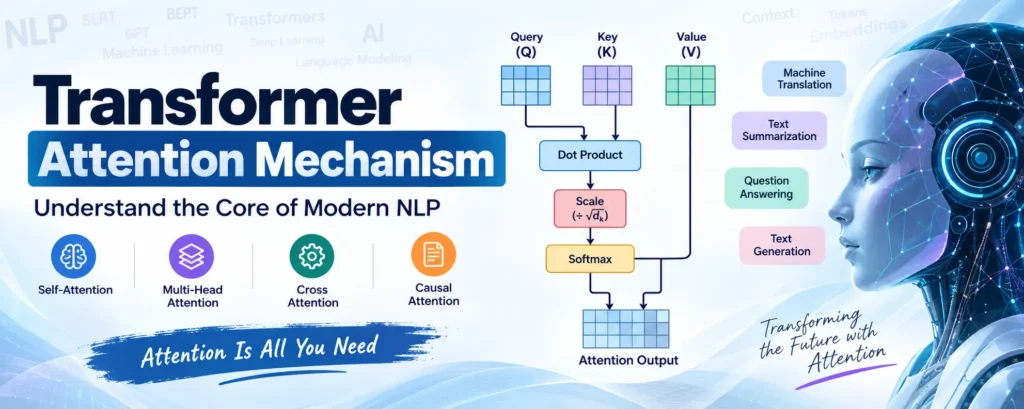
Scaled Dot-Product Attention is the fundamental attention operation used in Transformers. It calculates attention using three components: Queries (Q), Keys (K), and Values (V).
The process involves the following steps:
- Calculate the dot product between the query and key vectors.
- Scale the resulting scores by the square root of the key dimension.
- Apply the softmax function to convert the scores into attention weights.
- Multiply the attention weights by the value vectors to produce the final output.
Formula:
Attention(Q, K, V) = softmax((QKᵀ) / √dk) VHere, dk represents the dimension of the key vectors. Scaling helps prevent the dot-product values from becoming excessively large and improves training stability.
2. Multi-Head Attention
Multi-Head Attention enables a Transformer to learn different types of relationships within the same sequence. Instead of performing attention only once, the model uses multiple attention heads simultaneously.
Each head can learn different attention patterns. The outputs from all heads are then concatenated and passed through a linear transformation.
Formula:
MultiHead(Q, K, V) = Concat(head₁, ..., headₕ)Wᵒ

headᵢ = Attention(QWᵢQ, KWᵢK, VWᵢV)
3. Self-Attention
Self-attention, also known as intra-attention, allows each token in a sequence to interact with other tokens in the same sequence, including itself.
By comparing tokens with one another, the model can identify relationships and build a contextual representation of the sequence. Self-attention is used in both encoder and decoder architectures, although decoder self-attention is typically masked during autoregressive generation.
4. Encoder-Decoder (Cross) Attention
Encoder-decoder attention, commonly called cross-attention, is used in the decoder to connect the generated output with information produced by the encoder.
During decoding, the decoder uses its current representations as queries while attending to the encoder’s outputs as keys and values. This is particularly important in sequence-to-sequence tasks such as machine translation.
5. Masked (Causal) Self-Attention
In autoregressive text generation, the model must not use information from future tokens when predicting the current token. Masked self-attention, also known as causal attention, prevents the model from looking ahead.
The attention mask hides future positions so that each token can only attend to the appropriate previous and current positions.
Formula:
MaskedAttention(Q, K, V) = softmax((QKᵀ + M) / √dk) VHere, M is a mask that assigns a very large negative value to future positions before the softmax operation, effectively preventing attention to those positions.
How to Implement Transformer Attention Mechanism in TensorFlow
Let’s look at a basic implementation of the main attention components using TensorFlow.
Step 1: Import Required Libraries
import tensorflow as tf
from tensorflow.keras.layers import Layer, Dense, Dropout, LayerNormalization, Embedding
import numpy as np
Step 2: Scaled Dot-Product Attention Class
The following layer calculates attention scores, scales them according to the key dimension, applies an optional mask, and then generates a weighted combination of the value vectors.
class ScaledDotProductAttention(Layer):
    def call(self, q, k, v, mask=None):
        matmul_qk = tf.matmul(q, k, transpose_b=True)

        dk = tf.cast(tf.shape(k)[-1], tf.float32)
        scaled_logits = matmul_qk / tf.math.sqrt(dk)

        if mask is not None:
            scaled_logits += (mask * -1e9)

        attention_weights = tf.nn.softmax(
            scaled_logits, axis=-1
        )

        output = tf.matmul(attention_weights, v)

        return output, attention_weights
Step 3: Multi-Head Attention Layer
The Multi-Head Attention layer projects the queries, keys, and values, divides them into multiple heads, performs attention independently for each head, and then combines the results.
class MultiHeadAttention(Layer):
    def __init__(self, d_model, num_heads):
        super().__init__()

        self.num_heads = num_heads
        self.depth = d_model // num_heads

        self.wq = Dense(d_model)
        self.wk = Dense(d_model)
        self.wv = Dense(d_model)

        self.dense = Dense(d_model)

    def split_heads(self, x, batch_size):
        x = tf.reshape(
            x,
            (batch_size, -1, self.num_heads, self.depth)
        )

        return tf.transpose(x, perm=[0, 2, 1, 3])

    def call(self, v, k, q, mask=None):
        batch_size = tf.shape(q)[0]

        q = self.wq(q)
        k = self.wk(k)
        v = self.wv(v)

        q = self.split_heads(q, batch_size)
        k = self.split_heads(k, batch_size)
        v = self.split_heads(v, batch_size)

        attention, weights = ScaledDotProductAttention()(
            q, k, v, mask
        )

        attention = tf.transpose(
            attention,
            perm=[0, 2, 1, 3]
        )

        concat = tf.reshape(
            attention,
            (batch_size, -1, self.num_heads * self.depth)
        )

        return self.dense(concat), weights
Step 4: Positional Encoding
Because attention itself does not inherently provide information about the order of tokens, Transformers use positional encoding to add positional information to token representations.
class PositionalEncoding(Layer):
    def __init__(self, position, d_model):
        super().__init__()

        self.pos_encoding = self.positional_encoding(
            position,
            d_model
        )

    def positional_encoding(self, position, d_model):
        angle_rads = self.get_angles(
            np.arange(position)[:, np.newaxis],
            np.arange(d_model)[np.newaxis, :],
            d_model
        )

        angle_rads[:, 0::2] = np.sin(
            angle_rads[:, 0::2]
        )

        angle_rads[:, 1::2] = np.cos(
            angle_rads[:, 1::2]
        )

        return tf.cast(
            angle_rads[np.newaxis, ...],
            dtype=tf.float32
        )

    def get_angles(self, pos, i, d_model):
        return pos * 1 / np.power(
            10000,
            (2 * (i // 2)) / np.float32(d_model)
        )

    def call(self, x):
        return x + self.pos_encoding[
            :, :tf.shape(x)[1], :
        ]
Significance of the Transformer Attention Mechanism
- Parallelism: Transformers can process tokens in parallel during training instead of processing them strictly one after another like traditional RNNs. This makes better use of modern hardware and can significantly speed up training.
- Contextual Awareness: Attention enables the model to assign greater importance to tokens that are relevant to the current context.
- Handling Long-Range Dependencies: Attention allows tokens to directly interact with other tokens across a sequence, making it easier to learn relationships over long distances.
- Scalability: The Transformer architecture can be applied to sequences ranging from short sentences to much larger collections of text, making it suitable for a wide range of applications.
Applications of Attention in Real-World NLP Tasks
- Machine Translation: Attention helps sequence-to-sequence models identify relevant parts of an input sentence when generating translated text.
- Text Summarization: Attention helps models identify and use the most relevant information from longer documents when producing summaries.
- Sentiment Analysis: Attention can help models identify words and phrases that are important for determining the sentiment of a text.
- Question Answering: Attention enables models to connect questions with relevant information within a context passage.
- Named Entity Recognition (NER): Transformer-based models can use contextual relationships to identify entities such as people, locations, and organizations.
- Text Generation: Causal attention forms the foundation of autoregressive Transformer models used for generating text.
- Language Modeling: Transformer architectures can learn relationships between tokens to predict subsequent tokens and support applications such as autocomplete and other language-processing systems.
Download New Real Time Projects :- Click here
Conclusion
The attention mechanism has fundamentally changed the way modern NLP systems process and understand language. From Scaled Dot-Product Attention and Multi-Head Attention to Self-Attention and Causal Attention, these mechanisms allow Transformer models to capture context and relationships between tokens effectively.
The attention-based Transformer architecture has become a foundation of modern AI systems, powering applications in translation, text generation, summarization, question answering, and many other areas.
Whether you are developing an AI assistant, chatbot, translation system, or another NLP application, understanding the Transformer attention mechanism is an essential step toward understanding modern AI.
Stay tuned for more deep dives into AI and machine learning topics!
Keywords: attention is all you need, self-attention mechanism, purpose of attention mechanism in transformer architecture, attention mechanism in deep learning, attention in transformers visually explained, transformer model, transformers in large language models, types of attention mechanism, transformer attention mechanism, vision transformer attention mechanism, transformer attention mechanism explained, attention mechanism in transformer architecture, self attention mechanism in transformer based models, transformer self attention mechanism transformer attention mechanism, attention mechanism in transformer, transformer architecture, self-attention mechanism, multi-head attention, scaled dot-product attention, Transformer Attention MechanismTransformer Attention Mechanism Transformer Attention Mechanism masked self-attention, causal attention, cross-attention, encoder-decoder attention, transformer model, attention in deep learning, attention mechanism in NLP, transformer NLP, transformer self attention, how attention works in transformers, attention is all you need, transformer attention explained, large language models, LLM attention mechanism, TensorFlow transformer, TensorFlow attention mechanism, positional encoding, machine translation, text summarization, text generation, natural language processing, deep learning, AI transformers, vision transformer attention mechanism Transformer Attention MechanismTransformer Attention Mechanism