Linear vs Logistic Regression
Machine Learning is an important branch of Artificial Intelligence that enables machines to learn from data and make predictions or decisions. Two of the most fundamental algorithms in supervised learning are Linear Regression and Logistic Regression.
Although their names are similar, Linear Regression and Logistic Regression are designed for different types of problems. Linear Regression is mainly used to predict continuous values, while Logistic Regression is used for classification tasks.
In this post, we will understand the difference between Linear and Logistic Regression, how they work, and when to use each algorithm.
Complete Advance AI Topics: Click Here
SQL Tutorial: Click Here
What is Linear Regression?
Linear Regression is one of the simplest and most commonly used supervised machine learning algorithms. It is used to predict a continuous dependent variable using one or more independent variables.
Key Features of Linear Regression
- It is used to solve regression problems.
- It predicts continuous values such as salary, price, age, and temperature.
- It assumes a linear relationship between the variables.
- The output is a real or continuous number.
When only one independent variable is used, it is called Simple Linear Regression. When two or more independent variables are used, it is called Multiple Linear Regression.
Objective of Linear Regression
The main objective of Linear Regression is to find the best-fit line through the data points. The model attempts to minimize the difference between the actual and predicted values so that it can make accurate predictions on new data.
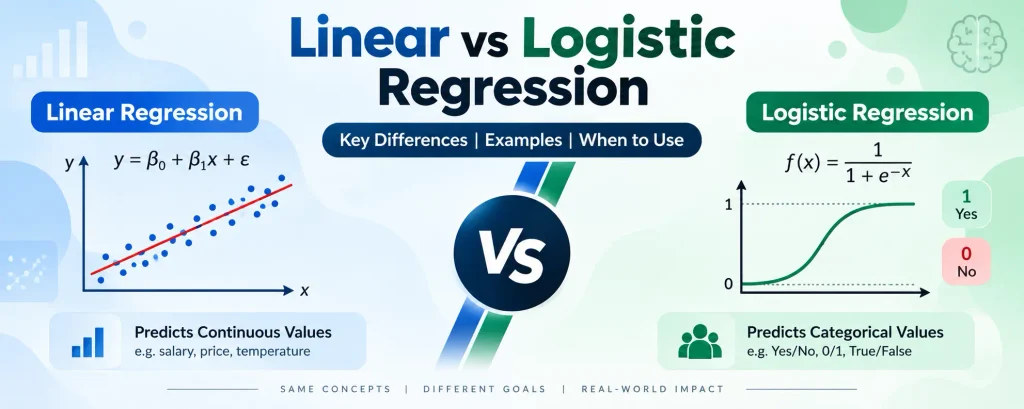
The general form of the Linear Regression equation is:
y = β₀ + β₁x + εWhere:
y= dependent variablex= independent variableβ₀= interceptβ₁= slope or coefficientε= error term
Example of Linear Regression
Suppose we want to predict a person’s salary based on their years of work experience. Salary is a continuous value, so Linear Regression can be used to identify the relationship between experience and salary and predict the expected salary for a given number of years of experience.
What is Logistic Regression?
Logistic Regression, despite having the word “regression” in its name, is primarily used for classification problems. It is a supervised learning algorithm used when the target variable represents a category or class.
Key Features of Logistic Regression
- It is mainly used to solve classification problems.
- It can predict outcomes such as Yes/No, 0/1, and True/False.
- It produces a probability between 0 and 1.
- It uses the sigmoid function to convert the model’s output into a probability.
Download New Real-Time Projects: Click here
Objective of Logistic Regression
The main objective of Logistic Regression is to calculate the probability that an input belongs to a particular category. A threshold is then commonly used to convert that probability into a class label.
The sigmoid, or logistic, function is:
f(x) = 1 / (1 + e^(-x))Where:
f(x)= predicted probabilityx= weighted sum of the input variablese= Euler’s number, approximately 2.718
The sigmoid function produces an S-shaped curve. It maps any real-valued input into a range between 0 and 1, which makes it useful for probability-based classification.
Example of Logistic Regression
Suppose we want to determine whether a customer will leave a service or not. The output can be either Yes or No. Logistic Regression can calculate the probability of the customer leaving and use that probability to assign the appropriate class.
Linear Regression vs Logistic Regression
| Feature | Linear Regression | Logistic Regression |
|---|---|---|
| Type of Problem | Regression | Classification |
| Output Variable | Continuous | Categorical |
| Prediction Type | Continuous numerical values | Class probabilities and class labels |
| Equation | y = β₀ + β₁x + ε | f(x) = 1 / (1 + e-x) |
| Graph Shape | Straight line | S-shaped sigmoid curve |
| Estimation Technique | Least Squares Estimation | Maximum Likelihood Estimation |
| Output Interpretation | Direct numerical value | Probability that can be converted into a class label |
| Typical Use Cases | House prices, salary, sales, temperature | Spam detection, fraud detection, customer churn |
When to Use Linear Regression vs Logistic Regression?
| Use Case | Recommended Algorithm |
|---|---|
| Predicting a student’s score based on study hours | Linear Regression |
| Classifying whether a customer will churn or not | Logistic Regression |
| Forecasting future temperature | Linear Regression |
| Identifying whether an image contains a cat or not | Logistic Regression |
Conclusion
Linear Regression and Logistic Regression are two important algorithms for understanding supervised machine learning. Although they have similar names, they solve different types of problems.
Linear Regression is used when the goal is to predict a continuous numerical value, while Logistic Regression is used when the goal is to classify data into categories.
In simple terms:
- Linear Regression → Predicts continuous values.
- Logistic Regression → Classifies data into categories.
Understanding the difference between these two algorithms provides a strong foundation for learning more advanced machine learning concepts. Whether you are predicting numerical values or building a classification model, selecting the appropriate algorithm is essential for creating an effective machine learning solution.
Stay connected for more hands-on tutorials, guides, and project ideas in Machine Learning and Artificial Intelligence.
Keywords: difference between linear and logistic regression with example, difference between linear and logistic regression in machine learning, when to use logistic regression vs linear regression, logistic regression vs classification, linear and logistic regression example, linear regression vs multiple regression, logistic regression formula, logistic regression, linear regression, linear vs logistic regression example, linear vs logistic regression in machine learning, linear vs logistic regression Python