
Machine Learning Life Cycle
Machine learning has changed the way computers work by allowing them to learn from data without being explicitly programmed for every task. But how does a machine learning system actually work? The answer is the Machine Learning Life Cycle, a systematic and iterative process used to develop effective machine learning models.
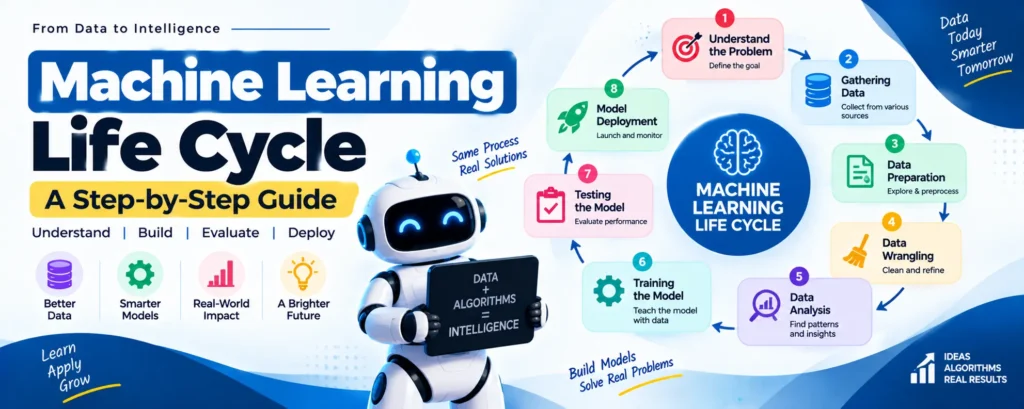
The main purpose of this life cycle is to find the best possible solution to a given problem by creating, testing, and improving a predictive model. It includes seven important steps, and each step contributes to the accuracy and reliability of the final model.
Complete Advance AI Topics: Click Here
SQL Tutorial: Click Here
Understanding the Problem
Before starting the different stages of the life cycle, the first and most important step in any machine learning project is to clearly understand the problem statement and the goal of the model. A clearly defined problem can lead to better insights, improved accuracy, and more effective decision-making.
Once the problem has been clearly defined, we can move forward with the seven essential steps of the machine learning life cycle.
1. Gathering Data
Data collection forms the foundation of machine learning. This stage involves collecting raw data from different sources, such as:
- Databases
- APIs
- Web scraping
- IoT sensors
- Public datasets
The quality and amount of collected data can directly affect model performance. Having more relevant and diverse data can contribute to better accuracy and improved predictions.
Key Tasks in Data Gathering:
- Identifying different data sources
- Collecting both structured and unstructured data
- Combining and integrating data from multiple sources
After collection, the data is brought together into a cohesive dataset that can be used in the next stage.
2. Data Preparation
Once the data has been collected, it needs to be prepared for further processing. This step ensures that the dataset is properly structured and formatted so that machine learning algorithms can work with it effectively.
Two Key Processes in Data Preparation:
Data Exploration
- Understand the characteristics, format, and overall quality of the data.
- Find patterns, correlations, trends, and outliers.
- Create initial visualizations to gain deeper insights.
Data Preprocessing
- Handle missing values.
- Normalize or standardize the data.
- Convert categorical data into numerical values.
By the end of this stage, we have a well-structured dataset that is ready for further refinement.
3. Data Wrangling
Data Wrangling, also called Data Cleaning, involves transforming and refining raw data into a usable format. Since real-world datasets can often contain messy or inconsistent information, this step is important for achieving accurate model predictions.
Common Issues in Raw Data:
- Missing values
- Duplicate records
- Irrelevant features
- Noisy or inconsistent data
Data Wrangling Techniques:
- Removing duplicate or unnecessary data
- Handling missing values using interpolation or mean substitution
- Removing outliers that may introduce bias into the model
- Transforming data into a consistent format
After the cleaning process, the dataset is optimized for analysis and prepared for model training.
4. Data Analysis
After preparing the data, the next step is to analyze it and identify important patterns and relationships.
Key Activities in Data Analysis:
Selecting Analytical Techniques: Choose techniques such as classification, regression, clustering, or association analysis according to the type of problem.
Building an Initial Model: Apply suitable machine learning algorithms to analyze the available data.
Reviewing Results: Evaluate the model’s performance using statistical and visualization tools.
At the end of this stage, we gain useful insights from the data and determine the most suitable model approach for the problem.
5. Training the Model
One of the most important stages is training the machine learning model. Here, the dataset is used to teach the model how to make predictions.
Training Process:
- Select a suitable machine learning algorithm according to the problem.
- Divide the data into training and validation sets.
- Train the model using labeled data so it can learn patterns and relationships.
The main goal is to help the model generalize well to unseen data and improve its prediction accuracy.
6. Testing the Model
After training the model, we need to evaluate its performance using a separate test dataset.
Key Steps in Model Testing:
- Use unseen data (test set) to measure model performance.
- Calculate evaluation metrics such as accuracy, precision, recall, and F1-score.
- Identify errors and overfitting issues.
If the model does not provide satisfactory results, we can fine-tune its parameters and retrain the model until the desired performance is achieved.
7. Model Deployment
Once the model has been successfully trained and tested, the final step is to deploy it into a real-world environment.
Deployment Considerations:
- Deploy the model in a production environment such as a web application, mobile app, or cloud.
- Monitor the model’s performance over time.
- Continuously update and improve the model as new data becomes available.
Before deployment, it is also important to check whether the model is scalable, secure, and optimized for real-world use cases.
Download New Real Time Projects :- Click here
Conclusion
The Machine Learning Life Cycle is an iterative process that helps in developing high-performing AI models. By following its seven stages — gathering data, preparing data, data wrangling, analyzing data, training, testing, and deployment — we can develop reliable and efficient machine learning systems.
As AI and ML continue to evolve, understanding this life cycle is important for data scientists, engineers, and AI enthusiasts who want to create innovative and impactful solutions.
machine learning life cycle pdf
machine learning life cycle diagram
machine learning life cycle in ai
machine learning life cycle with example
machine learning life cycle geeksforgeeks
machine learning life cycle ppt
7 steps of machine learning
machine learning life cycle
explain machine learning life cycle
list the stages of machine learning life cycle
stages of the machine learning life cycle
mlops spanning whole machine learning life cycle a survey
machine learning life cycle diagram
machine learning life cycle pdf
machine learning life cycle assessment
machine learning life cycle aws
machine learning life cycle in artificial intelligence
machine learning life cycle with diagram
machine learning life cycle example