
Overfitting in Machine Learning
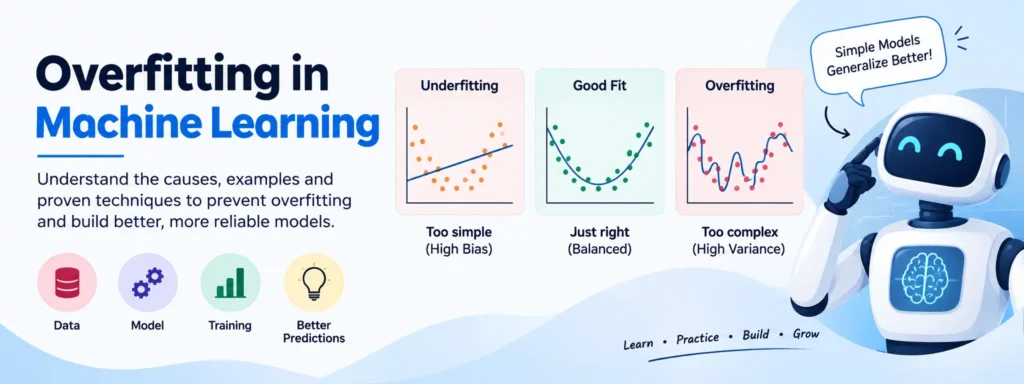
Overfitting is one of the most common challenges in machine learning. It occurs when a model learns the training data too closely, including its noise and random variations, instead of learning patterns that can generalize to new data.
An overfitted model may achieve excellent results on training data but perform poorly when it encounters unseen data. Finding the right balance between learning enough from the training data and avoiding unnecessary complexity is essential for building reliable machine learning models.
Complete Advance AI Topics: Click Here
SQL Tutorial: Click Here
How to Avoid Overfitting in Machine Learning
Several techniques can be used to reduce overfitting and improve a model’s ability to generalize to unseen data.
1. Early Stopping
Early stopping is commonly used during model training to prevent the model from learning the training data too closely.
The training process is stopped when the model’s performance on validation data stops improving. This helps prevent the model from continuing to learn noise and unnecessary details from the training dataset.
However, stopping too early can cause underfitting, so it is important to find the right balance.
2. Train with More Data
Providing more training data can help a machine learning model learn more accurate and general patterns instead of relying heavily on noise or individual examples.
However, additional data should be:
- Clean and relevant
- Free from unnecessary noise
High-quality data is important because simply increasing the dataset size does not guarantee better model performance.
3. Feature Selection
Not every feature in a dataset contributes positively to prediction. Irrelevant or redundant features can make a model unnecessarily complex and increase the risk of overfitting.
Feature selection techniques that can help include:
- Recursive Feature Elimination (RFE)
- Information Gain
- Correlation Analysis
By selecting useful features and removing unnecessary ones, the model can focus on the information that is most relevant to the prediction task.
4. Cross-Validation
K-Fold Cross-Validation is a useful technique for evaluating how well a model is likely to perform on unseen data.
The dataset is divided into multiple subsets, and the model is trained and evaluated using different subsets during each iteration. This provides a more reliable estimate of model performance and can help identify overfitting.
A common practice is to use 5 or 10 folds depending on the dataset and problem.
5. Data Augmentation
Data augmentation involves creating variations of existing training examples instead of collecting entirely new data. It can increase the diversity of the training dataset and help reduce overfitting.
This technique is particularly useful in areas such as image recognition. For example, images can be modified by:
- Rotating them
- Flipping them
- Adding noise
These variations provide the model with more diverse examples while using the existing data.
6. Regularization
Regularization is a technique used to reduce overfitting by penalizing overly complex models. A penalty term is added to the loss function, encouraging the model to avoid unnecessarily large or complex parameters.
Types of Regularization
- L1 Regularization (Lasso): Can shrink some coefficients to zero, which can also help with feature selection.
- L2 Regularization (Ridge): Shrinks coefficients more evenly without completely removing features.
Regularization helps control model complexity and can improve its ability to generalize to unseen data.
7. Ensemble Methods
Ensemble methods combine multiple models to produce more reliable predictions. By combining different models, these techniques can help reduce the effect of individual prediction errors and improve generalization.
Popular Ensemble Methods
- Bagging: Trains multiple models on different subsets of the data and combines their predictions. Random Forest is a popular example.
- Boosting: Trains models sequentially, with each new model focusing on correcting errors made by previous models. XGBoost is a popular example.
These approaches can help balance bias and variance and reduce the risk of relying too heavily on a particular training dataset.
Download New Real Time Projects: Click here
Summary
Overfitting is a critical challenge in machine learning that occurs when a model learns the training data too closely, including noise and unnecessary variations. Although an overfitted model may perform very well on training data, its performance can decrease significantly when it is used with unseen data.
Techniques such as early stopping, training with more data, feature selection, cross-validation, data augmentation, regularization, and ensemble methods can help reduce overfitting and improve a model’s ability to generalize.
Understanding overfitting, underfitting, and the balance between bias and variance is essential for developing robust machine learning models. By carefully selecting features, validating models, controlling complexity, and fine-tuning the training process, you can build models that perform more reliably on new data.
Keywords: what is underfitting in machine learning, underfitting and overfitting in machine learning, overfitting and underfitting, how to avoid overfitting in machine learning, bias and variance in machine learning, overfitting in machine learning example, overfitting example, difference between overfitting and underfitting with example, overfitting in machine learning, how to avoid overfitting in machine learning, define overfitting in machine learning, ways to prevent overfitting in machine learning, example of overfitting in machine learning, what causes overfitting in machine learning, overfitting in machine learning meaning, overfitting in machine learning bias and variance, overfitting in ml in simple words