Prerequisites for Machine Learning
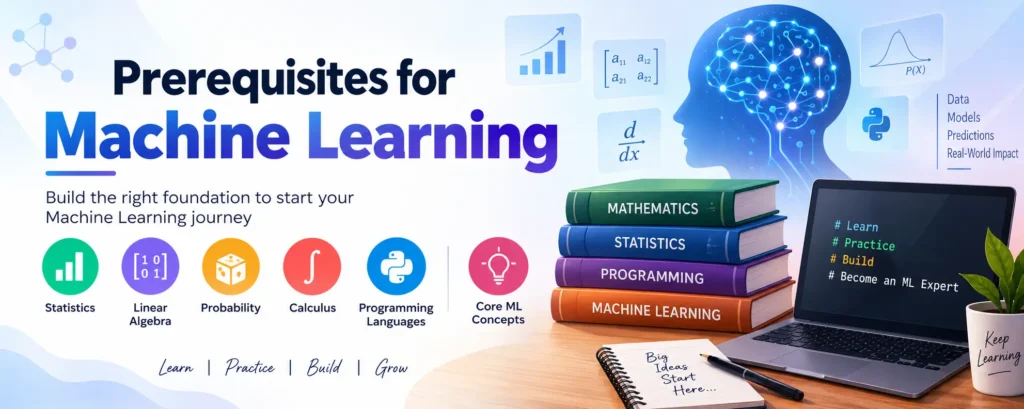
Machine learning has become one of the most in-demand technologies in the world and is playing a major role in shaping the future of industries across the globe. If you want to build a career in machine learning, understanding the prerequisites for machine learning is an important first step. These foundational skills make it easier to understand ML concepts and help you approach the field with confidence.
At its core, machine learning combines ideas from mathematics, statistics, and computer science. It allows computers to analyze data, identify patterns, and make predictions or decisions. Whether the input is numerical data, text, or images, machine learning systems can learn from examples and improve as they receive more data.
In this article, we will explore the important skills and knowledge you should have before going deeper into machine learning and artificial intelligence (AI).
Complete Advance AI Topics: Click Here
SQL Tutorial: Click Here
Educational Prerequisites for a Machine Learning Career
Is a Master’s or Ph.D. Required to Learn Machine Learning?
This is one of the most common questions beginners have, and the simple answer is no.
You do not need a Master’s degree or Ph.D. to begin learning machine learning. People from many different backgrounds, including software development, mathematics, data analysis, and business, have successfully moved into machine learning without an advanced academic degree.
A formal degree in areas such as computer science, data science, or applied mathematics can provide a strong foundation and may be useful when pursuing research-oriented roles. However, practical knowledge, hands-on experience, and the ability to apply machine learning concepts to real-world problems are much more important for getting started.
Skills-Based Prerequisites for Machine Learning
1. Statistics
Statistics plays an important role in machine learning because many ML algorithms and evaluation techniques are based on statistical concepts. A good understanding of statistics makes it easier to work with data and understand how machine learning models behave.
Some important topics include:
- Probability distributions
- Hypothesis testing
- Variance and standard deviation
- Bayes’ Theorem
- Combinatorics
- Random variables
- Conditional and joint distributions
Why it matters:
Statistics helps you understand data, detect unusual values, and evaluate whether the results produced by a model are meaningful. Algorithms and techniques such as logistic regression and Naive Bayes are closely connected to statistical principles.
2. Linear Algebra
Machine learning often works with datasets containing many variables and dimensions. Linear algebra provides the mathematical foundation needed to represent and process this type of data efficiently.
Some key concepts to learn are:
- Vectors and matrices
- Matrix multiplication
- Eigenvalues and eigenvectors
- Singular Value Decomposition (SVD)
- Principal Component Analysis (PCA)
Why it matters:
Many machine learning techniques, including Support Vector Machines (SVMs) and neural networks, depend heavily on linear algebra. Matrix operations are also an important part of optimization techniques used during model training.
3. Probability
Probability is concerned with uncertainty, which is a major part of working with real-world data. It helps machine learning systems represent uncertainty and reason about the likelihood of different outcomes.
Important probability topics include:
- Maximum Likelihood Estimation (MLE)
- Bayes’ Theorem
- Joint and conditional probability
- Gaussian distribution
- Density estimation
Why it matters:
Probability is useful for understanding predictions and uncertain outcomes. It is particularly important when studying models and techniques such as Naive Bayes, Hidden Markov Models, and Bayesian networks.
4. Calculus
Calculus is mainly useful for understanding how machine learning models are optimized during training. It provides the mathematical tools required to determine how changes in model parameters affect the output.
Some essential topics include:
- Derivatives and gradients
- Partial derivatives
- Multivariate calculus
- Chain rule
- Gradient descent
Why it matters:
Optimization methods such as gradient descent use derivatives to minimize loss functions and adjust model parameters during training.
Tip for beginners:
You do not need to become an expert in advanced calculus before starting machine learning. Focus first on understanding the basic concepts and why these mathematical operations are used in model training.
5. Programming Languages
Programming is an essential skill for machine learning. You will use programming to clean and prepare data, build models, train algorithms, and evaluate their performance.
Here are some of the commonly used programming languages in machine learning:
Python
- One of the most widely used languages in machine learning and data science.
- Relatively easy to learn and has a large ecosystem of libraries such as NumPy, pandas, TensorFlow, scikit-learn, and PyTorch.
- Offers strong community support and flexibility.
R
- Well suited for statistical analysis and data visualization.
- Popular among statisticians and data analysts.
- Provides useful packages such as
caret,randomForest,xgboost,gmodels, andTM.
Java
- Known for stability and scalability.
- Can be used in large-scale production environments.
- Follows the “Write Once, Run Anywhere” approach.
- Machine learning libraries include Deeplearning4j, MOA, and Weka.
Other Languages
- C/C++: Useful for performance-intensive machine learning tasks.
- MATLAB: Commonly used in academic and research environments.
- JavaScript: Can be used for machine learning applications that run in the browser with TensorFlow.js.
How to choose?
If you are a beginner, Python is generally the best place to start because it is easy to learn and has a large ecosystem of machine learning and data science libraries.
Bonus: Basic Machine Learning Concepts to Know
Once you have developed a basic understanding of mathematics and programming, you can begin exploring the fundamental concepts of machine learning, including:
- Types of Learning: Supervised Learning, Unsupervised Learning, and Reinforcement Learning
- Model Building: Feature selection, training/testing split, and model evaluation
- Algorithms: Linear regression, decision trees, k-means clustering, and more
- Performance Metrics: Accuracy, precision, recall, F1-score, and ROC-AUC
YT:- DecodeIT
Conclusion
Machine learning is not limited to people with a Ph.D. or a specialized data science degree. With a combination of mathematical knowledge, programming skills, and a willingness to learn, anyone can begin building a career in this field.
The learning process may feel challenging in the beginning, but developing each foundational skill will make it easier to understand machine learning concepts and work on practical projects.
Start with the basics, stay consistent, and keep practicing as you build your machine learning skills.
Keywords:
machine learning prerequisites, prerequisites for machine learning, machine learning prerequisites for beginners, prerequisites for machine learning in Python, machine learning required skills, prerequisites for artificial intelligence, prerequisites for data science, machine learning skills, machine learning basics, machine learning roadmap, mathematics for machine learning, statistics for machine learning, linear algebra for machine learning, probability for machine learning, calculus for machine learning, Python for machine learning, machine learning concepts, AI prerequisites, machine learning career, learn machine learning