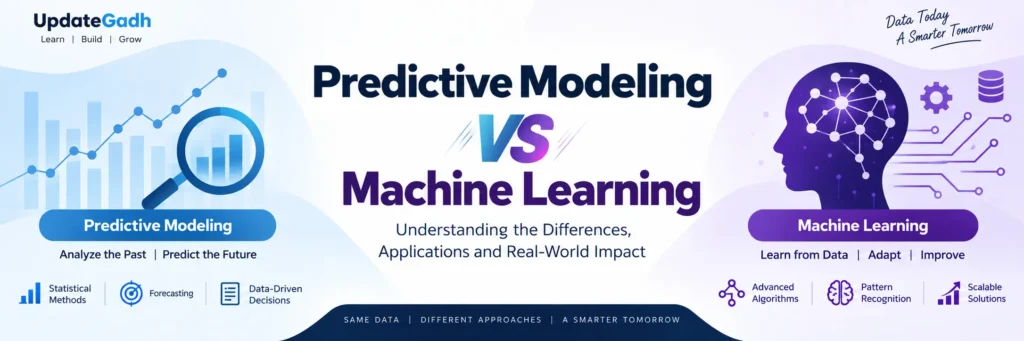
Predictive Modeling vs Machine Learning
Introduction
In today’s data-driven world, Predictive Modeling and Machine Learning are two important approaches that help businesses make informed decisions, personalize user experiences, and gain a competitive advantage. Although both work with data to generate useful insights, they differ in their techniques, flexibility, and applications.
In this article by Updategadh, we will explore the differences between predictive modeling and machine learning, including their definitions, methodologies, applications, and the key distinctions that every data enthusiast should understand.
Complete Advance AI Topics: Click Here
SQL Tutorial: Click Here
What is Predictive Modeling?
Predictive modeling is a statistical approach used to make predictions about future or unknown outcomes based on historical data. It involves identifying patterns in data, developing mathematical models, and using those models to estimate future values or outcomes.
Typical steps involved in predictive modeling include:
- Data collection and preprocessing
- Model selection, such as linear regression, logistic regression, or decision trees
- Model training and evaluation
- Deployment and maintenance
Common Predictive Models
- Regression Models: Used to predict continuous values, such as sales forecasting.
- Classification Models: Used to assign data to specific categories, such as spam detection.
- Time Series Forecasting: Used to predict trends and patterns over time, such as stock market or sales predictions.
Methodology of Predictive Modeling
- Problem Definition
Clearly identify what needs to be predicted, such as customer churn or future revenue. - Data Collection
Gather structured or unstructured data that is relevant to the prediction problem. - Data Cleaning and Preprocessing
Handle missing values, outliers, and other data-quality issues before building the model. - Feature Engineering
Create meaningful variables or features that can help improve the model’s predictive performance. - Model Selection
Select an appropriate model, such as regression, decision trees, SVM, or neural networks, depending on the problem. - Training
Train the selected model using historical data so that it can learn patterns and make predictions. - Evaluation
Evaluate the model using suitable metrics such as precision, recall, F1-score, and ROC-AUC. - Deployment
Integrate the trained model into software applications or systems where it can generate predictions. - Monitoring and Updating
Monitor the model’s performance and retrain or update it when necessary to adapt to changing data.
Applications of Predictive Modeling
- Finance: Credit scoring, stock prediction, and market trend analysis.
- Healthcare: Disease diagnosis, treatment optimization, and patient risk prediction.
- Marketing and CRM: Customer segmentation, churn prediction, and campaign optimization.
- Risk Management: Fraud detection and insurance claims analysis.
- Supply Chain: Inventory forecasting, demand planning, and equipment maintenance.
What is Machine Learning?
Machine Learning (ML) is a branch of Artificial Intelligence (AI) that enables computers to learn patterns from data and make decisions or predictions without being explicitly programmed for every task. Machine learning models can adapt to new data and improve their performance as they are trained with additional information.
Machine Learning is commonly categorized into:
- Supervised Learning: Includes tasks such as classification and regression.
- Unsupervised Learning: Includes techniques such as clustering and dimensionality reduction.
- Reinforcement Learning: Focuses on decision-making in dynamic environments through rewards and penalties.
Methodology of Machine Learning
- Data Acquisition
Collect data from sources such as sensors, logs, APIs, databases, and other systems. - Preprocessing
Clean, normalize, transform, and prepare the raw data for model training. - Feature Selection and Engineering
Identify or create relevant features that can improve the model’s performance. - Model Selection and Training
Select an appropriate algorithm, such as Random Forest or a Neural Network, and train it using the available data. - Evaluation
Evaluate the model using techniques such as cross-validation and metrics including RMSE, accuracy, and F1-score. - Hyperparameter Tuning
Optimize the model’s configuration using techniques such as grid search or random search. - Deployment
Integrate the trained machine learning model into production systems, such as web applications or analytics dashboards.
Applications of Machine Learning
- Natural Language Processing: Chatbots, machine translation, and sentiment analysis.
- Computer Vision: Face recognition, object detection, and medical image analysis.
- Recommendation Systems: Product recommendations and personalized content suggestions.
- Autonomous Systems: Self-driving vehicles and drones.
- Finance: Fraud detection, algorithmic trading, and credit scoring.
Key Differences Between Predictive Modeling and Machine Learning
| Feature | Predictive Modeling | Machine Learning |
|---|---|---|
| Approach | Primarily statistical | Algorithmic and data-driven |
| Scope | Focused mainly on prediction | Broader field within Artificial Intelligence |
| Data Requirements | Often works with structured and labeled data | Can work with labeled, unlabeled, or semi-structured data |
| Interpretability | Often easier to interpret, especially with simpler statistical models | Can be more difficult to interpret, particularly with complex models such as deep learning |
| Flexibility | Generally less adaptive to complex patterns | More adaptable to complex and large-scale problems |
| Automation | Often involves manual feature selection and model development | Can automate parts of the learning and feature-processing process |
Distinguishing Factors
- Complexity: Predictive models often use relatively simple structures such as regression, while machine learning can use complex techniques such as deep neural networks.
- Supervision: Predictive modeling is commonly associated with supervised prediction tasks, whereas machine learning includes supervised, unsupervised, and reinforcement learning.
- Interpretability vs Performance: Predictive modeling often places greater emphasis on understanding and explaining model results, while machine learning may prioritize predictive performance, sometimes at the cost of interpretability.
- Domain Expertise: Predictive modeling often relies heavily on domain knowledge for selecting appropriate features, variables, and models.
Download New Real Time Projects :- Click here
Conclusion
Both predictive modeling and machine learning are valuable approaches for extracting insights from data and supporting better decision-making. Predictive modeling generally emphasizes statistical techniques, prediction, and interpretability, while machine learning provides greater flexibility and adaptability for handling complex and large-scale problems.
Understanding the differences between these approaches helps organizations choose the right method for a particular problem. Whether the goal is to anticipate market trends or develop an intelligent recommendation system, knowledge of both predictive modeling and machine learning can provide significant value in a data-driven environment.
Stay tuned with Updategadh for more deep dives into data science, AI, and analytics!
Keywords: predictive analytics, machine learning examples, types of predictive models in machine learning, predictive analytics and machine learning, machine learning NLP and computer vision, machine learning for predictive data analytics, predictive modeling techniques, machine learning prediction models Python, best machine learning algorithms for prediction