Cross Validation in Machine Learning
Cross-validation is one of the most effective techniques in machine learning for evaluating model performance and determining how well a model can generalize to unseen data. Instead of depending on a single train-test split, cross-validation evaluates a model across multiple subsets of the dataset, helping produce more reliable and consistent performance results.
In this article, we will understand what cross-validation is, why it is important, the different cross-validation techniques, its limitations, and its applications in machine learning.
Complete Advance AI Topics: Click Here
SQL Tutorial: Click Here
What is Cross-Validation?
Cross-validation is a model evaluation technique used to determine how effectively a machine learning model performs on unseen data. It divides the available dataset into multiple subsets, trains the model using some subsets, and evaluates it using the remaining subset.
Unlike a traditional train-test split, where the data is divided only once, cross-validation rotates the validation set across different subsets of the data. The results from these iterations are then combined, usually by calculating their average, to provide a more dependable estimate of model performance.
This approach helps identify overfitting and gives a better understanding of how consistently a model is likely to perform on new data.
Why is Cross-Validation Needed?
A machine learning model should not simply perform well on the data it was trained on. It should also be able to make accurate predictions when presented with unseen data.
A single train-test split can sometimes produce misleading results because the performance of a model may depend heavily on which observations happen to fall into the training and testing sets. Cross-validation reduces this dependency by evaluating the model multiple times using different portions of the dataset.
Key goals of cross-validation include:
- Testing model stability
- Reducing the risk of overfitting
- Measuring generalization performance
- Comparing different machine learning models
- Optimizing model hyperparameters
Steps Involved in Cross-Validation
- Split the data: Divide the dataset into multiple subsets or folds.
- Train the model: Use some of the folds to train the machine learning model.
- Evaluate the model: Test the trained model using the remaining validation fold.
- Repeat the process: Rotate the validation fold and repeat the process several times.
- Calculate the final score: Average the evaluation scores from all iterations to obtain a more reliable performance estimate.
Common Cross-Validation Techniques
Different cross-validation techniques can be selected depending on the dataset, machine learning problem, and computational resources available.
1. Validation Set Approach
In the validation set approach, the dataset is divided into separate training and validation portions. For example, the data may be divided into two parts, with one portion used for training and the other used for validation.
- It is simple and easy to implement.
- The model is trained using only a portion of the available data.
- The evaluation result can depend heavily on the particular split.
Drawback: Using less data for training can increase bias and may cause the model to underperform.
2. Leave-P-Out Cross-Validation
Leave-P-Out Cross-Validation leaves p observations out of a dataset containing n observations and uses the remaining n-p observations for training.
The process is repeated for different combinations of observations until the possible combinations have been evaluated.
Drawback: The number of combinations can become extremely large, making this technique computationally expensive for larger datasets.
3. Leave-One-Out Cross-Validation (LOOCV)
Leave-One-Out Cross-Validation, commonly known as LOOCV, is a special case of Leave-P-Out Cross-Validation where p = 1.
For a dataset containing n observations, the model is trained n times. During each iteration, one observation is used for validation while the remaining n-1 observations are used for training.
Advantages:
- Uses almost the entire dataset for training in every iteration.
- Generally produces low bias in the performance estimate.
Disadvantages:
- Can be computationally expensive.
- May have relatively high variance in its performance estimate.
4. K-Fold Cross-Validation
K-Fold Cross-Validation is one of the most commonly used cross-validation techniques in machine learning.
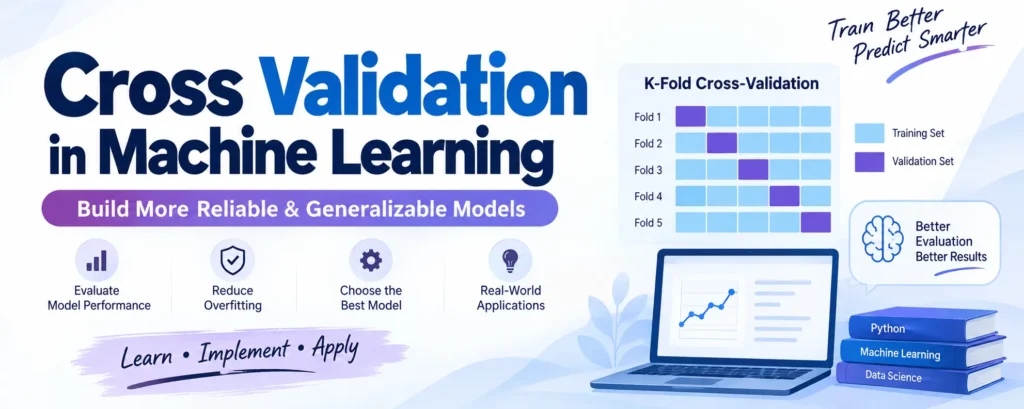
In K-Fold Cross-Validation, the dataset is divided into K approximately equal-sized folds. During each iteration, one fold is used for validation while the remaining K-1 folds are used to train the model.
The process continues until every fold has been used as the validation set.
Example: In 5-Fold Cross-Validation, the dataset is divided into five folds. The model is trained using four folds and validated using the remaining fold. This process is repeated five times so that each fold is used once for validation.
Advantages:
- Provides a more reliable evaluation than a single train-test split.
- Every observation gets an opportunity to be part of the validation set.
- Useful for model comparison and hyperparameter tuning.
5. Stratified K-Fold Cross-Validation
Stratified K-Fold Cross-Validation is a variation of K-Fold Cross-Validation that attempts to maintain a similar distribution of target classes in every fold.
It is particularly useful for classification problems where the classes are imbalanced, such as fraud detection or rare disease diagnosis.
By maintaining a representative class distribution across the folds, stratified cross-validation can provide a more reliable evaluation of classification models.
6. Holdout Method
The holdout method is a simple model evaluation approach in which the dataset is randomly divided into training and testing sets. Common splits include 70:30 or 80:20.
The training portion is used to build the model, while the testing portion is reserved for evaluating its performance.
Limitation: Since the data is divided only once, the evaluation result can be strongly influenced by the particular random split.
Cross-Validation vs Train/Test Split
| Feature | Train/Test Split | Cross-Validation |
|---|---|---|
| Data Splitting | One-time split | Multiple splits or folds |
| Model Evaluation | Based on one validation/test set | Based on multiple validation results |
| Performance | Can depend heavily on the chosen split | Usually provides a more stable estimate |
| Computation | Generally faster | Requires more computation |
| Typical Usage | Quick evaluation and final testing | Model selection and hyperparameter tuning |
Limitations of Cross-Validation
Although cross-validation is a powerful model evaluation technique, it also has some limitations.
- Computationally expensive: Training a model multiple times requires more computational resources than a single train-test split.
- Dataset distribution matters: Cross-validation works best when the folds appropriately represent the underlying data.
- Not always suitable for time-series data: Randomly mixing observations can break the temporal relationship between past and future observations.
Real-World Example
Consider a stock price prediction model. If historical data from the past five years is randomly divided into training and validation sets, information from later periods may end up in the training data while earlier periods appear in the validation data.
This does not accurately represent how the model would be used in practice, where future values must be predicted using information available from the past. Time-aware validation methods are therefore more appropriate for many time-series problems.
Applications of Cross-Validation
Cross-validation is widely used across machine learning and statistical modeling tasks.
- Comparing the performance of different machine learning algorithms
- Choosing suitable model hyperparameters
- Evaluating classification and regression models
- Evaluating diagnostic models in medical research
- Supporting statistical and scientific analysis
Download New Real Time Projects:- Click here
Final Thoughts
Cross-validation is an important technique for understanding whether a machine learning model can generalize beyond the data used for training. Instead of relying on a single split, it evaluates the model across multiple portions of the dataset and provides a more dependable view of its performance.
Choosing the right cross-validation strategy depends on the type of data and the machine learning problem. K-Fold and Stratified K-Fold are widely useful for many machine learning tasks, while specialized approaches may be required for datasets with particular structures, such as time-series data.
So, the next time you train a machine learning model, don’t rely only on a single split. Use the appropriate cross-validation technique to evaluate your model more confidently.
Did You Know?
K-Fold and Stratified K-Fold Cross-Validation are commonly used in machine learning workflows for model selection, hyperparameter tuning, and combining model predictions.
Explore more machine learning concepts, tutorials, and projects with your tech learning companion.
Keywords: cross validation in machine learning, k fold cross validation in machine learning, leave one out cross validation in machine learning, types of cross validation in machine learning, cross validation in machine learning python, cross validation in machine learning example, k fold cross validation python, purpose of cross validation in machine learning