Inductive vs Transductive Learning in Machine Learning
Machine learning has evolved significantly over the years, introducing different learning paradigms to solve real-world problems efficiently. Two important approaches are inductive learning and transductive learning.
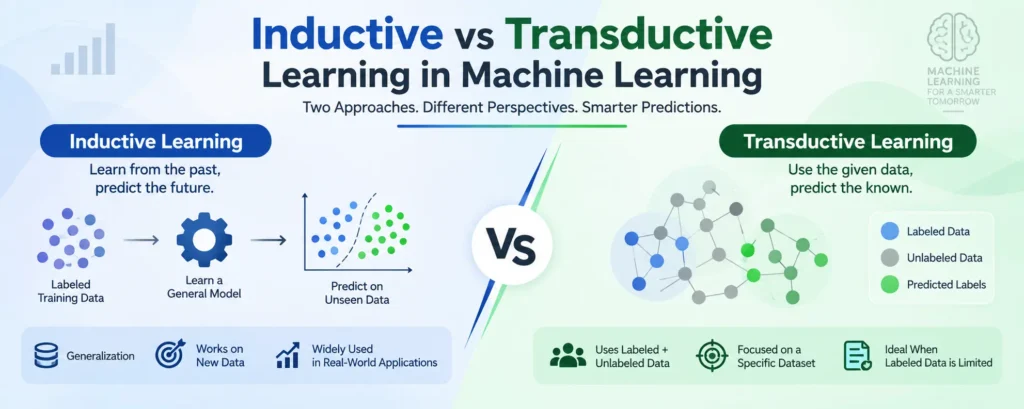
Although both approaches use data to make predictions, they differ in how they learn and generalize. Inductive learning focuses on building a model that can make predictions on future unseen data, while transductive learning focuses on predicting labels for a specific set of known data.
Complete Advance AI Topics: Click Here
SQL Tutorial: Click Here
What Is Inductive Learning?
Inductive learning is one of the most widely used approaches in machine learning. It involves learning patterns from training data and using those learned patterns to make predictions on previously unseen data.
This approach is commonly used in supervised machine learning applications such as spam detection, image classification, fraud detection, and medical diagnosis.
How Inductive Learning Works
Data Collection and PreprocessingInput data and corresponding labeled outputs are collected. The data is then cleaned and prepared using techniques such as feature selection, normalization, and other preprocessing methods. For example, an email dataset may contain email content along with labels such as “spam” or “not spam”.
Model Training and Pattern LearningA machine learning algorithm such as a decision tree, support vector machine, or neural network is trained using the available data. The model learns patterns that can be used to map inputs to their corresponding outputs.
Generalization to Unseen DataAfter training, the model is evaluated using fresh data that it has not previously encountered. The objective is for the model to make accurate predictions on future unseen examples.
Model EvaluationThe performance of the model can be evaluated using a test dataset and metrics such as accuracy, precision, recall, and F1-score. These metrics help determine how well the model performs outside the training data.
Challenges in Inductive Learning
- Overfitting: The model learns noise or specific patterns from the training data, which can reduce its performance on unseen data.
- Underfitting: The model is too simple to capture the important patterns present in the data.
Techniques such as cross-validation, pruning, and regularization can help reduce these problems and improve model performance.
Applications of Inductive Learning
- Image and speech recognition
- Email spam filtering
- Autonomous driving
- Financial fraud detection
- Medical diagnostics
What Is Transductive Learning?
Transductive learning takes a different approach from inductive learning. Instead of building a general model that can be applied to any future data, it focuses on making predictions for a specific set of test data that is already available during the learning process.
Transductive learning can be particularly useful when labeled data is limited and the main objective is to predict labels for a particular collection of unlabeled data.
How Transductive Learning Works
Semi-Supervised SetupTransductive learning commonly involves a small amount of labeled data along with a larger amount of unlabeled data. Both datasets are available during the learning process.
Learning Relationships Between DataTransductive approaches can use the relationships and similarities between labeled and unlabeled examples. Techniques such as graph-based learning can identify relationships between data points.
Label PropagationIn graph-based approaches, data points can be represented as nodes, while relationships between similar data points are represented by edges. Labels from known examples can then be propagated to similar unlabeled examples.
Characteristics of Transductive Learning
- Focuses on a specific and known set of test data.
- Does not aim to generalize to completely unseen future data.
- Can utilize relationships between labeled and unlabeled data.
- Can be useful when labeled data is scarce.
Applications of Transductive Learning
- Text classification with limited labeled documents
- Image labeling when only a few labeled examples are available
- Medical diagnosis for a specific patient dataset
- Fraud detection for a specific transaction batch
Advantages of Transductive Learning
- Can provide accurate predictions for a specific target dataset.
- Makes effective use of available unlabeled data.
- Can be useful when obtaining large amounts of labeled data is expensive.
Limitations of Transductive Learning
- It is not designed to generalize to future unseen datasets.
- Some transductive methods can become computationally expensive with large datasets.
- It may not be suitable for continuously changing or dynamic environments.
Inductive vs Transductive Learning
| Feature | Inductive Learning | Transductive Learning |
|---|---|---|
| Goal | Build a general model for unseen data | Predict labels for a specific known target set |
| Generalization | Yes | Not the primary goal |
| Training Data | Typically uses labeled training data | Can use labeled and unlabeled data |
| Use Case Suitability | Dynamic and evolving environments | Specific target datasets and static prediction tasks |
| Examples | Email filtering, image classification, autonomous driving | Document classification and batch-based labeling |
| Computational Complexity | Usually moderate depending on the algorithm | Can be high when relationships between many data points are calculated |
YT:- DecodeIT
Which One Should You Use?
The choice between inductive and transductive learning depends on the objective of your machine learning project and the type of data available.
Use Inductive Learning If:
- You need a model that can generalize to fresh, unseen data.
- You are working in a dynamic environment with continuous data.
- You want to reuse the trained model for future predictions.
Use Transductive Learning If:
- You want to predict labels for a particular dataset.
- Labeled data is limited or expensive to obtain.
- You do not need the model to generalize beyond the available target data.
Conclusion
Inductive and transductive learning are two different approaches to machine learning, and each is useful in different situations.
Inductive learning focuses on learning a general model from training data and applying it to unseen examples. This makes it suitable for applications such as spam filtering, image recognition, fraud detection, and other evolving real-world systems.
Transductive learning, on the other hand, focuses on making predictions for a specific target dataset and can make use of relationships between labeled and unlabeled examples. It is particularly useful when labeled data is limited and the target dataset is already known.
Understanding the difference between inductive and transductive learning can help machine learning practitioners select an appropriate learning strategy based on their data, objectives, and application requirements.
Keywords: inductive vs transductive learning, transductive learning, inductive learning, inductive and transductive learning in machine learning, transductive learning example, inductive learning example, difference between inductive and transductive learning, transductive vs inductive graph learning, inductive vs transductive machine learning examples