
Types of Sampling Techniques
Sampling is an important part of research, statistics, and data collection. It is the process of selecting a smaller group of individuals or items from a larger population to draw conclusions about the entire group. Since studying every member of a population can be difficult, expensive, and time-consuming, sampling provides a practical and efficient approach.
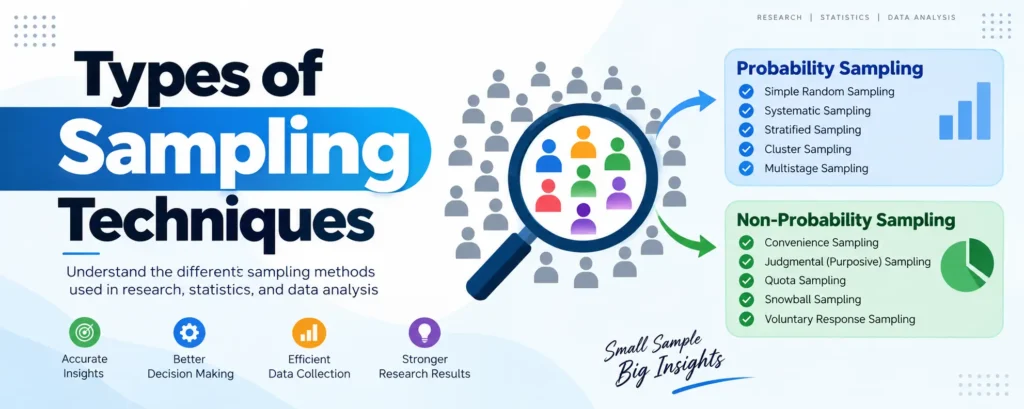
Sampling techniques are generally divided into two major categories: Probability Sampling and Non-Probability Sampling. Each category includes several methods that are useful for different research objectives and situations. Let’s explore these sampling techniques in detail.
Complete Advance AI Topics: Click Here
SQL Tutorial: Click Here
Probability Sampling
In probability sampling, every member of the population has a known and non-zero chance of being selected. This approach is especially useful when researchers want their findings to be representative of the larger population.
1. Simple Random Sampling
How it works:
Every member of the population has an equal chance of being selected. Researchers can use random number generators, lotteries, or other random selection methods to choose participants.
Pros:
- Minimizes selection bias
- Easy to understand and implement
- Produces reliable and generalizable results
Cons:
- May not be practical for very large populations
- Requires a complete list of the population
2. Systematic Sampling
How it works:
After randomly selecting a starting point, researchers choose every k-th member from an ordered list. For example, a researcher may select every tenth individual from a list containing 1,000 people.
Pros:
- Simple and quick to perform
- Provides an evenly distributed sample
- Requires less time than simple random sampling
Cons:
- Can introduce periodicity bias when the population contains a hidden pattern
- Provides less randomness than simple random sampling
3. Stratified Sampling
How it works:
The population is divided into smaller subgroups, known as strata, based on characteristics such as age, gender, income, or other relevant factors. A random sample is then selected from each stratum, often in proportion to its size within the population.
Pros:
- Ensures important subgroups are represented
- Can reduce sampling error
- Allows researchers to analyze different subgroups
Cons:
- Requires detailed information about the population
- Can be more complex and time-consuming
4. Cluster Sampling
How it works:
The population is divided into clusters, often based on geographical locations or naturally occurring groups. Researchers randomly select a number of clusters and then study either all members or a sample of members within the selected clusters.
Pros:
- Cost-effective when studying geographically dispersed populations
- Reduces travel and administrative requirements
Cons:
- Has a higher risk of sampling error
- Selected clusters may not accurately represent the entire population
5. Multistage Sampling
How it works:
Multistage sampling combines different sampling methods and applies them in multiple stages. For example, researchers may first use cluster sampling to select schools and then use simple random sampling to select students from those schools.
Pros:
- Flexible for studying complex populations
- Reduces logistical challenges
- Works well for large-scale studies
Cons:
- Can be complicated to organize and manage
- Each stage can introduce additional sampling error
Non-Probability Sampling
In non-probability sampling, not every member of the population has an equal or known chance of being selected. Although this can limit how widely the results can be generalized, these methods are often faster, easier, and more affordable. They are particularly useful for exploratory, preliminary, or qualitative research.
1. Convenience Sampling
How it works:
Researchers select individuals who are easiest to reach or access, such as classmates, shoppers, employees, or online respondents.
Pros:
- Fast and economical
- Simple to implement
- Useful for quick and informal studies
Cons:
- Has a high risk of selection bias
- May not accurately represent the larger population
2. Judgmental (Purposive) Sampling
How it works:
Researchers use their knowledge and judgment to select participants who are considered particularly relevant to the research topic.
Pros:
- Allows targeted data collection
- Useful for obtaining expert opinions or studying rare cases
- Commonly used in qualitative research
Cons:
- Subjective selection can introduce bias
- Results have limited generalizability
3. Quota Sampling
How it works:
The population is divided into different categories, and researchers select a fixed number of participants from each category. For example, a study may aim for a sample consisting of 50% males and 50% females.
Pros:
- Ensures representation of selected subgroups
- More structured than convenience sampling
Cons:
- Participants within each group are not randomly selected
- Can still introduce sampling bias
4. Snowball Sampling
How it works:
Existing participants help researchers identify or recruit additional participants. This technique is particularly useful when studying hard-to-reach, rare, or niche populations.
Pros:
- Effective for rare or hidden populations
- Cost-effective
- Makes use of existing participant networks
Cons:
- Can produce a relatively homogeneous sample
- Sampling error can be difficult to estimate
- Results may be strongly influenced by the initial participants
5. Voluntary Response Sampling
How it works:
Participants decide for themselves whether to take part in a study. Online surveys, polls, and public questionnaires are common examples of voluntary response sampling.
Pros:
- Easy and inexpensive to conduct
- Can collect responses quickly
- Useful for understanding opinions and public responses
Cons:
- Has a high risk of self-selection bias
- May not accurately represent the views of the general population
- People with particularly strong opinions may be more likely to participate
Download New Real Time Projects: Click here
Final Thoughts
Choosing the right sampling technique is an important part of any research or data collection process. Probability sampling generally provides stronger statistical support and better generalizability, while non-probability sampling is often more practical when researchers need quick and cost-effective insights.
The best sampling method depends on the research objectives, available resources, population characteristics, and the type of information being collected.
Understanding the different sampling techniques can help researchers select an appropriate approach and collect data that is reliable and useful for their study.
Explore more topics related to statistics, research methodologies, and data science at Updategadh.com.
Keywords: types of sampling techniques, types of sampling techniques in research, probability sampling, non-probability sampling, simple random sampling, systematic sampling, stratified sampling, cluster sampling, multistage sampling, convenience sampling, purposive sampling, quota sampling, snowball sampling, voluntary response sampling, sampling techniques in research methodology, sampling techniques in statistics types of sampling techniques, types of sampling techniques in research, sampling techniques, probability sampling, non-probability sampling, simple random sampling, systematic sampling, stratified sampling, cluster sampling, multistage sampling, convenience sampling, purposive sampling, judgmental sampling, quota sampling, snowball sampling, voluntary response sampling, sampling techniques in statistics, sampling techniques