Machine Learning Tools
Machine learning (ML) is one of the most transformative technologies of our time. It is changing the way businesses operate, improving the accuracy of predictive models, and enabling smarter automation across industries. As a major area of Artificial Intelligence (AI), machine learning allows systems to learn from data, identify patterns, and make decisions with minimal human intervention.
As the demand for machine learning continues to grow, developers, researchers, and technology enthusiasts are increasingly exploring ML to build intelligent applications. However, creating effective machine learning solutions requires more than theoretical knowledge. The right tools are essential for processing data, developing models, training algorithms, and deploying ML applications efficiently.
In this article, we will explore some widely used Machine Learning tools, along with their key features and applications.
Complete Advance AI Topics: Click Here
SQL Tutorial: Click Here
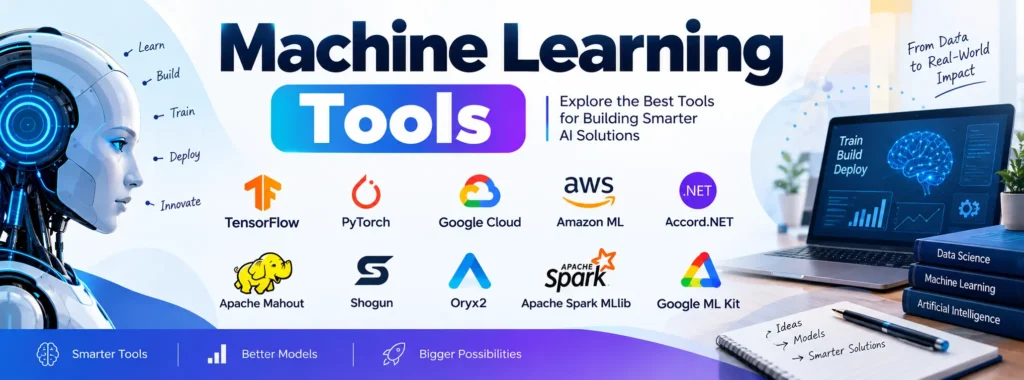
1. TensorFlow
TensorFlow is an open-source machine learning and deep learning framework originally developed by the Google Brain team. It is widely used by researchers and developers for numerical computation, model development, and large-scale machine learning applications.
Key Features:
- Keras and other high-level APIs for rapid model development.
- Support for CPUs, GPUs, and TPUs for distributed computing.
- TensorFlow.js for developing machine learning applications in web browsers.
- Eager execution for easier development and debugging.
- Deployment support for mobile, web, cloud, and other platforms.
- Automatic differentiation for efficient model training.
- Open-source ecosystem with a large developer community.
2. PyTorch
PyTorch is an open-source machine learning framework developed by Facebook’s AI Research Lab (FAIR). It has become especially popular among researchers and developers working on deep learning, computer vision, and natural language processing.
Key Features:
- Dynamic computational graphs provide flexibility during model development.
- Built-in support for GPU acceleration.
- Python-based interface with C++ support.
- Tools such as TorchScript help move models from research to production.
- Integrations with libraries and platforms such as Hugging Face and PyTorch Lightning.
- Simple debugging and an intuitive development experience.
3. Google Cloud ML Engine
Google Cloud ML Engine provides a managed environment for training, deploying, and scaling machine learning models on Google Cloud infrastructure. It is particularly useful for developers and organizations working with large datasets and complex ML workloads.
Key Features:
- Support for machine learning training and prediction services.
- Scalability for large datasets and workloads.
- Integration with other Google Cloud services.
- Suitable for enterprise-level AI applications.
- Efficient deployment of custom and pre-trained machine learning models.
4. Amazon Machine Learning (AML)
Amazon Machine Learning (AML) is an AWS-based solution for developing and deploying scalable machine learning models. It provides a user-friendly environment and integrates with various AWS data services and tools.
Key Features:
- Support for binary classification, multi-class classification, and regression.
- Data can be imported from Amazon S3, Redshift, and RDS.
- Support for real-time and batch predictions.
- Visual interfaces and guided workflows for creating models.
- Useful for developers who are getting started with machine learning.
5. Accord.NET
Accord.NET is a .NET-based machine learning framework designed for scientific computing and applications developed with C#. It is useful for areas such as signal processing, image analysis, statistics, and machine learning.
Key Features:
- More than 40 statistical distribution estimations.
- 35+ modules for hypothesis testing.
- Libraries for neural networks, pattern recognition, and linear algebra.
- Well suited for machine learning applications built with the .NET ecosystem.
6. Apache Mahout
Apache Mahout is an open-source machine learning project supported by the Apache Software Foundation. It focuses on scalable machine learning and provides tools for working with linear algebra and large datasets.
Key Features:
- Libraries for classification, clustering, and recommendation systems.
- Integration with Apache Hadoop and Apache Spark.
- Designed for large-scale distributed computing.
- Efficient support for vector and matrix operations.
7. Shogun
Shogun is a mature machine learning library written primarily in C++. It is known for its strong support for kernel-based algorithms and can be used with several programming languages, making it suitable for different machine learning environments.
Key Features:
- Comprehensive support for Support Vector Machines (SVMs) and kernel methods.
- Cross-language support including Python, Java, C#, and R.
- Ability to combine multiple kernels for improved performance.
- Designed to efficiently handle large volumes of data.
8. Oryx2
Oryx2 is a machine learning application development framework built around Apache Spark and Kafka. It is designed for large-scale applications that require real-time machine learning capabilities and supports use cases such as classification, clustering, and collaborative filtering.
Key Features:
- Based on a lambda architecture.
- Three-tier structure consisting of Speed, Batch, and Serving layers.
- Support for real-time data processing.
- Integration with Spark, Hadoop, and Kafka.
- Written in Java and designed for scalable machine learning applications.
9. Apache Spark MLlib
MLlib is the machine learning library of Apache Spark. It provides distributed and scalable machine learning algorithms and supports both batch and streaming data processing across different computing environments.
Key Features:
- Pre-built algorithms for recommendation, clustering, regression, and classification.
- APIs for Python, Scala, Java, R, and SQL.
- Compatibility with Hadoop, Kubernetes, and cloud environments.
- Integrated linear algebra capabilities for efficient data processing.
10. Google ML Kit for Mobile
Google ML Kit is designed for developers who want to add machine learning capabilities to Android and iOS applications. It provides ready-to-use APIs that allow developers to integrate common machine learning features without building models entirely from scratch.
Key Features:
- Supports both on-device and cloud-based machine learning features.
- APIs for text recognition, face detection, image labeling, and other tasks.
- Includes computer vision and natural language capabilities.
- Optimized for low-latency mobile applications.
- On-device processing can improve performance and help support offline functionality.
Download New Real-Time Projects: Click here
Conclusion
There is no single machine learning tool that is perfect for every project. Each tool has its own strengths, supported programming languages, features, and use cases. Therefore, your choice should depend on factors such as project requirements, technical expertise, data size, and deployment environment.
The machine learning ecosystem continues to evolve, with new frameworks, platforms, and solutions appearing regularly. Whether you are developing a recommendation system, training a deep learning model, processing large datasets, or adding ML capabilities to a mobile application, selecting the right tool can make the development process more efficient.
Understanding different machine learning tools can help you choose the technology that best fits your project and build more effective ML solutions.
Keywords: machine learning tools, machine learning tools Python, top 5 machine learning tools, machine learning tools for beginners, machine learning tools and techniques, machine learning tools and frameworks, free machine learning tools, machine learning tools for data science, types of machine learning, machine learning, AI tools, machine learning tools list, machine learning tools GitHub, AWS machine learning tools, Google machine learning tools, using machine learning tools, no code machine learning tools