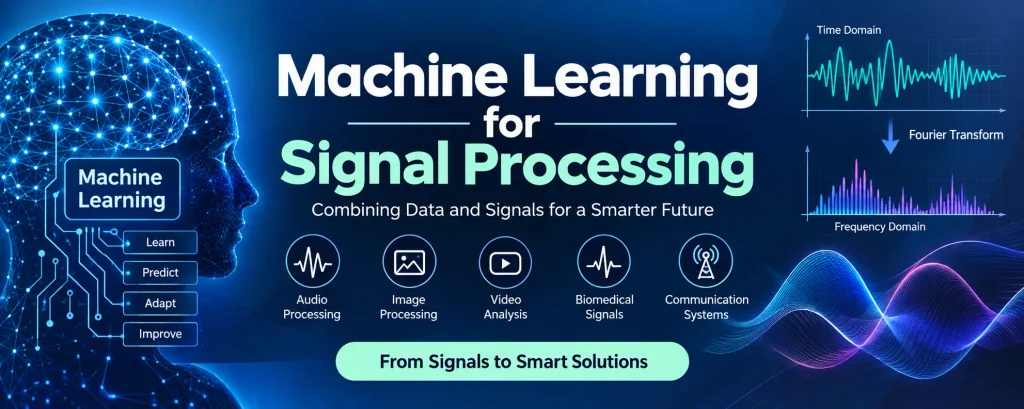
Machine Learning for Signal Processing
Machine Learning for Signal Processing Machine Learning (ML) is a powerful branch of artificial intelligence that enables systems to learn from data and improve their performance without being explicitly programmed. On the other hand, Signal Processing focuses on analyzing, modifying, and extracting meaningful information from signals such as audio, images, video, and sensor data.
When machine learning and signal processing are combined, they create a powerful approach for solving complex real-world problems. This combination improves performance, automates signal analysis, adapts to changing data, and supports predictive analytics. It is widely used in areas such as speech recognition, biomedical analysis, video processing, communication systems, and audio enhancement.
Complete Advance AI Topics: Click Here
SQL Tutorial: Click Here
Types of Signal Processing
1. Analog Signal Processing
Analog signal processing deals with continuous-time signals. These signals are processed using physical electronic components such as resistors, capacitors, and inductors.
Applications:
- Radio and TV broadcasting
- Analog audio systems
- Sensor signal acquisition
2. Digital Signal Processing (DSP)
Digital Signal Processing (DSP) involves converting analog signals into digital data using Analog-to-Digital Converters (ADCs). Once converted into digital form, signals can be processed and analyzed using algorithms.
Applications:
- Speech recognition
- Image and video compression
- Networking and telecommunications
- Medical imaging and diagnostics
3. Time-Domain Signal Processing
Time-domain signal processing focuses on analyzing signals according to how they change over time. It can be used for detecting events, filtering signals, and identifying patterns.
Applications:
- Heart rate detection from ECG signals
- Time-Domain Reflectometry (TDR)
- Echo detection in sonar and radar systems
4. Frequency-Domain Signal Processing
Frequency-domain signal processing transforms signals from the time domain into the frequency domain. Techniques such as the Fourier Transform make it easier to identify and analyze different frequency components.
Applications:
- Spectrum analysis
- Audio noise cancellation
- Signal modulation and demodulation in communication systems
5. Adaptive Signal Processing
Adaptive signal processing is used when signal characteristics change over time. Adaptive algorithms can adjust their behavior in real time to maintain effective signal processing performance.
Applications:
- Adaptive noise cancellation
- Communication channel equalization
- Echo suppression in phone calls
6. Statistical Signal Processing
Statistical signal processing analyzes signals in situations involving uncertainty by using concepts from probability and statistics.
Applications:
- Speech and pattern recognition
- Signal estimation and detection
- Financial data analysis
Fundamental Signal Processing Techniques
Filtering
Filtering is used to enhance desired parts of a signal or remove unwanted components such as noise.
- Low-pass filters: Allow low-frequency signals to pass while reducing higher frequencies.
- High-pass filters: Allow high-frequency signals to pass while reducing lower frequencies.
- Band-pass filters: Allow a specific range of frequencies to pass.
- Notch filters: Block or significantly reduce a specific frequency range.
Fourier Transform
The Fourier Transform converts a signal from the time domain into the frequency domain. It is widely used to understand the frequency components present in a signal.
- DFT (Discrete Fourier Transform): Computes the frequency representation of discrete signals.
- FFT (Fast Fourier Transform): An efficient algorithm for computing the DFT.
Convolution and Correlation
- Convolution: Combines two signals to produce another signal and is a fundamental operation in filtering.
- Correlation: Measures the similarity between signals and is useful for detection and pattern matching.
Modulation and Demodulation
Modulation and demodulation are important techniques used to transmit and retrieve information through carrier waves.
- AM: Amplitude Modulation
- FM: Frequency Modulation
- PM: Phase Modulation
Demodulation is the process of recovering the original information from a modulated signal.
Sampling and Quantization
- Sampling: Converts a continuous-time signal into a discrete-time signal by measuring it at specific intervals.
- Quantization: Assigns sampled signal values to a limited number of discrete levels.
Wavelet Transform
The Wavelet Transform breaks down signals into components at multiple resolutions. It is particularly useful when both time and frequency information are important.
Intersection of Machine Learning and Signal Processing
Combining machine learning with signal processing provides new ways to interpret, manipulate, and extract useful information from signals. Traditional rule-based signal processing methods can be enhanced with intelligent, data-driven approaches.
How Machine Learning Enhances Signal Processing
1. Feature Extraction and Selection
- Automation: ML models can automatically learn useful features from raw signal data.
- Dimensionality Reduction: Techniques such as PCA and t-SNE can simplify complex signal datasets.
2. Noise Reduction and Enhancement
- Denoising Autoencoders: Learn to reduce noise and reconstruct cleaner signals.
- CNNs and RNNs: Deep learning models can be applied to signal enhancement and pattern extraction.
3. Classification and Recognition
Machine learning is highly effective at identifying patterns in complex signal datasets.
Models such as Support Vector Machines (SVMs) and Deep Neural Networks (DNNs) can be used in applications involving speech, images, and health diagnostics.
4. Predictive Analysis
- LSTM networks: Can be used for time-series forecasting and sequential signal analysis.
- Regression models: Can be used to predict trends and future signal behavior.
5. Adaptive Filtering
Machine learning can improve adaptive filtering systems by helping them respond to changing signal conditions. Kalman Filters and Particle Filters are also useful for estimation in uncertain and non-stationary environments.
Real-Time Signal Processing with Machine Learning
Real-time signal processing refers to processing signals as they are received while maintaining minimal delay. This capability is important in applications such as autonomous driving, real-time monitoring, and live communication.
Key Requirements
- Low Latency: Results should be generated with minimal delay.
- High Throughput: Systems should process large amounts of signal data efficiently.
- Robustness: Models should continue to perform reliably under changing conditions.
- Adaptability: Systems should be able to respond to changing signal characteristics.
Machine Learning Techniques for Real-Time Signal Processing
1. Online Learning
Online learning allows models to update incrementally as new data becomes available instead of requiring complete retraining.
Examples include:
- Online k-means
- Perceptron
- Stochastic Gradient Descent (SGD)
2. Lightweight Models
Lightweight machine learning models are useful for devices with limited computing resources. Models such as Decision Trees and Linear Regression can be optimized for low-power devices.
Edge AI enables machine learning models to run locally on IoT and edge devices, helping reduce latency and dependence on cloud processing.
3. Model Optimization
Machine learning models can be optimized to reduce their computational requirements and make them suitable for real-time applications.
- Pruning: Removes unnecessary model parameters.
- Quantization: Reduces numerical precision to decrease model size and computational cost.
- Hardware Acceleration: GPUs, TPUs, and FPGAs can improve processing speed.
4. Streaming Data Processing
Streaming technologies can process continuously generated signal data in real time. Platforms such as Apache Kafka, Apache Storm, and Apache Flink can be used for handling high-volume streaming data.
Real-time data can be divided into smaller batches or streams and processed in parallel for improved performance.
Tools and Frameworks for Machine Learning and Signal Processing
| Tool / Framework | Description |
|---|---|
| TensorFlow | An open-source machine learning platform that also provides support for deploying models on edge devices. |
| PyTorch | A popular machine learning and deep learning framework widely used for research and deployment. |
| Scikit-learn | A Python library that provides traditional machine learning algorithms and tools for model development. |
| SciPy | Provides scientific computing functions, including tools for signal filtering, Fourier transforms, and convolution. |
| MATLAB | A widely used platform for numerical computing and signal processing, particularly in academic and engineering environments. |
| Apache Kafka | A high-throughput platform designed for processing and streaming large volumes of data. |
| Apache Storm | A distributed real-time computation system suitable for processing streaming data and live analytics. |
Download New Real Time Projects :- Click here
Conclusion
The combination of Machine Learning and Signal Processing is transforming modern technology. Together, these fields enable smarter, faster, and more flexible systems for applications ranging from predictive health monitoring to real-time noise cancellation.
As signal environments become increasingly complex, the ability of machine learning to learn, adapt, and predict provides significant advantages. The integration of machine learning with signal processing is becoming an important part of developing intelligent signal-based systems.
Stay tuned to UpdateGadh for more insightful articles on machine learning, signal processing, artificial intelligence, and emerging technologies.
Keywords: machine learning for signal processing, machine learning signal processing, machine learning for signal processing python, signal processing with machine learning, ML for signal processing, real-time signal processing, machine learning signal processing course, ml signal processing syllabus, machine learning signal processing PDF, machine learning signal processing PPT, machine learning for signal processing IISc, ml for signal processing CMU, IEEE workshop on machine learning for signal processing, MLSP, signal processing ml applications