What Is Graph Neural Network (GNN) and How Does It Work?
Graph Neural Network (GNN) is a type of deep learning model designed to work with data that can be represented as a graph. Unlike traditional neural networks that mainly process structured data such as tables, images, or sequences, GNNs are designed to understand relationships and connections between different entities.
Graphs are commonly used to represent real-world relationships. For example, a social network can be represented as a graph where people are nodes and friendships are edges. Similarly, in a recommendation system, users and products can be represented as nodes, while interactions such as purchases or ratings can be represented as connections.
Because GNNs can learn from both individual objects and their relationships, they are becoming an important technology in Artificial Intelligence, Machine Learning, recommendation systems, fraud detection, drug discovery, social network analysis, and knowledge graphs.

Complete Advance AI Topics: Click Here
Real Time Projects on YouTube:- DecodeIT
What Is a Graph in Machine Learning?
Before understanding Graph Neural Networks, it is important to understand what a graph means in machine learning.
A graph is a data structure consisting mainly of nodes and edges.
- Nodes: Represent individual entities or objects.
- Edges: Represent relationships or connections between nodes.
- Node Features: Store information about individual nodes.
- Edge Features: Store information about relationships between nodes.
- Graph Features: Describe properties of the complete graph.
For example, consider a social media platform. Each user can be represented as a node, while a friendship or follower relationship can be represented as an edge. Information such as age, interests, or activity can be stored as node features.
This structure allows machine learning models to study not only the characteristics of individual entities but also how those entities interact with each other.
What Is a Graph Neural Network?
A Graph Neural Network (GNN) is a neural network architecture that learns representations from graph-structured data. It processes information from a node as well as information received from its neighboring nodes.
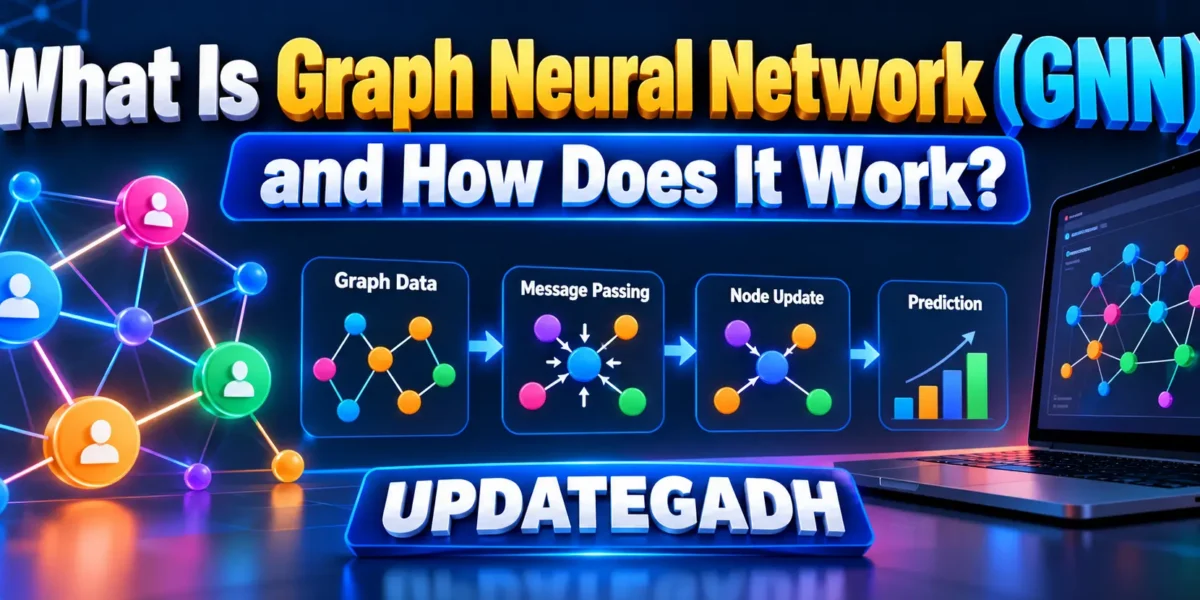
The main idea behind a GNN is called message passing. During this process, nodes exchange information with their neighboring nodes. The model combines this information and updates the representation of each node.
For example, suppose a graph contains several users connected through friendships. A user’s representation may initially contain information only about that user. A GNN can then gather information from connected users and create a richer representation that considers the user’s surrounding network.
This makes GNNs particularly useful when relationships between data points are important for making predictions.
How Does a Graph Neural Network Work?
The working process of a GNN can be understood through several major stages.
1. Graph Representation
The first step is to represent the problem as a graph. The entities involved become nodes, and relationships between those entities become edges.
For example, in a movie recommendation system:
- Users can be represented as nodes.
- Movies can be represented as nodes.
- User-movie interactions can be represented as edges.
Additional information can be attached to nodes and edges as features.
2. Initial Node Features
Each node generally starts with an initial feature representation. These features can contain information about the entity.
For example, a product node may contain information such as category, price, rating, and other relevant attributes. A user node may contain information about preferences or previous interactions.
These features provide the initial information that the GNN uses for learning.
3. Message Passing
Message passing is one of the most important concepts in GNNs.
During message passing, a node receives information from its neighboring nodes. The model aggregates this information and combines it with the node’s existing representation.
In simple terms, the process can be understood as:
Neighbor Information → Aggregation → Node Update
This process can be repeated across multiple layers. With each additional layer, a node can obtain information from a larger portion of the graph.
4. Aggregation
After receiving information from neighboring nodes, the GNN needs to combine that information. This is known as aggregation.
Different GNN architectures can use different aggregation strategies, such as summation, averaging, maximum operations, or learned functions.
The purpose of aggregation is to create a meaningful representation of the neighborhood while maintaining useful information about the node itself.
5. Updating Node Representations
The aggregated information is combined with the node’s existing representation. A neural network layer can then transform the information into a new representation.
When several GNN layers are stacked together, nodes can gradually capture information from nodes that are farther away in the graph.
6. Prediction
After the GNN has learned useful representations, those representations can be used for different machine learning tasks.
Depending on the problem, a GNN can make predictions about individual nodes, relationships between nodes, or the complete graph.
Types of GNN Tasks
Graph Neural Networks can be used for several types of machine learning problems.
Node Classification
Node classification predicts a category or label for an individual node. For example, a social network could use node classification to identify different types of users based on their features and connections.
Link Prediction
Link prediction attempts to determine whether a relationship exists, or may exist, between two nodes.
A recommendation system can use link prediction to estimate whether a user may be interested in a particular product or movie.
Graph Classification
In graph classification, the entire graph is assigned a label. This approach can be useful when each graph represents a complete object or structure.
For example, in molecular analysis, a molecule can be represented as a graph where atoms are nodes and chemical bonds are edges. A GNN can then be used to predict properties of the molecule.
Popular Types of Graph Neural Networks
Several GNN architectures have been developed for different graph learning problems.
Graph Convolutional Network (GCN)
Graph Convolutional Networks apply the idea of convolution to graph-structured data. GCNs update node representations by combining information from neighboring nodes.
They are widely used as a foundational architecture for learning representations from graphs.
Graph Attention Network (GAT)
Graph Attention Networks use attention mechanisms to determine how important different neighboring nodes are when updating a node representation.
This allows the model to assign different levels of importance to different relationships.
GraphSAGE
GraphSAGE, or Graph Sample and Aggregate, learns node representations by sampling and aggregating information from neighboring nodes.
This approach can be useful for large graphs where processing every neighbor of every node may be expensive.
Applications of Graph Neural Networks
GNNs are useful in many areas where relationships between data points are important.
Recommendation Systems
GNNs can model relationships between users, products, movies, or other items. By learning from user-item interactions, they can help generate personalized recommendations.
Social Network Analysis
Social networks naturally form graphs. GNNs can analyze relationships between users and identify patterns in connected communities and interactions.
Fraud Detection
Financial transactions can be represented as graphs involving customers, accounts, devices, merchants, and transactions. GNNs can analyze relationships between these entities to identify suspicious patterns.
Drug Discovery
Molecules can naturally be represented as graphs, with atoms acting as nodes and chemical bonds acting as edges. GNNs can therefore be used to learn molecular representations and support research involving molecular properties.
Knowledge Graphs
Knowledge graphs contain entities and relationships between them. GNNs can use these structures for tasks such as entity classification, relationship prediction, and knowledge graph completion.
Traffic and Transportation
Road networks can be represented as graphs where roads or locations are nodes and connections between them are edges. GNN-based approaches can be applied to transportation and traffic-related prediction problems.
Advantages of Graph Neural Networks
GNNs provide several important advantages when working with graph-structured data.
- They can learn from relationships between entities.
- They can combine node information with neighborhood information.
- They are suitable for many real-world network-based problems.
- They can support node, edge, and graph-level prediction tasks.
- They can learn useful representations automatically instead of relying entirely on manually designed features.
- They can be applied across different domains, including social networks, recommendation systems, finance, chemistry, and knowledge graphs.
Limitations of GNNs
Although GNNs are powerful, they also have some challenges.
Large graphs can require significant computational resources. Graph data may also be dynamic, noisy, incomplete, or highly connected, which can make model training more complicated.
Another challenge is over-smoothing. When too many GNN layers are applied, node representations can become increasingly similar, making it difficult for the model to distinguish between different nodes.
Choosing the appropriate graph structure, features, architecture, and training strategy can also require considerable experimentation.
GNN vs Traditional Neural Networks
| Feature | Traditional Neural Networks | Graph Neural Networks |
|---|---|---|
| Data Structure | Structured data, images, sequences, etc. | Graph-structured data |
| Relationships | Usually not explicitly modeled | Central to the learning process |
| Main Components | Neurons and layers | Nodes, edges, and graph layers |
| Neighborhood Information | Not a core concept | Used through message passing |
| Common Applications | Images, text, forecasting | Networks, recommendations, molecular graphs |
Why Are GNNs Important for AI?
Many real-world datasets are not simply collections of independent records. They contain relationships. People interact with people, customers interact with products, accounts interact through transactions, and components interact inside complex systems.
Traditional machine learning approaches may not fully capture these relationships when the graph structure is important. GNNs provide a way to incorporate this relational information directly into the learning process.
As AI systems increasingly work with connected data, graph-based learning provides an important approach for understanding complex relationships and structures.
Final Thoughts
Graph Neural Networks are an important part of modern machine learning because they are specifically designed to learn from connected and relational data. Their key concept is message passing, where nodes gather and aggregate information from their neighbors before updating their representations.
GNNs can be used for node classification, link prediction, graph classification, recommendation systems, fraud detection, social network analysis, molecular research, and knowledge graphs. Understanding how nodes, edges, features, aggregation, and message passing work provides a strong foundation for learning graph-based AI.
For students and developers interested in Artificial Intelligence, Machine Learning, and Deep Learning, Graph Neural Networks are an important topic to explore because they demonstrate how neural networks can learn not only from individual data points but also from the relationships connecting them.
Keywords: What Is Graph Neural Network (GNN) and How Does It Work, Graph Neural Network, GNN, GNN in Machine Learning, Graph Neural Networks Explained, Graph Machine Learning, GNN Applications, Deep Learning