
Bias and Variance in Machine Learning
Machine Learning (ML), a major branch of Artificial Intelligence (AI), enables machines to learn from data and make predictions without being explicitly programmed for every task. However, machine learning predictions are rarely perfect, and some level of error is unavoidable.
Two important sources of prediction error are bias and variance. Understanding these concepts is essential for building machine learning models that perform well not only on training data but also on unseen data.
In this blog post, we’ll explore what bias and variance mean, how they contribute to machine learning errors, and how to find the right balance between them to build accurate and reliable models.
Complete Advance AI Topics: Click Here
SQL Tutorial: Click Here
Understanding Errors in Machine Learning
Before understanding bias and variance, it is important to know what an error means in machine learning. Error represents the difference between the predictions made by a model and the actual values.
Understanding these errors helps us evaluate models and determine how well they can generalize to unseen data.
Machine learning errors are generally divided into two categories:
- Reducible Errors: These errors can be reduced by improving the model, its features, or the training process. Bias and variance are major sources of reducible error.
- Irreducible Errors: These errors are caused by noise, measurement errors, or unknown factors in the data. They cannot be completely eliminated by changing the machine learning algorithm.
What is Bias?
Bias refers to the error introduced when a machine learning model makes overly strong or simplifying assumptions about the data. A high-bias model is often unable to capture the true relationships and important patterns present in the dataset.
Characteristics of Bias
- High Bias: The model is too simple and cannot learn the underlying patterns in the data. This generally results in underfitting.
- Low Bias: The model makes fewer simplifying assumptions and can better capture the complexity of the data.
Examples of High-Bias Models
- Linear Regression
- Logistic Regression
- Linear Discriminant Analysis
These models are often fast, relatively simple, and easy to interpret, but they may fail to capture complex relationships in some datasets.
Examples of Lower-Bias Models
- Decision Trees
- Support Vector Machines (SVM)
- k-Nearest Neighbors (k-NN)
These models can be more flexible and are capable of learning complex relationships, depending on their configuration and the dataset.
How to Reduce High Bias
- Add relevant input features.
- Use a more complex model.
- Add polynomial features when appropriate.
- Reduce the strength of regularization.
What is Variance?
Variance describes how sensitive a machine learning model is to changes in its training data. A high-variance model can learn the training dataset too closely, including its noise and random fluctuations.
As a result, the model may perform extremely well on training data but perform poorly on new or unseen data. This is commonly known as overfitting.
Characteristics of Variance
- High Variance: The model performs very well on training data but performs significantly worse on test data. This usually indicates overfitting.
- Low Variance: The model’s predictions remain relatively consistent when trained on different datasets.
Examples of Models That Can Have High Variance
- Deep Decision Trees
- Highly flexible SVM models
- k-Nearest Neighbors with a small value of k
These models can learn complex relationships, but without proper control they may also learn noise from the training data.
Examples of Models That Often Have Lower Variance
- Linear Regression
- Logistic Regression
- Linear Discriminant Analysis
How to Reduce High Variance
- Increase the amount of training data.
- Simplify the model when appropriate.
- Remove irrelevant or unnecessary features.
- Use regularization such as L1 or L2 regularization.
- Prune decision trees or limit their depth.
- Increase the value of k in k-NN when a smaller k is causing overfitting.
Bias-Variance Trade-Off
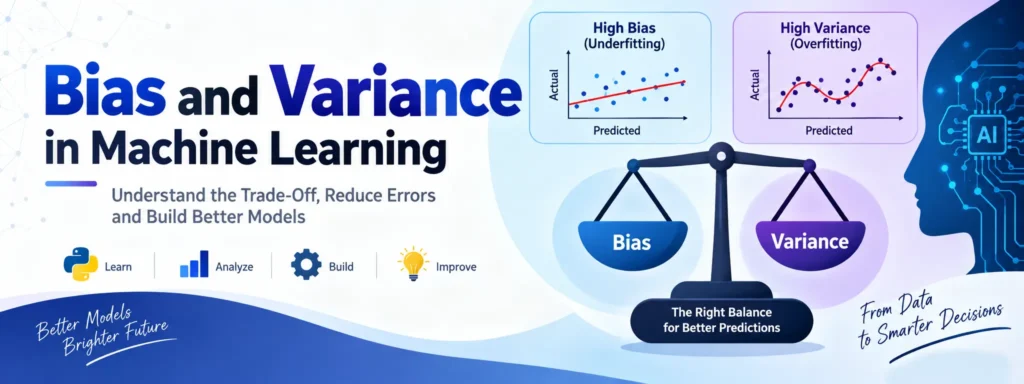
The bias-variance trade-off is one of the fundamental concepts in machine learning. It highlights the challenge of balancing two major sources of model error.
- A high-bias model is usually too simple and tends to underfit the data.
- A high-variance model is usually too complex and tends to overfit the data.
Ideally, we would want a model with both low bias and low variance. However, achieving both at the same time is difficult in real-world machine learning problems.
The goal is therefore to find a suitable balance where the model captures meaningful patterns without becoming too simple or too dependent on the training data.
| Bias | Variance | Description |
|---|---|---|
| Low | Low | Ideal situation, although it can be difficult to achieve. |
| Low | High | Model tends to overfit; training performance is high but generalization is poor. |
| High | Low | Model tends to underfit; predictions are consistent but may be inaccurate. |
| High | High | Model is both inaccurate and unstable, making this an undesirable situation. |
How to Detect High Bias or High Variance?
Training and validation or test performance can help identify whether a model is suffering from high bias or high variance.
Symptoms of High Bias
- High training error.
- High validation or test error.
- Training and test errors are relatively close.
- The model fails to capture important patterns in the data.
- The model generally underfits the dataset.
Symptoms of High Variance
- Very low training error.
- Significantly higher validation or test error.
- A large gap between training and validation performance.
- The model is too closely fitted to the training data.
- The model generally overfits the dataset.
Download New Real Time Projects :- Click here
Final Thoughts
Managing the bias-variance trade-off is an important part of developing successful machine learning models. A model should be complex enough to learn meaningful patterns while remaining simple enough to generalize effectively to new data.
At Updategadh, model evaluation techniques such as cross-validation and learning curves can help identify problems related to bias and variance during the development process.
To build effective machine learning models, it is essential to:
- Understand the complexity of your model.
- Use appropriate metrics to evaluate performance.
- Compare training and validation or test performance.
- Regularly evaluate the model on unseen data.
- Choose an appropriate balance between model simplicity and flexibility.
Finding the right balance between bias and variance is essential for creating models that not only perform well on training data but also deliver reliable predictions in real-world situations.
For more practical tips and in-depth explanations of machine learning concepts, stay tuned with Updategadh.
Keywords: bias and variance tradeoff, bias in machine learning, difference between bias and variance, bias and variance in machine learning, bias variance tradeoff in machine learning, bias and variance in machine learning example, bias and variance in machine learning diagram, bias and variance in machine learning definition, what are bias and variance in machine learning, compare bias and variance in machine learning, bias and variance in machine learning explained, explain bias and variance in machine learning, bias and variance in machine learning formula