
Model Selection in Survival Analysis
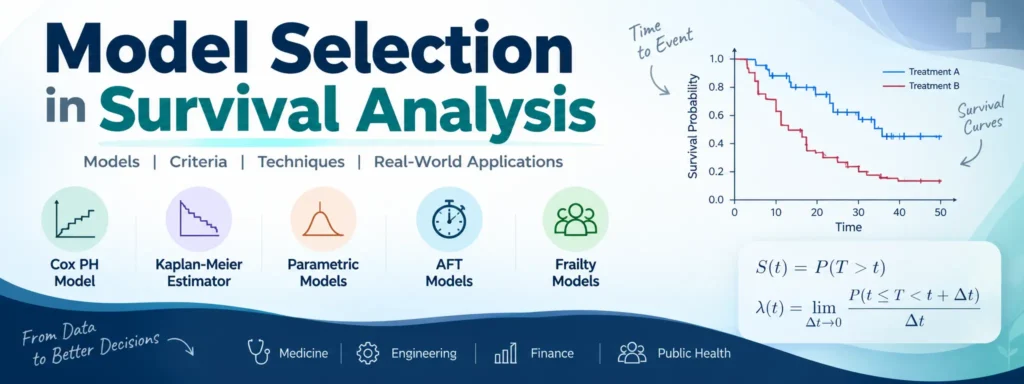
Survival analysis is a subfield of statistics that focuses on analyzing the time until one or more specific events occur, such as disease recurrence, machine failure, or death. Unlike traditional time-series or longitudinal methods, survival analysis can handle censored data, where the event of interest has not occurred for every individual by the end of the study period.
Two central concepts in survival analysis are:
- Survival Function (S(t)): The probability that an individual survives beyond a specific time t.
- Hazard Function (λ(t)): The instantaneous risk of an event occurring at time t, given that the individual has survived up to that point.
Among the different statistical models available, the Cox Proportional Hazards (PH) Model is one of the most widely used because of its flexibility and interpretability. Survival analysis is extensively applied in medicine, engineering, finance, and public health to predict event occurrence, evaluate risks, and support decision-making even when data is incomplete.
Complete Advance AI Topics: Click Here
SQL Tutorial: Click Here
Common Models in Survival Analysis
1. Cox Proportional Hazards Model (Cox PH)
The Cox Proportional Hazards model is a semi-parametric model in which the baseline hazard function does not need to be explicitly specified. It assumes that covariates have a multiplicative effect on the hazard and that these effects remain proportional over time.
Strength: Flexible and widely applicable.
Limitation: It relies on the proportional hazards assumption, which may not always hold.
2. Kaplan-Meier Estimator
The Kaplan-Meier estimator is a non-parametric method used to estimate the survival function from data containing censored observations. It produces a step-wise survival curve and is commonly used to compare survival between different groups, often together with statistical tests such as the log-rank test.
3. Parametric Models
Parametric survival models assume that survival times follow a particular probability distribution. Common examples include Weibull, exponential, and log-normal models.
Strength: They can provide accurate predictions when the selected distribution closely matches the observed data.
Use Case: Clinical trials and reliability testing.
4. Accelerated Failure Time (AFT) Models
Accelerated Failure Time models assume that variables can speed up or slow down the time until an event occurs. Instead of directly modeling the hazard, AFT models focus on the survival time itself.
Strength: Useful when the proportional hazards assumption is not satisfied.
5. Frailty Models
Frailty models introduce random effects to account for unobserved differences between individuals or groups. They are particularly useful when observations are clustered or when repeated events occur.
Use Case: Recurrent events and hierarchical or grouped data.
Model Selection Criteria
Choosing an appropriate survival model requires evaluating both its performance and the assumptions it makes. Several important criteria can be considered during model selection.
1. Goodness of Fit
Statistical measures can help compare how well different models fit the available data. Two commonly used criteria are:
- AIC (Akaike Information Criterion): Balances model fit with model complexity.
- BIC (Bayesian Information Criterion): Penalizes model complexity more strongly than AIC.
In general, lower AIC or BIC values indicate a preferable model among the models being compared.
2. Proportional Hazards Assumption
The proportional hazards assumption is essential when using Cox models. It can be assessed using techniques such as:
- Schoenfeld residuals: Used to assess the proportional hazards assumption, including through graphical analysis.
- Log-rank test: Commonly used to compare survival distributions between groups.
If the proportional hazards assumption is violated, alternatives such as AFT models or stratified models may be considered.
3. Interpretability vs. Complexity
A more complex model does not always provide the best practical solution. Simpler models may sacrifice some predictive precision but can be easier to understand and communicate, which is especially important for clinical insights and stakeholder decision-making.
4. Predictive Accuracy
Predictive performance is another important factor when selecting a survival model. Common evaluation approaches include:
- Harrell’s C-Index: Measures how effectively a model ranks individuals according to their survival risk.
- Time-dependent ROC Curves: Analyze model sensitivity and specificity at different points in time.
5. Handling Censored Data
The selected model should be appropriate for the type of censoring present in the dataset. Common types include:
- Right-censoring: The event has not occurred by the end of the observation period.
- Left-censoring: The event occurred before the individual could be observed.
- Interval-censoring: The event is known to have occurred within a particular time interval.
6. Validation Techniques
Validation helps determine whether a model is likely to generalize beyond the data used to develop it. Common techniques include:
- Cross-validation, such as k-fold and leave-one-out validation
- Bootstrap sampling
- External validation using independent datasets
7. Computational Efficiency
Computational efficiency becomes increasingly important when working with large datasets. Complex survival models may require significant computational resources, so scalable algorithms can be useful for practical applications.
8. Domain-Specific Utility
The final model should provide meaningful, contextually relevant, and actionable insights for its intended domain. The requirements may differ depending on whether survival analysis is being used for medical decisions, product lifecycle planning, engineering reliability, or financial risk assessment.
Techniques for Model Selection
1. Stepwise Selection (Forward/Backward)
Stepwise selection methods choose variables based on criteria such as statistical significance or AIC values.
- Forward Selection: Starts with no predictors and progressively adds variables.
- Backward Elimination: Starts with all available predictors and progressively removes less useful variables.
2. Lasso and Ridge Regression
Lasso and Ridge techniques can be useful when working with high-dimensional data.
- Lasso: Shrinks some coefficients to zero, which can perform variable selection.
- Ridge: Shrinks coefficients while retaining all variables and can help handle multicollinearity.
3. Cross-Validation
Cross-validation divides the dataset into training and validation subsets to evaluate model performance and reduce the risk of overfitting. It provides an estimate of how well the model may generalize to new data.
4. Bootstrap Methods
Bootstrap methods repeatedly sample data with replacement to estimate variability and assess model robustness. They can be particularly useful when working with smaller datasets.
5. Likelihood Ratio Tests
Likelihood ratio tests are commonly used to compare nested models. A statistically significant result can indicate that the more complex model provides a better fit than the simpler model.
6. Time-Dependent ROC Curves
Time-dependent ROC curves evaluate model performance at different time points. They are useful when the probability of an event changes over time.
7. Harrell’s Concordance Index
Harrell’s Concordance Index, or C-index, evaluates how well a model orders individuals according to their predicted risk. Values closer to 1 indicate stronger concordance and better predictive discrimination.
Real-World Applications
Cancer Clinical Trials
Survival analysis is widely used in oncology to evaluate treatment effectiveness. For example, researchers can compare survival between patients receiving chemotherapy and those receiving immunotherapy using Kaplan-Meier estimators and Cox models.
Engineering Reliability
Parametric survival models, such as Weibull models, can be used to estimate component lifetimes and support maintenance planning. One example is estimating the expected lifespan of airplane engine components.
Public Health Research
Survival analysis can be used to study the relationship between exposures and the time until a disease develops. For example, researchers can analyze the time to lung cancer development among smokers and non-smokers.
Finance and Economics
Survival analysis can also be applied to financial problems such as default risk, bankruptcy, and employment duration. For example, a bank can use survival analysis to estimate the time until a loan default occurs.
Download New Real Time Projects :- Click here
Conclusion
Survival analysis is a versatile statistical approach for understanding time-to-event data. Selecting the appropriate model is an important part of the analysis and depends on more than statistical metrics such as AIC and C-index.
Factors including model assumptions, interpretability, predictive performance, computational efficiency, validation, and domain-specific requirements should all be considered when selecting a survival model.
By combining statistical and practical considerations, analysts and researchers can select models that provide useful predictive insights while effectively handling censored data and uncertain event timelines.
Keywords: model selection, model selection in machine learning, model selection criteria, model selection methods, model selection in data mining, model selection in Python, survival analysis, survival analysis models, Cox proportional hazards model, Kaplan-Meier estimator, AFT models, parametric survival models, frailty models, Bayesian model selection