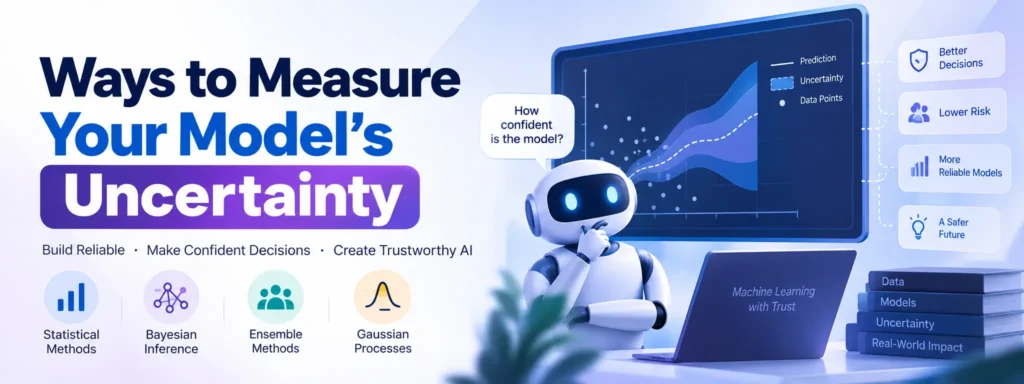
Measure Your Models Uncertainty
Overview
In machine learning, accuracy is not everything. A highly accurate model that cannot communicate how confident it is about its predictions can still lead to poor decisions, especially in critical domains such as healthcare, finance, and autonomous systems. This is why quantifying model uncertainty has become an important part of building reliable and trustworthy machine learning systems.
Model uncertainty represents the level of doubt or variability associated with a model’s predictions. It can arise from several factors, including limited training data, noisy measurements, model design, or unpredictable events. Understanding how confident a model is about a prediction can often be just as important as the prediction itself.
Complete Advance AI Topics: Click Here
SQL Tutorial: Click Here
Why Measuring Model Uncertainty Matters
Understanding and quantifying uncertainty provides several important benefits in machine learning:
- Informed Decision-Making: Provides a clearer understanding of the confidence behind predictions, allowing users to make more cautious and informed decisions.
- Risk Management: Helps identify situations where predictions have high uncertainty and may require human review or additional validation.
- Model Robustness: Helps evaluate how reliable and resilient a model remains under different data conditions.
- Resource Allocation: Identifies areas where collecting additional data or improving the model could provide the greatest benefit.
Types of Uncertainty: Aleatoric vs. Epistemic
Model uncertainty is generally divided into two major categories: aleatoric uncertainty and epistemic uncertainty.
1. Aleatoric Uncertainty (Data Noise)
Aleatoric uncertainty comes from the inherent randomness or noise present in the data. It is generally considered irreducible, meaning that collecting more training data does not completely eliminate it.
Example: Variations in sensor measurements caused by changing environmental conditions.
2. Epistemic Uncertainty (Model Knowledge Gaps)
Epistemic uncertainty occurs because the model has limited knowledge about the underlying problem. Unlike aleatoric uncertainty, it is generally reducible by collecting more representative data or improving the model.
Example: An image classifier trained on a limited or biased dataset may be uncertain or perform poorly when it encounters previously unseen images.
Techniques to Measure Model Uncertainty
1. Statistical Methods
Statistical methods are based on classical statistical techniques and provide relatively interpretable ways to estimate and communicate uncertainty.
Confidence Intervals
Confidence intervals provide a range of plausible values for an estimated parameter, such as a population mean or model performance metric, at a specified confidence level such as 95%.
Use Case: Evaluating model performance metrics or estimating model parameters.
Prediction Intervals
Prediction intervals estimate a range in which future observations are likely to fall. They account for both uncertainty in the model and variability in the underlying data.
Use Case: Time-series forecasting and regression problems.
Bootstrapping
Bootstrapping is a resampling technique in which multiple samples are repeatedly generated from the original dataset, typically with replacement. These samples are used to estimate the variability of model parameters or performance metrics.
- Advantage: It is non-parametric and does not require a specific assumption about the underlying data distribution.
- Use Case: Estimating uncertainty in metrics such as accuracy, AUC, or other model evaluation measures.
2. Bayesian Inference
Bayesian methods provide a probabilistic framework for representing uncertainty. Instead of treating model parameters as fixed values, Bayesian approaches represent them using probability distributions.
Markov Chain Monte Carlo (MCMC)
Markov Chain Monte Carlo methods generate samples from a posterior probability distribution. They are particularly useful when directly calculating the posterior distribution is computationally difficult.
Use Case: Probabilistic programming and parameter estimation in complex models.
Bayesian Neural Networks (BNNs)
Bayesian Neural Networks place probability distributions over neural network weights rather than assigning a single fixed value to each weight. This allows the model to represent uncertainty in its parameters and predictions.
Common Techniques:
- Variational Inference
- Monte Carlo Dropout
Benefits: Bayesian neural networks can provide additional insight into prediction uncertainty while also offering useful regularization effects.
Use Case: Medical diagnosis, autonomous systems, and other applications where prediction confidence is important.
3. Ensemble Methods
Ensemble methods combine predictions from multiple models. Differences between the models’ predictions can provide useful information about uncertainty while often improving overall predictive performance.
Bagging (Bootstrap Aggregating)
Bagging trains multiple models using different bootstrap samples of the training dataset. Their predictions are then combined, usually by averaging for regression or majority voting for classification.
Use Case: Random Forests and other bagging-based algorithms.
Benefit: Reduces variance and can improve model stability.
Random Forests
Random Forests extend the bagging approach by introducing additional randomness when selecting features for individual decision trees. This creates diverse models whose predictions can be combined to produce more stable results.
Strength: Random Forests are relatively easy to use and can provide useful feature-importance information.
Use Case: Classification and regression problems.
Stacking and Blending
Stacking and blending combine predictions from multiple base models using another model, commonly called a meta-model, to produce the final prediction.
- Strength: Can outperform individual models when the base models provide complementary predictions.
- Challenge: Adds complexity and may increase the risk of overfitting if not designed carefully.
- Use Case: Complex applications such as fraud detection and recommendation systems.
4. Gaussian Processes (GPs)
Gaussian Processes provide a powerful Bayesian, non-parametric approach for regression and classification problems. Instead of producing only a single prediction, they can provide a probability distribution over possible outputs.
Key Features:
- Produce a distribution over possible outputs rather than only a point estimate.
- Naturally represent uncertainty using the mean and variance of predictions.
- Use kernel functions to describe relationships and similarities between data points.
Use Cases: Active learning, time-series forecasting, and Bayesian optimization.
Challenge: Gaussian Processes can become computationally expensive on large datasets because of the matrix operations involved.
Practical Considerations
Before selecting a technique for measuring model uncertainty, consider the following factors:
- Data Size: Bootstrapping and Bayesian approaches can benefit from larger and more representative datasets.
- Computational Cost: Methods such as MCMC and Gaussian Processes can require significant computational resources.
- Model Complexity: Ensemble methods are often easier to scale than full Bayesian inference.
- Domain Requirements: High-stakes applications such as healthcare require reliable and interpretable uncertainty estimates.
Real-World Applications
| Domain | Application of Uncertainty Quantification |
|---|---|
| Healthcare | Predicting disease risks and treatment outcomes |
| Finance | Quantifying market risk and portfolio volatility |
| Engineering | Assessing failure probabilities in complex systems |
| Climate Science | Modeling uncertainty in weather and environmental forecasts |
Download New Real-Time Projects:- Click here
Key Takeaways
- Uncertainty is inevitable: Understanding uncertainty makes machine learning models more valuable and actionable.
- Use statistical methods when simplicity and interpretability are important.
- Use Bayesian approaches when detailed probabilistic uncertainty modeling is required.
- Use ensemble methods to combine multiple models and improve stability and predictive performance.
- Use Gaussian Processes when probabilistic predictions and uncertainty estimates are central to the problem.
- Always select an uncertainty estimation technique based on the domain, available data, model requirements, and computational budget.
By integrating uncertainty estimation into your machine learning pipeline, you can improve model trustworthiness and make predictions more useful for smarter and safer decision-making.
Want to Learn More?
Stay updated with the latest developments in machine learning, model interpretability, and AI best practices.
Keywords
uncertainty estimates from classifiers in machine learning, uncertainty estimation in machine learning, uncertainty estimation in deep learning, how do you evaluate the uncertainty of predictions in machine learning models, uncertainty quantification, a survey of uncertainty in deep neural networks, types of uncertainty in AI, predictive uncertainty, ways to measure your model’s uncertainty Python, ways to measure your model’s uncertainty in deep learning, ways to measure your models uncertainty, model uncertainty analysis, model uncertainty definition, two simple ways to measure your models uncertainty model uncertainty, uncertainty estimation in machine learning, uncertainty quantification, predictive uncertainty, machine learning uncertainty, deep learning uncertainty, model uncertainty analysis, uncertainty estimation in deep learning, aleatoric uncertainty,