Clustering in Machine Learning
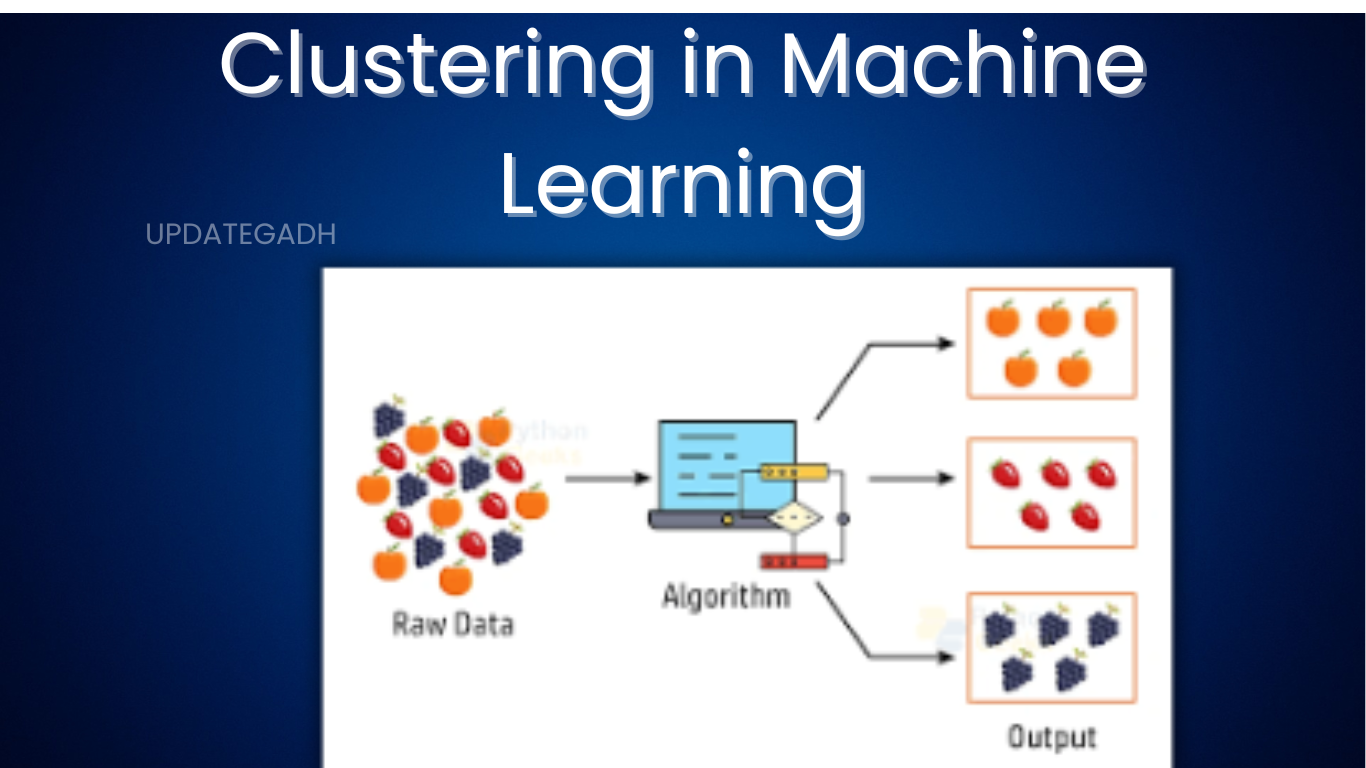
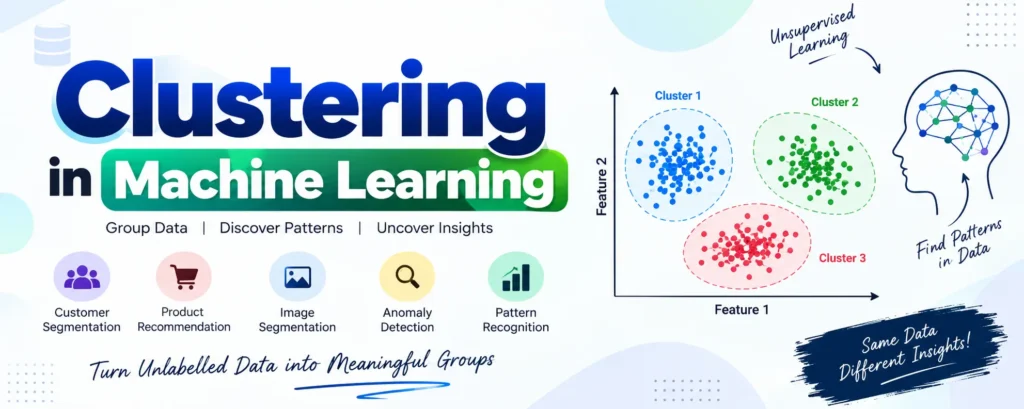
Clustering, also known as Cluster Analysis, is a fundamental machine learning technique used to group unlabelled datasets based on similarities. In simple terms, clustering organizes a collection of data points into different groups, or clusters, where data points within the same group are more similar to each other than to those in other groups.
The clustering process helps identify hidden patterns in data based on characteristics such as shape, size, color, behavior, or other similarities. It is one of the most important techniques in unsupervised learning, where the algorithm works with data that does not have predefined labels.
Complete Advance AI Topics: Click Here
SQL Tutorial: Click Here
Why Clustering?
When clustering is applied to a dataset, each group is assigned a cluster ID. This makes it easier for machine learning systems to organize, analyze, and process large and complex datasets.
Clustering is widely used in statistical data analysis, pattern recognition, image segmentation, social media analytics, and many other applications where discovering natural groups within data is important.
Note: Clustering may appear similar to classification, but both techniques work with different types of datasets.
- Classification uses labelled data.
- Clustering uses unlabelled data.
Real-Life Example: Clustering at the Mall
Imagine visiting a shopping mall. You may find t-shirts, jeans, and accessories arranged in separate sections. Similarly, in the fruit section, apples, bananas, and mangoes are grouped together based on their type.
This type of logical grouping makes it easier for customers to find what they are looking for. Clustering works in a similar way by grouping similar data points together, making complex datasets easier to understand and analyze.
Common Applications of Clustering
Clustering techniques are used across many fields to discover meaningful groups and patterns in data. Some common applications include:
- Market Segmentation
- Statistical Data Analysis
- Social Network Analysis
- Image Segmentation
- Anomaly Detection
Clustering is also used by large technology companies to provide more personalized experiences to users.
- Amazon: Clustering can help identify groups of customers with similar interests and support product recommendations based on their browsing and purchasing behavior.
- Netflix: Clustering can help group users with similar viewing patterns and recommend shows and movies based on their watch history.
Types of Clustering Methods
Generally, clustering techniques can be divided into different categories based on how they assign data points to clusters. Two broad approaches are:
- Hard Clustering: Each data point belongs exclusively to a single cluster.
- Soft Clustering: A data point can have membership in multiple clusters with different probabilities or degrees of membership.
Let’s look at some of the major clustering methods used in machine learning.
1. Partitioning Clustering
Partitioning clustering, also known as centroid-based clustering, divides a dataset into non-overlapping groups. K-Means Clustering is one of the most widely used examples of this approach.
- You define the number of clusters, represented by K.
- Each data point is assigned to the closest cluster center, known as the centroid.
- The objective is to minimize the distance between data points within a cluster while keeping different clusters as separate as possible.
2. Density-Based Clustering
Density-based clustering identifies clusters as dense regions within the data space. Areas with a high concentration of data points form clusters, while sparse regions help separate different clusters.
- Works well with arbitrarily shaped data distributions.
- DBSCAN (Density-Based Spatial Clustering of Applications with Noise) is a popular example.
- It can struggle when clusters have significantly different densities or when working with high-dimensional data.
3. Distribution Model-Based Clustering
Distribution model-based clustering groups data points according to the probability that they belong to a particular statistical distribution, often a Gaussian distribution.
- Expectation-Maximization (EM) with Gaussian Mixture Models (GMM) is a common example.
- It provides more flexibility than K-Means when dealing with overlapping clusters.
4. Hierarchical Clustering
Hierarchical clustering creates a tree-like structure called a dendrogram by repeatedly merging smaller clusters or splitting larger clusters.
- There is no strict requirement to define the number of clusters beforehand.
- The dendrogram can be cut at a selected level to obtain the desired number of clusters.
- Agglomerative Hierarchical Clustering is one of the most commonly used approaches.
5. Fuzzy Clustering
In Fuzzy Clustering, a data point can belong to more than one cluster with different degrees of membership.
- Every data point receives a membership coefficient.
- Fuzzy C-Means is a popular example and can be considered a soft extension of K-Means.
Popular Clustering Algorithms
Different clustering algorithms are designed to work with different types of data distributions and patterns. Some of the commonly used clustering algorithms are discussed below.
K-Means Clustering
- Simple, fast, and efficient for many datasets.
- Requires the number of clusters, K, to be specified in advance.
- Its computational cost depends on factors such as the number of data points, clusters, iterations, and dimensions.
Mean Shift
- A centroid-based clustering technique.
- Moves cluster centers toward regions with the highest density of data points.
- Does not require the number of clusters to be specified beforehand.
DBSCAN
- A density-based clustering algorithm.
- Works well with noise and arbitrarily shaped clusters.
- Does not require the number of clusters to be specified in advance.
Expectation-Maximization Using GMM
- Uses probabilistic models to assign data points to clusters.
- Useful when K-Means is not suitable because clusters overlap or have different characteristics.
Agglomerative Hierarchical Clustering
- Uses a bottom-up approach.
- Initially treats individual data points as separate clusters and progressively merges them.
- Useful when the appropriate number of clusters is not known beforehand.
Affinity Propagation
- Does not require the number of clusters to be defined beforehand.
- Uses message passing between data points to identify representative examples.
- One drawback is its relatively high computational complexity, which can become expensive for large datasets.
Real-World Applications of Clustering
Clustering provides significant value in many real-world scenarios. Some important applications include:
1. Cancer Cell Detection
Clustering can help group and differentiate cancerous and non-cancerous cells based on their characteristics.
2. Search Engines
Search engines can use clustering to group similar search results, helping organize information and improve the relevance of results.
3. Customer Segmentation
Businesses and marketers can use clustering to divide customers into groups based on their buying behavior, preferences, and interests.
4. Biological Research
Clustering can assist researchers in grouping and classifying species using characteristics obtained through image recognition and other forms of biological data.
5. Land Use Classification
GIS systems can use clustering techniques to identify different patterns and suggest land-use types based on geographical data.
Download New Real Time Projects :- Click here
Final Thoughts
Clustering is a flexible and effective technique in the field of unsupervised machine learning. Whether you are developing a recommendation system, analyzing customer behavior, processing images, or studying biological data, clustering can help uncover meaningful structures and patterns within unlabelled datasets.
As machine learning continues to evolve, clustering will remain an important technique for making sense of massive amounts of raw and unstructured data.
Written by Your trusted guide in Machine Learning & Data Science.
Subscribe for more ML insights and tutorials.
Keywords:
clustering in machine learning in hindi, clustering in machine learning python, k-means clustering in machine learning, types of clustering in machine learning, clustering in machine learning examples, hierarchical clustering in machine learning, clustering algorithms in machine learning, partitioning clustering in machine learning, clustering in machine learning, k means clustering in machine learning, hierarchical clustering in machine learning, types of clustering in machine learning, spectral clustering in machine learning, agglomerative clustering in machine learning, density based clustering in machine learning, partitioning clustering in machine learning, k mode clustering in machine learning