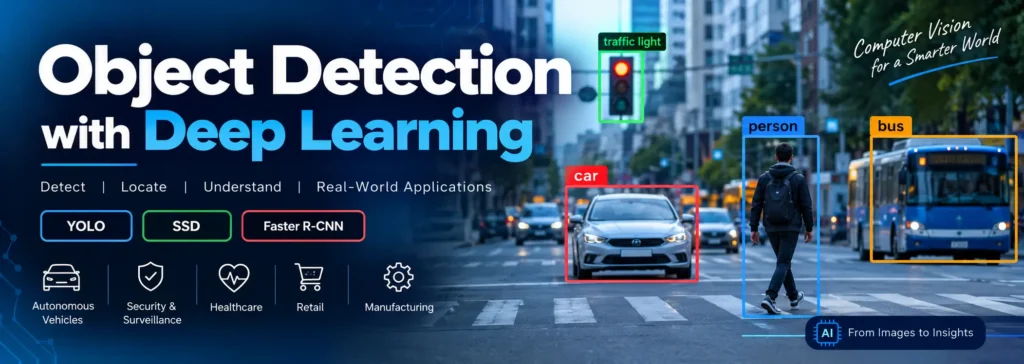
Introduction to Object Detectio
Object detection is an important technology in computer vision. Unlike image classification, which assigns a single label to an entire image, object detection identifies and localizes multiple objects within an image or video. It commonly uses bounding boxes to show the location of each detected object.
This technology powers many real-world applications, including self-driving cars, facial recognition, security systems, healthcare, retail, agriculture, and sports analytics. Deep learning, particularly Convolutional Neural Networks (CNNs), has significantly improved object detection by making highly accurate and real-time detection possible.
Some of the most widely used deep learning frameworks and architectures for object detection include:
- YOLO (You Only Look Once)
- SSD (Single Shot MultiBox Detector)
- Faster R-CNN
These models are trained using large annotated datasets and can detect objects with different sizes, shapes, and orientations.
Complete Advance AI Topics: Click Here
SQL Tutorial: Click Here
Fundamentals of Deep Learning
Deep learning is a branch of machine learning inspired by the structure of the human brain. It uses artificial neural networks to learn patterns and relationships from large amounts of data.
A typical neural network consists of the following layers:
- Input Layer: Receives raw data, such as image pixels.
- Hidden Layers: Perform complex mathematical computations and learn useful patterns.
- Output Layer: Produces the final prediction or result.
The term “deep” refers to the presence of multiple hidden layers. Unlike traditional machine learning approaches that often require manual feature engineering, deep learning can automatically learn useful features directly from raw data.
Common Deep Learning Architectures
- CNNs: Highly effective for image-related tasks such as classification, segmentation, and object detection.
- RNNs: Commonly used for sequence-based tasks, including text processing and time-series analysis.
Training a deep learning model generally involves these steps:
- Forward propagation
- Calculating the error using a loss function
- Backpropagation
- Optimization using techniques such as Stochastic Gradient Descent (SGD)
CNN (Convolutional Neural Network)
Convolutional Neural Networks (CNNs) form the foundation of many modern computer vision and object detection systems. They automatically learn important visual features such as edges, textures, shapes, and patterns from images.
Key Components of CNNs
- Convolutional Layers: Apply filters to images to identify important spatial features.
- Pooling Layers: Reduce the spatial dimensions of feature maps, helping lower computational requirements.
- Fully Connected Layers: Use the extracted features to generate the final prediction.
Advantages of CNNs
- Reduce the need for manual feature engineering.
- Provide high accuracy for many computer vision tasks.
Disadvantages of CNNs
- Often require large labeled datasets.
- Can be computationally expensive to train and run.
R-CNN (Region-based CNN)
R-CNN was one of the early deep learning approaches that achieved strong results in object detection. It was introduced by Ross Girshick and his colleagues in 2014.
R-CNN Architecture
- Selective Search generates possible object region proposals.
- Each proposed region is passed through a CNN to extract features.
- The extracted features are classified using Support Vector Machines (SVMs).
Limitations of R-CNN
- Very slow inference.
- High memory requirements.
- Different components require separate training processes.
Fast R-CNN
Fast R-CNN was introduced in 2015 to improve the speed and efficiency of the original R-CNN approach.
Major Improvements
- The entire image is processed through the CNN only once.
- ROI Pooling converts features from proposed regions into fixed-size feature vectors.
- Classification and bounding-box regression are trained together.
Advantages
- Much faster training than R-CNN.
- Significantly faster inference.
- Improved memory efficiency.
However, Fast R-CNN still relied on Selective Search to generate region proposals, which remained a major bottleneck.
Faster R-CNN
To overcome the region proposal bottleneck, Faster R-CNN introduced the Region Proposal Network (RPN) in 2015.
Faster R-CNN Architecture
- Region Proposal Network (RPN): Replaces Selective Search for generating region proposals.
- Anchor Boxes: Help detect objects with different shapes and sizes.
- End-to-End Training: Allows the detection pipeline to be trained more efficiently.
Advantages of Faster R-CNN
- Faster region proposal generation.
- High object detection accuracy.
- More integrated and trainable detection pipeline.
YOLO (You Only Look Once)
YOLO (You Only Look Once) treats object detection as a single regression problem. Instead of processing individual regions separately, YOLO processes the image in one pass and predicts bounding boxes and class probabilities simultaneously.
Key Highlights of YOLO
- Very fast and suitable for real-time applications.
- Can detect multiple objects in a single image.
Limitations of YOLO
- Earlier YOLO versions could struggle with very small or closely overlapping objects.
- The grid-based detection approach could reduce spatial precision in certain situations.
SSD (Single Shot MultiBox Detector)
SSD (Single Shot MultiBox Detector) is another single-stage object detection approach. Similar to YOLO, it performs detection in a single pass, but it uses multi-scale feature maps to improve the detection of objects with different sizes.
How SSD Works
- Generates default bounding boxes with different aspect ratios.
- Predicts bounding-box offsets and class probabilities.
- Uses Non-Maximum Suppression (NMS) to remove redundant bounding boxes.
Key Strengths of SSD
- Provides a good balance between speed and accuracy.
- Multi-scale feature maps help with detecting objects of different sizes.
Real-World Applications of Object Detection
Autonomous Vehicles
Self-driving systems use object detection to identify pedestrians, vehicles, traffic signs, road elements, and other objects required for safe navigation.
Surveillance and Security
Object detection can be used with CCTV systems to identify intruders, unusual activities, unattended objects, and other security-related events.
Healthcare
In medical imaging, object detection can help locate structures, tumors, fractures, and other abnormalities in medical scans, supporting healthcare professionals during diagnosis.
Retail and Inventory
Retail systems can use computer vision and object detection to recognize products, monitor inventory, and support automated checkout experiences.
Agriculture
Drones and other computer vision systems can use object detection to monitor crops, identify pests, distinguish weeds from crops, and improve agricultural resource management.
Construction
Object detection can help monitor construction sites by identifying equipment, workers, safety hazards, and other important site conditions.
Sports Analytics
Sports organizations can use object detection to track players, identify ball movement, analyze game footage, and support real-time decision-making.
Wildlife Conservation
Object detection can be applied to drone and camera footage to monitor animal populations, track wildlife movement, and assist conservation efforts.
Manufacturing
Manufacturing companies can use computer vision to identify product defects automatically, improve quality control, and reduce errors caused by manual inspection.
Case Studies: Object Detection in Action
Tesla Autopilot
Computer vision systems used in autonomous-driving technology can identify road elements, vehicles, pedestrians, and other objects to support navigation and driving decisions.
Amazon Go
Cashier-less retail systems use cameras and computer vision technologies to understand product interactions and support automated shopping experiences.
Apple Face ID
Face ID uses specialized cameras and machine learning to analyze facial features and create a secure representation of a user’s face for device authentication.
Google Photos
Google Photos uses machine learning and computer vision to recognize objects and other visual information in images, making it easier to organize and search photo collections.
John Deere
Modern agricultural equipment uses computer vision and machine learning to identify crops and weeds, helping farmers optimize agricultural operations and reduce unnecessary resource usage.
Download New Real-Time Projects: Click here
Conclusion
Object detection using deep learning has transformed the way machines understand and interpret visual information. Approaches such as YOLO, SSD, and Faster R-CNN have made accurate object detection practical for a wide range of applications.
From healthcare and agriculture to autonomous vehicles, security, manufacturing, and retail, object detection continues to play an important role in modern computer vision.
As deep learning continues to evolve, object detection systems are becoming increasingly capable of detecting, classifying, and locating objects under challenging conditions. Detecting small, overlapping, or partially visible objects remains an important challenge, while future improvements are expected to make these systems even more accurate and efficient.
Stay tuned for more tutorials and insights into AI, deep learning, and computer vision technologies.
Keywords: object detection using deep learning, object detection with deep learning, deep learning object detection, object detection Python, object detection AI, YOLO object detection, SSD object detection, Faster R-CNN, CNN