Overview of Gaussian Splatting
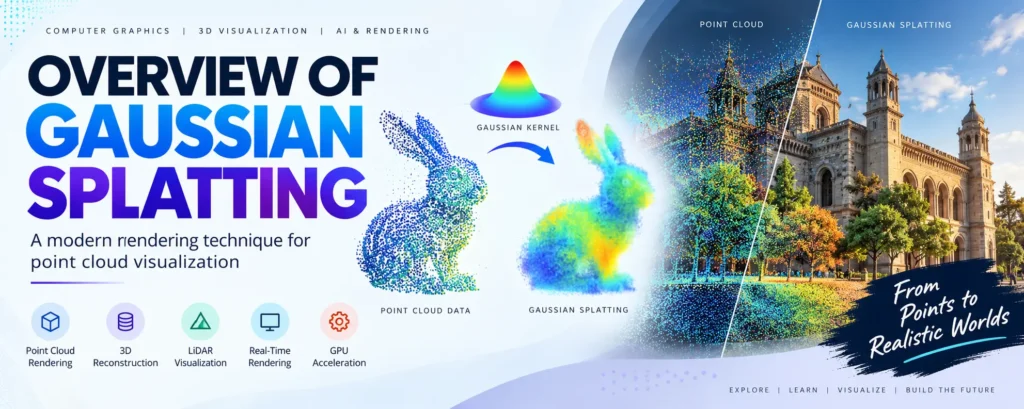
Gaussian splatting is an advanced rendering technique used to visualize point cloud data in computer graphics and scientific visualization. Instead of mapping every 3D point to a single pixel, it distributes the point’s influence across nearby pixels using Gaussian functions.
The spread of each Gaussian is controlled by its standard deviation (σ). This allows the rendered points to blend smoothly, producing a more continuous and visually natural representation of a scene while helping reduce gaps and aliasing.
Gaussian splatting can be useful for applications involving LiDAR scans, 3D reconstruction, geospatial visualization, scientific visualization, and real-time 3D rendering.
Complete Advance AI Topics: Click Here
SQL Tutorial: Click Here
Why Do We Need Splatting Methods?
1. Handling Sparse or Incomplete Data
Point clouds generated through LiDAR scanning or photogrammetry can contain gaps and irregularly distributed points. Conventional point rendering may leave visible spaces between points.
Gaussian splatting spreads each point’s influence across an area, allowing neighboring points to blend together and produce a more continuous visualization.
2. Reducing Aliasing Artifacts
Traditional rendering approaches can produce jagged edges and abrupt transitions, particularly when working with detailed or high-frequency data.
Gaussian splatting uses smooth Gaussian-based blending to reduce these artifacts and create more visually appealing results.
3. Adaptive and Flexible Rendering
Gaussian splatting can represent different point attributes, including color, density, depth, and intensity. This flexibility allows the rendering process to be adapted to different visualization requirements.
For example, attributes can be used to emphasize elevation in terrain visualization or highlight specific characteristics within scientific datasets.
4. Efficiency with Large Datasets
Gaussian splatting can take advantage of GPU parallel processing, making it suitable for handling large amounts of 3D data efficiently.
This makes the technique useful for interactive and real-time applications such as VR/AR, simulations, and live visualization.
5. Use in Scientific and Engineering Domains
Gaussian splatting can be applied across areas such as geospatial analysis, medical visualization, CAD modeling, and scientific simulations, where clear visualization of complex spatial data is important.
Core Concepts in Gaussian Splatting
Point Cloud Initialization
The process starts with a 3D point cloud. Each point generally contains a position represented by coordinates such as (x, y, z), along with additional attributes such as color or intensity.
These points may come from sources such as LiDAR scans, 3D reconstruction systems, or other spatial data-generation methods.
3D-to-2D Projection
Each 3D point is projected onto a 2D image plane using camera information. Camera position, orientation, and projection parameters determine where the point appears in the rendered image.
Splat Shape and Distribution
Instead of representing a point as a single pixel, Gaussian splatting distributes its influence over a small region known as a splat.
The splat can be represented as a Gaussian circle or ellipse centered around the projected point. Its size and shape determine how widely the point influences surrounding pixels.
Weighted Averaging
When multiple splats overlap, their contributions can be combined using Gaussian-based weights. Pixels closer to the center of a splat receive greater influence than pixels farther away.
This weighted approach creates smoother transitions between neighboring points.
Gaussian Kernel Function
The Gaussian kernel controls the distribution and intensity of each splat. A wider kernel produces a broader influence and a softer appearance, while a narrower kernel creates a more concentrated and sharper representation.
Rendering Pipeline
Gaussian splatting is incorporated into the rendering process between 3D point projection and final image composition. Modern GPU architectures can efficiently process many splats in parallel, supporting interactive rendering workflows.
Gaussian Splatting: Step-by-Step Algorithm
- Selection: Choose a point cloud containing 3D coordinates such as
(x, y, z)and attributes such as color(r, g, b). Define the required camera parameters. - Projection: Project every 3D point onto the 2D image plane to obtain screen-space coordinates such as
(u, v). - Gaussian Splatting: Create a Gaussian kernel around each projected point and distribute its attributes across surrounding pixels.
- Accumulation: Combine the contributions from all visible points and their corresponding splats on the image plane.
- Output Generation: Compose the final image using the accumulated contributions for each pixel.
- Optimization: Use GPU-based parallel processing to improve rendering performance, particularly for large point clouds and interactive applications.
Benefits of Gaussian Splatting
Smooth Transitions
Gaussian splatting distributes point influence gradually rather than creating sharp pixel boundaries. This produces smoother and more cohesive visual results.
Anti-Aliasing Support
The blending behavior of Gaussian splats helps reduce visible aliasing artifacts, making the technique useful for high-quality visualization.
Attribute Flexibility
Point clouds can contain multiple attributes, including color, depth, and intensity. Gaussian splatting provides a flexible way to represent these attributes during rendering.
High Efficiency
Because the technique can be optimized for GPU processing, Gaussian splatting is well suited to applications that require a balance between rendering quality and performance.
YT:- DecodeIT
Consistent Data Representation
Gaussian splatting helps maintain spatial relationships and attribute information across the rendered scene, making it useful for areas such as GIS, medical visualization, and scientific simulations.
Comparison with Other Rendering Techniques
| Technique | Smoothness | Aliasing Control | Real-Time Suitability | GPU Optimization | Best Use Case |
|---|---|---|---|---|---|
| Gaussian Splatting | High | Excellent | Yes | Excellent | Sparse point clouds and real-time visualization |
| Point-Based Rendering | Low | Poor | Yes | Good | Simple point cloud data |
| Depth Buffering | Medium | Medium | Yes | Excellent | Polygonal models |
| Volumetric Rendering | High | Good | Depends | Moderate | Dense volume data |
| Ray Tracing | High | Good | Limited | High | Complex lighting and realistic rendering |
Final Thoughts
Gaussian splatting provides an effective approach for rendering and visualizing complex 3D point cloud data. By spreading each point’s influence through Gaussian functions, it can produce smooth visual results while reducing gaps and aliasing artifacts.
The combination of visual quality, performance, and flexible attribute representation makes Gaussian splatting useful for sparse, noisy, and complex 3D datasets.
As applications such as autonomous driving, digital twins, scientific visualization, and real-time 3D systems continue to work with large amounts of spatial data, Gaussian splatting offers a valuable approach to modern 3D rendering.
For developers, designers, and researchers working with data visualization, computer graphics, and real-time 3D rendering, understanding Gaussian splatting can provide useful insight into modern rendering techniques.
Keywords: Gaussian splatting, Gaussian splatting paper, Gaussian splatting example, Gaussian splatting tutorial, 4D Gaussian splatting, Gaussian splatting vs photogrammetry, Gaussian splatting online, Gaussian splatting Python, 2D Gaussian splatting