Supervised and Unsupervised Learning
Supervised and Unsupervised Learning are two important approaches in the field of Machine Learning. Although both are part of ML, they are used for different purposes depending on the dataset and the type of problem being solved. In this blog by Updategadh, we will understand how these two learning methods work, what makes them different, and where they are commonly used, along with examples and a clear comparison.
Complete Advance AI Topics: Click Here
SQL Tutorial: Click Here
What is Supervised Machine Learning?
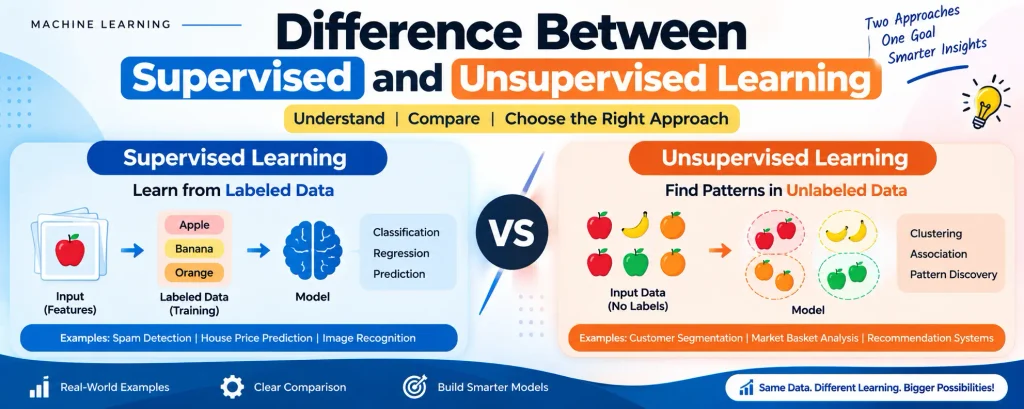
Supervised Learning is a machine learning approach in which a model is trained using a labeled dataset. This means the expected output is already available for each input. The model learns the relationship between the inputs (X) and outputs (Y), allowing it to predict an appropriate output when new data is provided.
In simple terms, it is similar to teaching a student using answer keys. The model learns with guidance or supervision, which is why it is called supervised learning.
Applications of Supervised Learning:
- Classification Problems (e.g., Spam Detection, Image Recognition)
- Regression Problems (e.g., House Price Prediction, Weather Forecasting)
Example:
Suppose you have a dataset containing images of different fruits such as apples, bananas, and oranges. The dataset includes features like color, size, and shape. In supervised learning, you provide both the input (fruit features) and the output (fruit name). The model learns from these examples and can then classify new fruit images after training.
What is Unsupervised Machine Learning?
Unsupervised Learning works differently because the model is trained using data that does not contain labeled outputs. Instead of being told what the correct answer is, the system tries to discover patterns and structures within the input data on its own.
It is similar to giving a child a collection of toys without explaining what each toy is. Over time, the child may group the toys according to similarities such as color, shape, or function.
Applications of Unsupervised Learning:
- Clustering (e.g., Customer Segmentation, Market Research)
- Association (e.g., Market Basket Analysis, Recommendation Engines)
Example:
Let’s take the same fruit dataset, but this time there are no labels. The unsupervised model will try to group the fruits according to their similarities. For example, it may place round red fruits in one group and long yellow fruits in another, without actually knowing the names of the fruits such as apple or banana.
Key Differences: Supervised vs Unsupervised Learning
The following table highlights the main differences between these two machine learning approaches:
| Supervised Learning | Unsupervised Learning |
|---|---|
| Trained using labeled data | Trained using unlabeled data |
| Requires supervision during training | Does not require supervision |
| Learns to predict outputs | Learns to identify patterns |
| Both input and output data are provided | Only input data is provided |
| Used for Classification and Regression | Used for Clustering and Association |
| Goal: Predict an outcome for new data | Goal: Discover hidden structures in the data |
| Generally more accurate and controlled | Can be less accurate, but offers more flexibility |
| Closer to traditional learning methods | Closer to true Artificial Intelligence |
| Examples: Linear Regression, Decision Trees, SVM | Examples: K-Means, Apriori, Hierarchical Clustering |
| Needs a training phase with outputs | Learns by observing input features only |
Download New Real Time Projects :- Click here
Conclusion
Both Supervised and Unsupervised Learning are useful approaches in machine learning, but which one you choose depends mainly on the nature of your data and the objective of your problem.
- If you have labeled data and a clearly defined output, Supervised Learning is the suitable choice.
- If you want to discover unknown patterns and do not have labeled data, Unsupervised Learning provides greater flexibility.
At Updategadh, we recommend selecting the right approach by considering the structure, availability, and scale of your dataset. Understanding the difference between these two methods is important for anyone interested in data science, artificial intelligence, or advanced analytics.
Explore more ML concepts and project tutorials only at Updategadh — Where Learning Meets Innovation!
supervised and unsupervised learning examples
supervised and unsupervised learning and reinforcement learning
difference between supervised and unsupervised learning and reinforcement learning
difference between supervised and unsupervised learning with examples
supervised and unsupervised learning diagram
supervised and unsupervised learning in ai
difference between supervised and unsupervised learning class 10
semi supervised learning
reinforcement learning
supervised and unsupervised learning difference
supervised and unsupervised learning in hindi