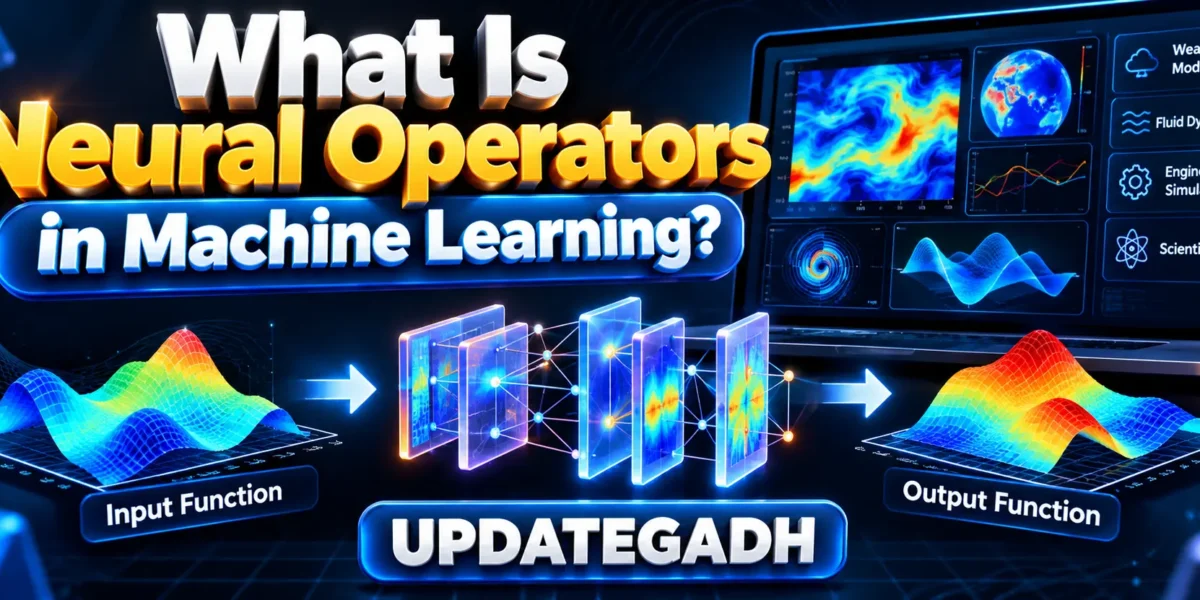
What Is Neural Operators in Machine Learning
Machine learning has traditionally focused on learning relationships between individual inputs and outputs. However, many real-world scientific and engineering problems involve something more complex: mapping an entire function to another function. This is where Neural Operators come into the picture.
Neural Operators are an emerging machine learning approach designed to learn mappings between functions. They are particularly useful for scientific computing, physics-based simulations, weather forecasting, fluid dynamics, engineering systems, and other problems where the output is not simply a single value but an entire field or function.
Unlike conventional neural networks that generally operate on fixed-dimensional data, neural operators aim to learn relationships that can work across different discretizations and resolutions. This makes them an important research direction for combining machine learning with numerical simulation and scientific computing.
Complete Advance AI Topics: Click Here
Real Time Projects on YouTube:- DecodeIT
What Are Neural Operators?
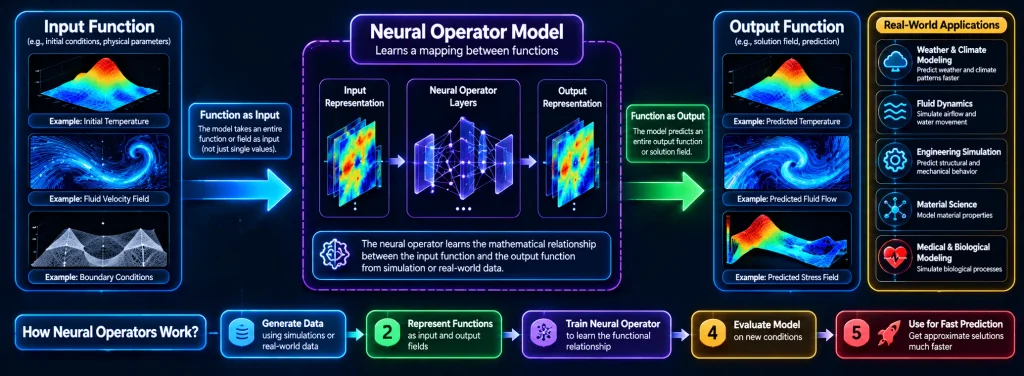
A Neural Operator is a machine learning model that learns an operator, meaning a mathematical mapping that takes one function as input and produces another function as output.
For example, consider a physical system where the input describes properties such as temperature, pressure, material characteristics, or boundary conditions. Instead of predicting one numerical result, a neural operator can learn to predict an entire solution field associated with that system.
In simple terms:
Traditional Machine Learning: Input → Output
Neural Operator: Input Function → Output Function
This distinction makes neural operators especially interesting for problems governed by partial differential equations (PDEs) and other mathematical models.
Why Are Neural Operators Important?
Scientific simulations can be computationally expensive. Numerical methods may need to perform many calculations across a spatial or temporal grid before producing a solution. When the same type of simulation needs to be repeated many times, the computational cost can become significant.
Neural operators attempt to learn the underlying mapping from previously generated examples. After training, the model can potentially produce approximate solutions much faster than repeatedly running the original numerical simulation.
This creates an interesting workflow where traditional scientific computing can be combined with machine learning. Numerical solvers can provide training data, while neural operators can learn an approximation of the solution process.
How Do Neural Operators Work?
The basic idea behind a neural operator is to learn the relationship between an input function and an output function from a collection of examples.
Suppose a scientific problem has many different input conditions. A traditional simulator can generate the corresponding solutions. These input-output pairs can then be used to train a neural operator.
The general process can be described as:
- Define the scientific or mathematical problem.
- Generate training examples using simulations or observed data.
- Represent the input and output functions.
- Train a neural operator to learn the functional relationship.
- Evaluate the model on previously unseen conditions.
- Use the learned operator for faster prediction or simulation.
The important concept is that the model is not only learning values at individual points. It is attempting to learn a broader functional relationship.
Neural Networks vs Neural Operators
Neural networks and neural operators are closely related because neural operators can be constructed using neural network components. However, their objectives are different.
| Aspect | Neural Networks | Neural Operators |
|---|---|---|
| Primary Goal | Learn relationships between data points | Learn mappings between functions |
| Input | Vectors, images, sequences, or structured data | Functions or fields |
| Output | Values, classes, sequences, or predictions | Functions or solution fields |
| Typical Applications | Computer vision, NLP, classification, prediction | Scientific simulation and physical systems |
| Resolution Flexibility | Often dependent on the input representation | Can be designed to work across different discretizations |
This does not mean neural operators replace conventional neural networks. Instead, they address a different class of problems where functional relationships are important.
Types of Neural Operators
Several neural operator architectures have been proposed in research. Different approaches use different mathematical and neural network techniques to learn operators.
Fourier Neural Operator
The Fourier Neural Operator (FNO) is one of the most widely discussed neural operator architectures. It uses Fourier transformations to represent information in the frequency domain.
The model learns important frequency components of the underlying function and uses them to approximate the desired mapping. Fourier-based operations can be particularly useful for problems involving spatial patterns and physical fields.
Deep Operator Network
Deep Operator Networks, commonly called DeepONets, use a structure designed specifically for learning operators. A DeepONet generally contains separate components that process the input function and the location or coordinate where the output is required.
This architecture provides a flexible way to approximate mappings between functions and has been explored for various scientific machine learning applications.
Other Neural Operator Approaches
Research in this area has also produced other approaches based on graph-based methods, kernels, attention mechanisms, and different forms of spectral representations. The field continues to evolve as researchers investigate more efficient and accurate ways to learn complex operators.
Applications of Neural Operators
Neural operators are mainly associated with scientific machine learning, but their potential applications cover several important areas.
Weather and Climate Modeling
Weather and climate systems involve large-scale physical processes that are computationally expensive to simulate. Neural operators can be explored for learning approximations of these complex dynamics and potentially accelerating certain simulation workflows.
Fluid Dynamics
Fluid dynamics is another major application area. Problems involving airflow, water movement, turbulence, and other fluid behavior can often be represented using mathematical equations. Neural operators can learn mappings between physical conditions and resulting fluid fields.
Engineering Simulation
Engineers frequently use simulations to understand how structures and systems behave under different conditions. Neural operators can potentially provide faster approximations for repeated simulation tasks.
Material Science
Material properties and physical responses can depend on complex variables. Neural operator methods can be investigated for modeling relationships between material characteristics and resulting physical behavior.
Medical and Biological Modeling
Biological systems can involve spatial and temporal processes that are difficult to model directly. Neural operators provide a potential machine learning framework for learning these functional relationships from simulation or observational data.
Advantages of Neural Operators
One of the main advantages of neural operators is their ability to learn mappings between functions rather than simply predicting individual values.
- Fast Approximation: Once trained, a neural operator can potentially provide solutions much faster than repeatedly running expensive simulations.
- Scientific Applications: They are naturally suited to problems involving physical laws, differential equations, and continuous fields.
- Resolution Flexibility: Some neural operator architectures can generalize across different discretizations or resolutions.
- Reusable Models: A trained operator can potentially be reused for multiple input conditions within the learned problem domain.
- Machine Learning and Simulation: They provide a bridge between deep learning and traditional numerical methods.
Challenges of Neural Operators
Despite their potential, neural operators are not a universal replacement for traditional numerical solvers. They also introduce several challenges.
Training Data: High-quality simulation or experimental data can be expensive to generate.
Generalization: A model trained within a particular physical regime may not perform reliably outside the conditions represented in its training data.
Accuracy: Scientific applications can require extremely accurate results, making validation an important part of the development process.
Computational Requirements: Training large neural operator models can itself require substantial computational resources.
Physical Consistency: Predictions need to be evaluated carefully to determine whether they respect important physical constraints and relationships.
Neural Operators and Scientific Machine Learning
Neural operators are an important part of the broader field of Scientific Machine Learning. This field focuses on combining machine learning with scientific knowledge, mathematical models, numerical methods, and physical laws.
Instead of treating machine learning as an isolated prediction system, scientific machine learning attempts to use data-driven methods alongside established scientific approaches.
Neural operators fit naturally into this idea because many scientific problems can be expressed as mappings between functions. They can therefore provide a machine learning-based approximation of complex computational processes.
Are Neural Operators the Future of Scientific Simulation?
Neural operators are receiving significant attention because they address a fundamental limitation of conventional machine learning approaches: many scientific problems are naturally defined over continuous spaces rather than fixed sets of input features.
However, their practical use depends on factors such as training data, accuracy requirements, computational resources, problem complexity, and validation. In many applications, neural operators are more likely to complement traditional numerical methods rather than completely replace them.
As research continues, improvements in architecture, training methods, physical constraints, and computational efficiency could make neural operators increasingly useful for scientific and engineering workflows.
Final Thoughts
Neural Operators represent an important development in modern machine learning, particularly for scientific and engineering applications. Their main objective is to learn mappings between functions, making them different from conventional models that generally learn mappings between fixed-dimensional inputs and outputs.
From fluid dynamics and climate modeling to engineering simulations and material science, neural operators provide a promising framework for accelerating computationally expensive tasks. Approaches such as Fourier Neural Operators and DeepONets demonstrate how deep learning can be combined with mathematical concepts to address complex scientific problems.
Keywords: What Is Neural Operators in Machine Learning, Neural Operators, Neural Operators in Machine Learning, Neural Operators in Machine Learning, Neural Operators in Machine Learning, Neural Operators in Machine Learning, Neural Operator Machine Learning, Fourier Neural Operator, DeepONet, Neural Operators in Machine Learning, Scientific Machine Learning, Neural Operators Applications, Machine Learning, Neural Operators in Machine Learning, Neural Operators in Machine Learning, Neural Operators in Machine Learning, Neural Operators in Machine Learning,Neural OperatorsNeural Operators in Machine LearningNeural Operator Machine Learning Neural Operators in Machine Learning, Neural Operators in Machine Learning, Neural Operators in Machine Learning,What Are Neural OperatorsNeural OperatorFourier Neural OperatorFourier Neural OperatorsDeepONetNeural Operator ArchitectureNeural Operator ApplicationsOperator LearningScientific Machine LearningScientific AIMachine LearningDeep, Neural Operators in Machine Learning