Machine Learning Algorithms
In today’s data-driven world, Machine Learning (ML) has become the foundation of many intelligent systems. From voice assistants and recommendation platforms to medical diagnostics and autonomous vehicles, machine learning helps computers learn from data, identify patterns, make predictions, and improve their performance without being explicitly programmed for every situation.
Machine learning algorithms are the core techniques that make this possible. They analyze large datasets, recognize useful patterns, and support accurate predictions and decisions. Whether you are predicting house prices, filtering spam emails, or detecting fraudulent transactions, selecting the right machine learning algorithm is an important part of building an effective ML solution.
In this article, we will explore the most popular machine learning algorithms, their major categories, and their common real-world applications in a simple and easy-to-understand way.
Complete Advance AI Topics: Click Here
SQL Tutorial: Click Here
Types of Machine Learning Algorithms
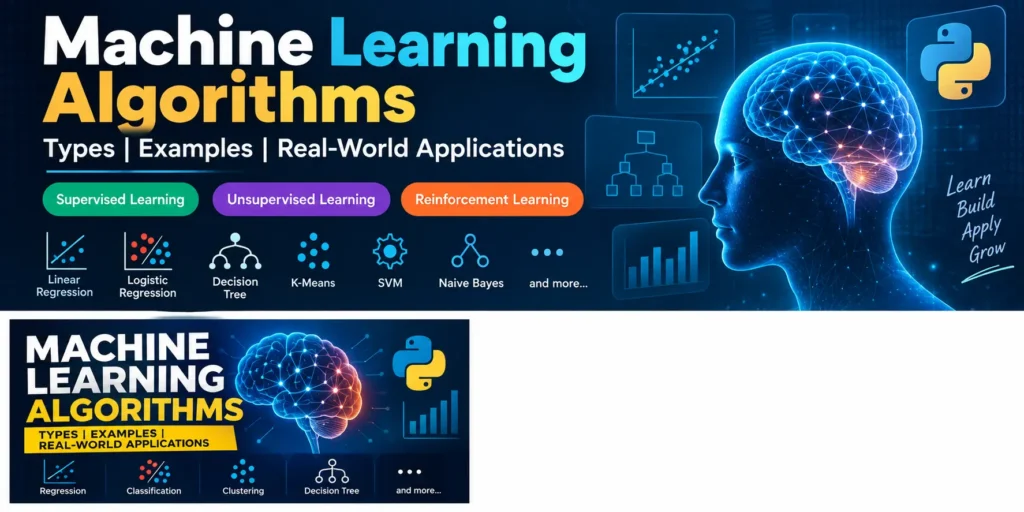
Machine learning algorithms can broadly be divided into three primary categories:
- Supervised Learning
- Unsupervised Learning
- Reinforcement Learning
Let’s understand each category in detail.
1. Supervised Learning Algorithms
Supervised learning involves training a machine learning model using labelled data. In this type of learning, each input has a known output or target value. The algorithm learns the relationship between inputs and outputs during training and then uses that knowledge to make predictions on new data.
It can be compared to learning under the guidance of a teacher, where examples are provided along with their correct answers.
Supervised learning is mainly used for:
- Classification: Predicting categories, such as whether an email is spam or not spam.
- Regression: Predicting continuous values, such as house prices.
Popular supervised learning algorithms include:
- Linear Regression
- Logistic Regression
- Decision Trees
- K-Nearest Neighbors (KNN)
- Support Vector Machines (SVM)
2. Unsupervised Learning Algorithms
Unsupervised learning works with unlabelled data. Unlike supervised learning, the algorithm is not given predefined output values. Instead, it attempts to discover hidden patterns, relationships, groups, or structures within the dataset.
Unsupervised learning is commonly used for:
- Clustering: Grouping similar data points, such as customer segmentation.
- Association: Discovering relationships between items, such as products frequently purchased together.
Popular unsupervised learning algorithms include:
- K-Means Clustering
- Apriori Algorithm
- Principal Component Analysis (PCA)
3. Reinforcement Learning
Reinforcement learning is based on an agent interacting with its environment and learning through trial and error. The agent receives rewards for desirable actions and penalties for undesirable actions. Over time, it adjusts its strategy to make better decisions.
This approach is useful when an algorithm needs to learn a sequence of actions rather than simply predict an output from a given input.
Popular reinforcement learning algorithm:
- Q-Learning
Top Machine Learning Algorithms Explained Simply
Let’s now look at some of the most widely used machine learning algorithms, what they do, and where they are commonly applied.
1. Linear Regression
Used for: Predicting continuous values
Linear Regression is a supervised learning algorithm that identifies the relationship between a dependent variable and one or more independent variables. It attempts to fit a straight line through the data that best represents the relationship between the variables.
Basic formula:
y = a0 + a*x + bWhere:
yis the predicted outputxis the inputa0is the interceptarepresents the slope
Use Cases: Salary prediction, real estate price prediction, and sales forecasting.
2. Logistic Regression
Used for: Classification problems
Despite its name, Logistic Regression is mainly used for classification tasks. It predicts categorical outcomes such as Yes/No, 0/1, or Pass/Fail.
The algorithm uses the logistic function, also known as the sigmoid function, to convert predictions into probabilities between 0 and 1.
Use Cases: Spam detection, medical diagnosis, and customer churn prediction.
3. Decision Tree
A Decision Tree is a tree-based machine learning model that divides data using a series of decision rules. Each internal node represents a feature or condition, branches represent possible decisions, and leaf nodes represent the final outcomes.
Decision Trees are relatively easy to understand because their decision-making process can be represented as a series of questions and answers.
Use Cases: Loan approval systems, medical diagnostics, and recommendation systems.
4. Support Vector Machine (SVM)
Support Vector Machine (SVM) is a powerful machine learning algorithm used for both classification and regression tasks. For classification, it attempts to find the best decision boundary, or hyperplane, that separates different categories of data.
Use Cases: Face recognition, text classification, and bioinformatics.
5. Naive Bayes
Naive Bayes is a probabilistic machine learning algorithm based on Bayes’ Theorem. It makes a simplifying assumption that the features are conditionally independent of one another.
Despite this assumption, Naive Bayes can perform very well on many practical classification problems.
Formula:
P(A|B) = (P(B|A) * P(A)) / P(B)Use Cases: Email spam filtering, sentiment analysis, and document classification.
6. K-Nearest Neighbors (KNN)
K-Nearest Neighbors (KNN) is a simple machine learning algorithm that makes predictions based on nearby data points. It is often described as a lazy learner because it does not build an explicit model during the training phase.
When a new data point is provided, KNN identifies the K nearest data points and uses their labels or values to make a prediction.
Common distance metrics include:
- Euclidean Distance
- Manhattan Distance
- Minkowski Distance
- Hamming Distance
Use Cases: Image recognition, recommendation systems, and handwriting recognition.
7. K-Means Clustering
K-Means is an unsupervised learning algorithm used to divide data into K clusters based on similarity.
Each cluster has a central point called a centroid. The algorithm repeatedly assigns data points to clusters and updates the centroids to minimize the distance between data points and their respective cluster centers.
Use Cases: Customer segmentation, anomaly detection, and organizing computing clusters.
8. Random Forest
Random Forest is an ensemble machine learning method that combines the predictions of multiple decision trees to improve overall performance.
For classification tasks, each decision tree produces a prediction, and the final result is generally determined using majority voting.
Because it combines multiple trees, Random Forest can provide more robust predictions than relying on a single decision tree.
Use Cases: Fraud detection, predictive maintenance, and stock price forecasting.
9. Apriori Algorithm
The Apriori Algorithm is a rule-based technique commonly used for association rule mining. It identifies frequently occurring itemsets in datasets and uses them to discover relationships or associations between different items.
Use Cases: Market basket analysis, product recommendations, and healthcare diagnostics.
10. Principal Component Analysis (PCA)
Principal Component Analysis (PCA) is a dimensionality reduction technique used to simplify datasets containing a large number of variables.
PCA transforms high-dimensional data into a smaller number of dimensions while attempting to retain as much important information as possible. This can make complex datasets easier to visualize, analyze, and process.
Use Cases: Image compression, gene expression analysis, and pattern recognition.
Download New Real-Time Projects: Click here
Final Thoughts
Machine learning algorithms form the foundation of many modern AI and data-driven systems. Different algorithms are designed for different types of problems, datasets, and prediction tasks.
The right algorithm depends on factors such as the type of data, the problem being solved, the required performance, and the desired accuracy. Whether you are building a predictive model, grouping customers, detecting fraud, or automating decisions, understanding the fundamentals of machine learning algorithms is an important first step toward developing intelligent applications.
Stay tuned for more hands-on guides, source codes, and real-world machine learning applications.
Keywords: machine learning algorithms, machine learning algorithms Python, machine learning algorithms list, machine learning algorithms for prediction, machine learning algorithms examples, supervised machine learning algorithms, unsupervised machine learning algorithms, reinforcement learning algorithms, machine learning, deep learning algorithms, machine learning cheat sheet