
Supervised Machine Learning
In the broad world of Artificial Intelligence and Machine Learning, Supervised Learning has an important role. It is one of the most widely used machine learning approaches, where machines are trained using labeled data. This means that the data provided to the model already contains the correct output.
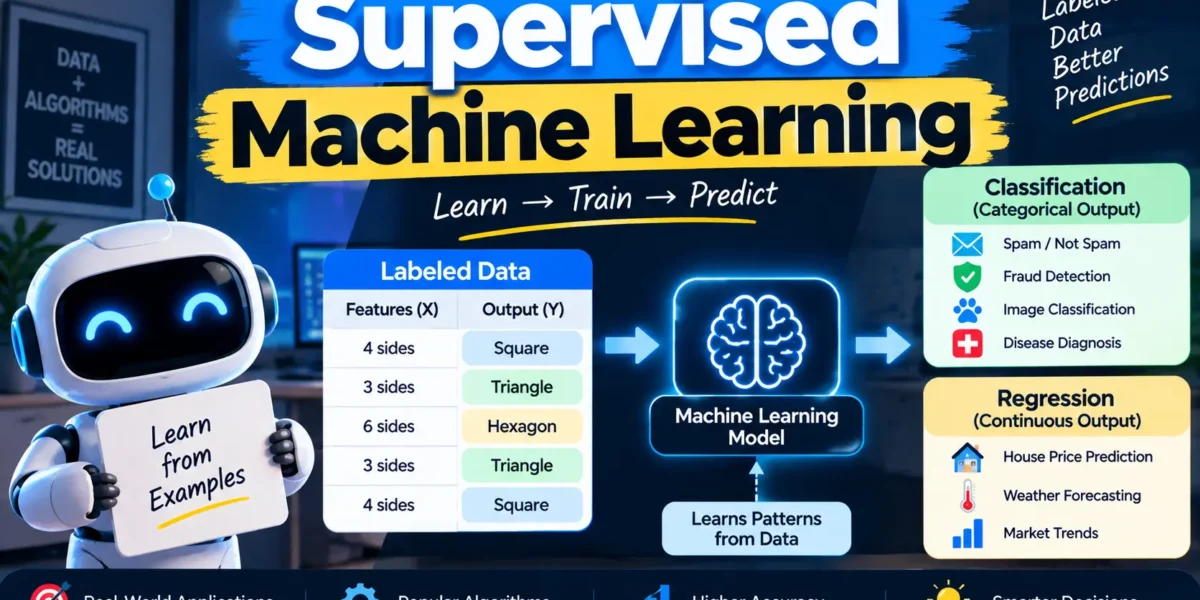
It is similar to the way a student learns with the help of a teacher. In supervised learning, machines learn from existing data and use that knowledge to build a model. The main goal is to create a model that can correctly map input variables (x) to output variables (y) and use this relationship to make predictions about future data.
Complete Advance AI Topics: Click Here
SQL Tutorial: Click Here
What is Supervised Learning?
Supervised Learning is a machine learning approach in which models are trained using a dataset containing both input values and their desired outputs. By studying this data, the model learns patterns and relationships between the variables.
Once the training process is complete, the model is tested using unseen data to check how accurately it can make predictions.
How Does Supervised Learning Work?
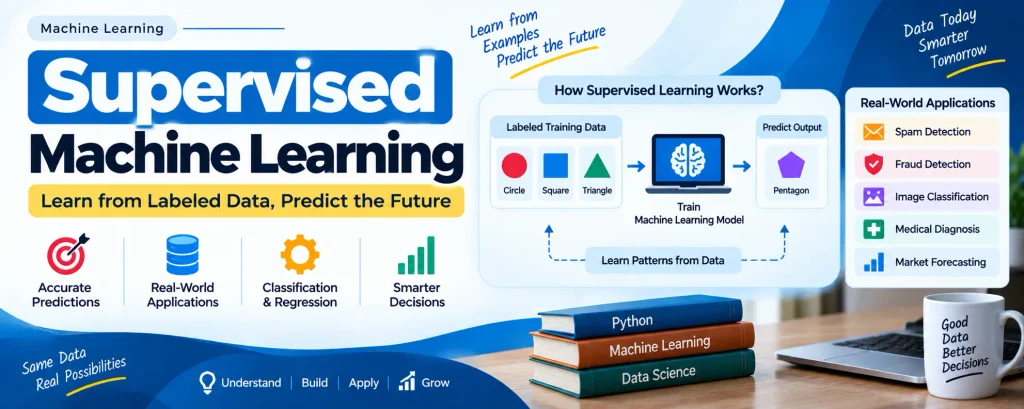
Let’s understand the working of supervised learning step by step:
- A labeled dataset is provided to the machine.
- The machine studies the data and tries to learn the patterns within it.
- After training, the model is given new or unseen test data.
- Using what it learned during training, the model predicts the output for the test data.
Example:
Suppose we want to train a model to recognize different geometric shapes:
- If a shape has four equal sides, label it as a Square.
- If it has three sides, label it as a Triangle.
- If it has six equal sides, label it as a Hexagon.
After learning from these examples, the machine can identify and label a new shape based on the number of sides it contains. This gives us a simple practical example of how supervised learning works.
Steps Involved in Supervised Learning
Here is the step-by-step process generally followed when implementing supervised learning:
- Identify the problem and dataset required for the task.
- Collect properly labeled training data.
- Split the dataset into training, testing, and optionally validation sets.
- Select relevant features (input variables) for the task.
- Choose a suitable algorithm such as Decision Trees, SVM, or Linear Regression.
- Train the model using the training dataset.
- Validate and test the model’s performance using test data.
- Evaluate the accuracy and fine-tune the parameters when required.
Types of Supervised Learning Algorithms
Supervised learning is mainly divided into two types:
1. Regression
Regression algorithms are used when the output variable is a continuous value. They are useful for predicting values such as:
- House prices
- Temperature forecasting
- Market trends
Common Regression Algorithms:
- Linear Regression
- Regression Trees
- Polynomial Regression
- Bayesian Linear Regression
- Non-Linear Regression
2. Classification
Classification is used when the output variable is categorical, meaning it belongs to a specific category such as Yes/No, True/False, or Male/Female.
Use Cases:
- Spam detection
- Fraud detection
- Disease diagnosis
Popular Classification Algorithms:
- Logistic Regression
- Decision Trees
- Random Forest
- Support Vector Machines (SVM)
Advantages of Supervised Learning
- It predicts outputs based on past experiences.
- It provides clear information about the classes of data.
- It is useful in real-world applications such as spam filtering and fraud detection.
- The model’s behavior is generally easier to understand and interpret.
Disadvantages of Supervised Learning
- It requires a large amount of labeled data.
- The training process can be computationally expensive.
- Performance can decrease when test data differs significantly from the training data.
- It may not be ideal for very complex or ambiguous tasks without extensive preprocessing.
Real-World Applications
Supervised learning is more than just a theoretical concept. It powers many of the tools and services we use in everyday life:
- Spam Filters in email services
- Fraud Detection in banking
- Image Classification in security and tagging applications
- Medical Diagnoses based on historical records
- Market Forecasting using past trends
Download New Real Time Projects :- Click here
Final Thoughts From UpdateGadh
Supervised learning plays an important role in many AI systems that we use today. It gives machines a structured way to learn from existing data and make intelligent decisions.
Although supervised learning has its own challenges, its accuracy and usefulness in real-world applications make it an essential part of machine learning.
supervised machine learning algorithms
supervised machine learning examples
unsupervised machine learning
supervised machine learning types
unsupervised machine learning algorithms
semi supervised machine learning
supervised and unsupervised machine learning
supervised machine learning python


This blog has opened my eyes to new ideas and perspectives that I may not have considered before Thank you for broadening my horizons