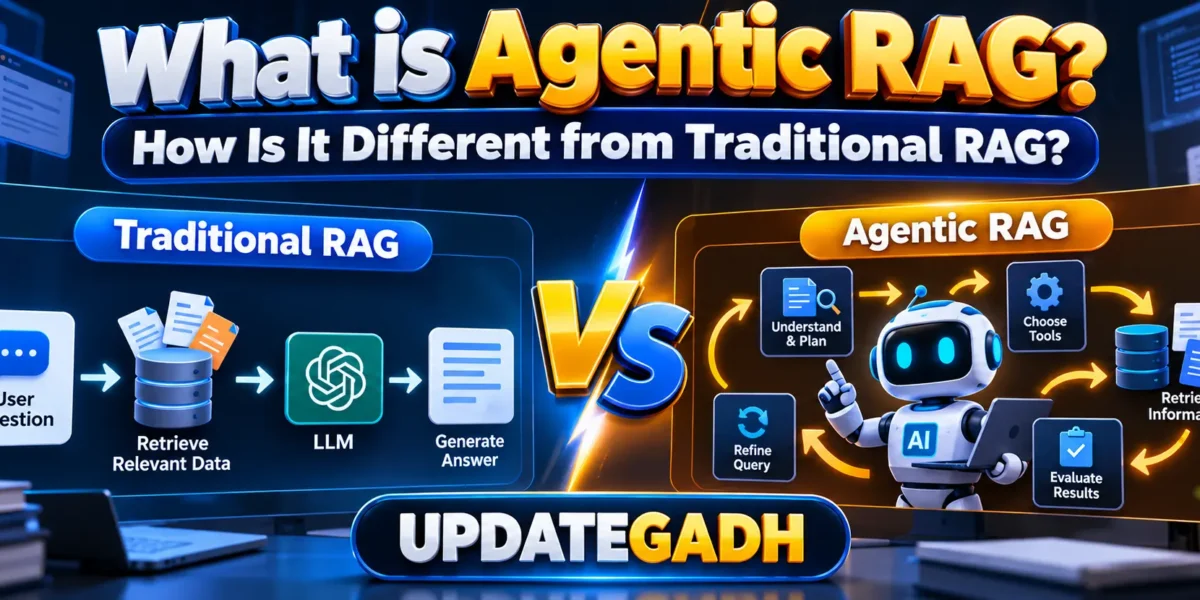
What is Agentic RAG
Artificial Intelligence is moving beyond simple question-answering systems. Modern AI applications are increasingly expected to understand complex questions, search multiple sources, decide which information is useful, and improve their answers before responding. This is where Agentic RAG is becoming an important concept in modern AI development.
Traditional Retrieval-Augmented Generation (RAG) already allows AI models to retrieve information from external databases or documents before generating an answer. Agentic RAG takes this idea further by giving an AI agent control over the retrieval process.
Table of Contents
Complete Advance AI Topics: Click Here
Real Time Projects on YouTube:- DecodeIT
What is RAG?
RAG stands for Retrieval-Augmented Generation. It is an AI architecture that combines information retrieval with a Large Language Model (LLM).
Instead of relying only on information stored in the model’s training data, a RAG system retrieves relevant information from an external knowledge source such as documents, databases, websites, or vector databases.
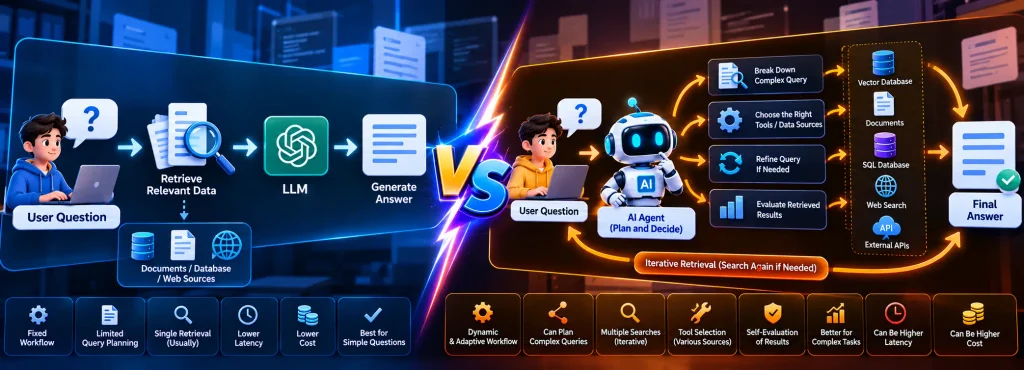
A basic RAG workflow looks like this:
User Question
      ↓
Query Processing
      ↓
Information Retrieval
      ↓
Relevant Documents
      ↓
LLM
      ↓
Generated Answer
For example, if a student asks a college chatbot about its examination rules, the RAG system can search the college documents, retrieve the relevant information, and use it to generate an answer.
What is Agentic RAG?
Agentic RAG is an advanced form of RAG where an AI agent controls the retrieval and reasoning process.
Instead of always following a fixed retrieve-then-generate workflow, the agent can decide what information it needs, which source should be searched, whether the retrieved information is sufficient, and whether another search is required.
The important difference is that retrieval becomes a decision made by the AI agent rather than simply a fixed step in the pipeline.
A simplified Agentic RAG workflow looks like this:
User Question
      ↓
AI Agent
      ↓
Understand and Plan
      ↓
Choose Tool / Data Source
      ↓
Retrieve Information
      ↓
Evaluate Results
      ↓
Enough Information?
   ↙           ↘
 No             Yes
 ↓               ↓
Search Again   Generate Answer
 ↓
Refine Query
 ↓
Retrieve Again
This allows the system to handle questions that require multiple searches, different information sources, query rewriting, or validation.
How Does Agentic RAG Work?
1. Understand the User Query
The agent first analyzes the user’s question and determines what information is required to complete the task.
2. Create a Retrieval Plan
For complex questions, the agent can break the problem into smaller steps. It may determine that information needs to be collected from multiple sources.
3. Select the Appropriate Tool
The agent can choose between different tools or data sources, such as a vector database, SQL database, document collection, API, or web search system.
4. Retrieve Information
The selected retrieval tool searches for relevant information and returns the available context to the agent.
5. Evaluate the Results
The agent can check whether the retrieved information actually answers the question. If the results are incomplete or irrelevant, it can modify the query and search again.
6. Generate the Final Answer
After gathering sufficient evidence, the agent provides a grounded response using the retrieved information.
Traditional RAG vs Agentic RAG
| Feature | Traditional RAG | Agentic RAG |
|---|---|---|
| Workflow | Mostly fixed | Dynamic and adaptive |
| Retrieval | Usually performed as a predefined step | Agent decides when and how to retrieve |
| Query Planning | Limited | Can decompose and plan complex queries |
| Multiple Searches | Usually limited or predefined | Can perform iterative searches |
| Tool Selection | Generally predefined | Agent can select appropriate tools |
| Self-Evaluation | Usually limited | Can evaluate retrieved results |
| Complex Tasks | Best for straightforward questions | Better suited for multi-step tasks |
| Latency | Generally lower | Can be higher because of multiple steps |
| Cost | Usually lower | Can require more tokens and tool calls |
Simple Example of the Difference
Imagine asking an AI system:
“Compare the admission requirements of three universities and tell me which university accepts students with a particular qualification.”
A traditional RAG system might retrieve a fixed number of documents and generate an answer from those results. If important information is missing, the system may still attempt to answer.
An Agentic RAG system can approach the task differently. The agent can break the question into multiple university-specific searches, retrieve the admission requirements, compare the information, identify missing details, perform additional searches, and then generate the final comparison.
This adaptive behavior is one of the main reasons Agentic RAG is useful for complex AI applications.
Key Features of Agentic RAG
- Dynamic Retrieval: The agent decides when retrieval is necessary.
- Query Decomposition: Complex questions can be divided into smaller tasks.
- Query Rewriting: The agent can improve a search query when initial results are poor.
- Multiple Data Sources: Different databases, APIs, documents, or search systems can be used.
- Iterative Retrieval: The system can search multiple times when additional information is required.
- Result Evaluation: Retrieved information can be checked before generating the final response.
- Tool Calling: The agent can select and use different tools according to the task.
Advantages of Agentic RAG
Agentic RAG is particularly useful when an application needs more than a single retrieval operation.
- Handles complex multi-step questions.
- Can combine information from multiple sources.
- Can adapt when the first retrieval attempt fails.
- Supports dynamic tool selection.
- Can improve the quality of retrieved context through iterative searches.
- Useful for enterprise knowledge systems and research applications.
Limitations of Agentic RAG
Agentic RAG is not automatically better for every application. Its additional reasoning and retrieval steps introduce additional complexity.
- Higher latency compared with simple RAG workflows.
- Potentially higher API and token costs.
- More complicated system architecture.
- More difficult testing and evaluation.
- Agent decisions can introduce additional failure points.
- Requires proper access control when agents can use external tools or sensitive data.
When Should You Use Agentic RAG?
Traditional RAG is usually a good choice when users ask straightforward questions and the required information can be found with a single retrieval operation.
Agentic RAG becomes more useful when the application requires:
- Multi-step reasoning
- Multiple document or database searches
- Dynamic source selection
- Query planning
- Information verification
- External API or tool usage
- Complex enterprise research
Agentic RAG in Modern AI Applications
Agentic RAG can be used to build advanced AI systems such as enterprise research assistants, intelligent customer support systems, document analysis platforms, AI-powered knowledge bases, financial research assistants, educational assistants, and internal company copilots.
For example, an enterprise assistant could retrieve information from company documents, check a SQL database, call an internal API, compare the results, and then provide one final answer. The agent determines which steps are necessary instead of following exactly the same retrieval process for every question.
Conclusion
Agentic RAG is an evolution of traditional Retrieval-Augmented Generation. Traditional RAG generally follows a predefined retrieval and generation pipeline, while Agentic RAG introduces an AI agent that can plan, select tools, retrieve information multiple times, evaluate results, and adapt its approach.
Keywords: What is Agentic RAG, Agentic RAG vs Traditional RAG, Agentic RAG architecture, Traditional RAG, Retrieval Augmented Generation, RAG AI, AI agents, Agentic AI, AI retrieval,What is Agentic RAG What is Agentic RAG what is agentic rag vs rag what is agentic rag in ai what is agentic rag system what is agentic rag ibm what is agentic rag weaviate what is agenticrag architecture what is agentic rag pipeline what is agentic rag and code what is agentic rag example,Agentic RAG Agentic RAG agentic rag architecture agentic rag projects agentic rag vs rag agentic rag github agentic rag vs traditional rag agentic rag systems agentic rag means agentic rag for dummies agentic rag github project