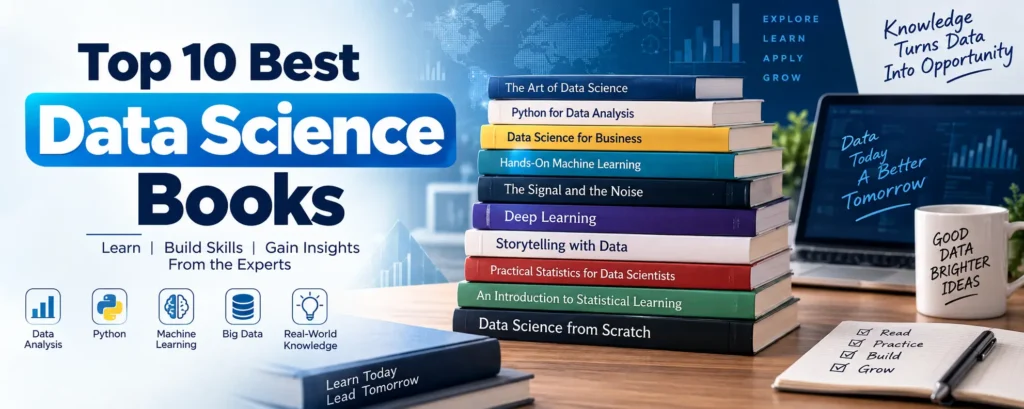
Top 10 Best Data Science Books
Data science is more than working with numbers. It combines statistics, programming, business understanding, critical thinking, visualization, and the ability to communicate insights effectively. In today’s data-driven world, learning from experienced authors and experts can help you build a stronger foundation and develop practical skills.
Whether you are a student, beginner, working professional, or data science enthusiast, the right books can help you understand everything from statistics and Python to machine learning, deep learning, and data storytelling. Here are the top 10 best data science books worth reading.
Table of Contents
Complete Advance AI Topics: Click Here
SQL Tutorial: Click Here
1. The Art of Data Science
By Roger D. Peng and Elizabeth Matsui (2015)
The Art of Data Science focuses on the thinking process behind successful data science projects. Roger D. Peng and Elizabeth Matsui explain that data science is not simply about applying algorithms or writing code. It also requires asking the right questions, understanding context, evaluating results, and communicating findings effectively.
This concise book is especially useful for readers who want to develop better analytical thinking and understand the practical side of working with data.
2. Python for Data Analysis
By Wes McKinney (2017)
Python for Data Analysis is a practical resource for learning how to work with data using Python. Written by Wes McKinney, the creator of the pandas library, the book covers important areas such as data cleaning, manipulation, transformation, analysis, and visualization.
It is a valuable choice for beginners and intermediate learners who want hands-on experience working with real-world datasets and Python-based data analysis tools.
3. Data Science for Business
By Foster Provost and Tom Fawcett (2013)
Data Science for Business explains how data science can be applied to solve business problems and support better decision-making. Instead of focusing only on technical methods, the authors explain why different data science techniques matter in real business environments.
The book is particularly useful for professionals who want to understand the relationship between data, analytics, business strategy, and responsible decision-making.
4. Hands-On Machine Learning with Scikit-Learn, Keras, and TensorFlow
By Aurélien Géron (2019)
Hands-On Machine Learning with Scikit-Learn, Keras, and TensorFlow provides a practical introduction to machine learning and its implementation using popular Python libraries and frameworks.
The book walks readers through important stages of machine learning, including preparing data, training models, evaluating results, improving performance, and working with neural networks. Its practical approach makes it a popular resource for learners who want to move from machine learning concepts to implementation.
5. The Signal and the Noise
By Nate Silver (2012)
The Signal and the Noise explores how data and statistical thinking can be used to make better predictions. Nate Silver examines why forecasts often fail and how meaningful signals can be separated from large amounts of noise.
The book uses examples from areas such as economics, weather forecasting, politics, and other prediction-based fields. It is a useful read for anyone interested in understanding the strengths and limitations of data-driven predictions.
6. Deep Learning
By Ian Goodfellow, Yoshua Bengio, and Aaron Courville (2016)
Deep Learning is a comprehensive resource for readers interested in neural networks and advanced machine learning. Written by Ian Goodfellow, Yoshua Bengio, and Aaron Courville, the book covers important concepts including neural networks, backpropagation, optimization, convolutional networks, and other deep learning techniques.
This book is better suited to readers who already have some knowledge of mathematics, machine learning, and programming and want to explore deep learning in greater depth.
7. Storytelling with Data
By Cole Nussbaumer Knaflic (2015)
Storytelling with Data focuses on one of the most important skills in data science: communicating insights clearly. Cole Nussbaumer Knaflic explains how effective visualization and thoughtful presentation can make complex information easier to understand.
The book provides practical guidance on choosing charts, removing unnecessary visual elements, highlighting important information, and creating presentations that communicate a clear message.
It is useful not only for data scientists but also for analysts, marketers, business professionals, and anyone who regularly works with data.
8. Practical Statistics for Data Scientists
By Peter Bruce, Andrew Bruce, and Peter Gedeck (2020)
Practical Statistics for Data Scientists introduces the statistical concepts that are frequently used in data science. It covers topics such as probability, sampling, regression, statistical experiments, and hypothesis testing.
The book focuses on practical understanding rather than overwhelming readers with mathematical theory. Examples and programming approaches help readers connect statistical concepts with real data science tasks.
9. An Introduction to Statistical Learning
By Gareth James, Daniela Witten, Trevor Hastie, and Robert Tibshirani (2013)
An Introduction to Statistical Learning is widely regarded as an accessible introduction to statistical learning and machine learning concepts. The authors explain topics such as regression, classification, resampling methods, and model selection using clear explanations and practical examples.
It is a good choice for beginners and learners who want to develop a solid understanding of statistical learning without starting with highly advanced mathematical concepts. The book is also available as a free online resource.
10. Data Science from Scratch
By Joel Grus (2019)
Data Science from Scratch takes a fundamentals-first approach to learning data science. Joel Grus explains important concepts such as linear algebra, statistics, probability, and machine learning while encouraging readers to implement many ideas using Python.
This approach helps learners understand what happens behind commonly used data science tools and libraries. It is particularly useful for readers who prefer learning by building concepts themselves.
Download New Real-Time Projects: Click here
Final Thoughts
Learning data science requires more than knowing a programming language or using machine learning libraries. A strong understanding of statistics, data analysis, machine learning, visualization, and problem-solving can make a significant difference in your learning journey.
These top 10 best data science books cover a broad range of topics, from Python and statistics to machine learning, deep learning, business applications, and data visualization. Choose books according to your current skill level and learning goals, and combine reading with hands-on projects to strengthen your practical knowledge.
Keywords
top 10 best data science books, top 10 best data science books pdf, best data science books pdf, top 5 books for data science, top 10 best data science books reddit, top 10 best data science books for beginners, best data science books for beginners, best book for data science with python, top 10 books on data analytics, advanced data science books, best data science textbooks, top data science books to read, best books for data science, data science books for beginners, machine learning books, Python data science books