Essential Mathematics for Machine Learning
Machine Learning (ML) has rapidly emerged as one of the most transformative technologies of our time. From self-driving cars to intelligent voice assistants such as Google Assistant, machine learning is changing the way we interact with technology and the world around us. Behind these intelligent systems, however, lies a fundamental component that enables machines to learn, predict, and improve: mathematics.
Mathematics forms the foundation of many machine learning algorithms. It helps machines represent data, identify patterns, make predictions, and generate meaningful insights. If you are planning to learn machine learning, understanding the mathematical concepts behind it can help you build a much stronger foundation.
Table of Contents
Complete Advance AI Topics: Click Here
SQL Tutorial: Click Here
Why Is Mathematics Important for Machine Learning?
You do not need a PhD in mathematics to get started with machine learning. However, having a solid understanding of important mathematical concepts can make it much easier to understand how ML algorithms work and why they produce particular results.
Mathematics is important in machine learning because:
- It helps explain how machine learning algorithms work and how to select an appropriate algorithm.
- Computers represent and process data mathematically. For example, images can be represented as matrices of numerical values.
- It helps minimize errors, improve accuracy, and optimize model performance.
- Concepts such as the Bias-Variance Tradeoff help in understanding underfitting and overfitting.
- It supports parameter tuning, model evaluation, and accurate data interpretation.
Learning mathematics for machine learning is therefore not simply about solving complicated equations. It is about developing an understanding of how algorithms behave and how mathematical principles can be used to improve their performance.
Key Mathematical Concepts for Machine Learning
Let us explore the essential branches of mathematics that beginners and machine learning practitioners should understand.
1. Linear Algebra
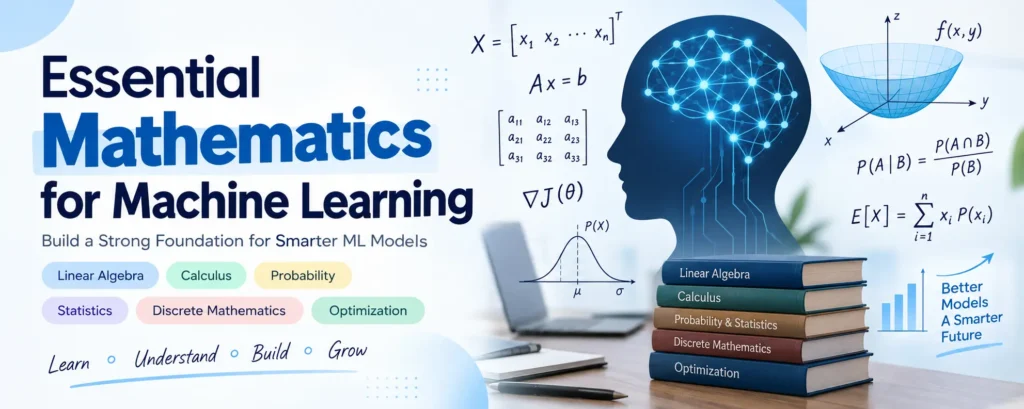
Linear algebra is often considered the language of machine learning. It deals with vectors, matrices, and operations performed on them. These concepts are fundamental to data representation and many machine learning computations.
Applications in Machine Learning:
- Data preprocessing and transformation
- Principal Component Analysis (PCA)
- Support Vector Machines
- Singular Value Decomposition (SVD)
- Deep learning and neural networks
Important Topics:
- Matrix multiplication and inversion
- Eigenvalues and eigenvectors
- Orthogonality
- Projections
- Norms and vector spaces
Linear algebra plays an important role throughout the ML pipeline, from feature engineering and data transformation to model training.
2. Multivariate Calculus
Calculus becomes particularly important when working with optimization problems, such as minimizing the error or loss produced by a machine learning model.
Applications:
- Training models using Gradient Descent
- Backpropagation in neural networks
- Optimizing cost and loss functions
Important Topics:
- Partial derivatives
- Gradient vectors
- Jacobian and Hessian matrices
- Directional derivatives
- Lagrangian optimization
Understanding multivariable calculus helps you understand how optimization algorithms move toward better solutions and how machine learning models converge during training.
3. Probability Theory
Probability theory helps quantify uncertainty and randomness, making it an important part of machine learning systems that work with predictions and uncertain outcomes.
Applications:
- Bayesian Networks
- Naive Bayes Classifier
- Hypothesis Testing
- Uncertainty estimation in predictions
Important Topics:
- Joint, marginal, and conditional probability
- Probability distributions such as Gaussian and Binomial distributions
- Maximum Likelihood Estimation (MLE)
- Bayes’ Theorem
A good understanding of probability allows you to model the likelihood of events and reason about possible outcomes more effectively.
4. Statistics
Statistics focuses on extracting meaningful information from data, identifying patterns, and drawing logical conclusions. It is particularly useful when working with real-world datasets.
Applications:
- Exploratory Data Analysis (EDA)
- Predictive modeling
- Classification and regression
Important Topics:
- Mean, variance, and standard deviation
- Random variables
- Hypothesis testing
- Confidence intervals
- Combinatorics
- Axioms of probability
Statistical thinking is especially valuable when working with real-world data that may be noisy, incomplete, or variable.
5. Discrete Mathematics
Discrete mathematics deals with countable and distinct elements such as integers, graphs, sets, and logical statements. It provides useful foundations for areas such as combinatorics, logic, and graph theory.
Applications:
- Graph-based machine learning models
- Decision trees and rule-based models
- Optimization in finite domains
Important Topics:
- Graph theory
- Set theory
- Logic and proof techniques
- Combinatorics
Although advanced discrete mathematics is not required for every basic machine learning task, it becomes increasingly useful when working with structured prediction and graphical models.
6. Algorithms & Optimization
Optimization is central to machine learning because many algorithms involve some form of optimization to minimize a loss function or improve model performance.
Applications:
- Parameter tuning
- Cost minimization
- Model performance improvement
Important Topics:
- Gradient Descent and Stochastic Gradient Descent
- Convex optimization
- Primal-Dual methods
- Dynamic programming
- Data structures such as trees, heaps, and stacks
Learning optimization techniques helps you understand how machine learning models find better solutions and how algorithms can be implemented efficiently.
Best Resources to Learn Mathematics for Machine Learning
Looking to start learning these mathematical concepts? Here are some useful free and paid resources for building your mathematics foundation for machine learning.
Books
Mathematics for Machine Learning by Marc Peter Deisenroth
A beginner-friendly resource covering important concepts from linear algebra, calculus, and probability.
Hands-On Mathematics for Deep Learning by Jay Dawani
Useful for understanding the mathematical concepts behind CNNs, RNNs, and other deep learning architectures.
Online Platforms
- Khan Academy – Provides beginner-friendly video lessons covering topics such as linear algebra, statistics, and calculus.
- Udacity Intro to Statistics – Covers foundational statistical concepts that are useful for machine learning and data science.
- Imperial College London (YouTube) – Offers free lectures covering multivariable calculus and its applications.
- Coursera Mathematics for Machine Learning – Provides structured learning material covering key mathematical concepts used in machine learning.
Download New Real Time Projects:- Click here
Conclusion
Mathematics is the invisible force behind machine learning. Whether you are training a model, tuning parameters, optimizing performance, or analyzing data, mathematical concepts are involved at every stage.
However, you do not need to become a mathematician before starting machine learning. Begin with the fundamentals, focus on building intuition, and gradually apply what you learn to practical ML problems.
A solid foundation in mathematics helps you understand how machine learning works rather than simply learning how to use machine learning tools. Take your time, study each concept carefully, and practice applying it along the way.
With the right approach and learning resources, you can develop a better understanding of machine learning and become a more confident and effective ML practitioner.
Stay tuned for more in-depth guides on machine learning, artificial intelligence, data science, and programming.
Keywords: essential mathematics for machine learning, mathematics for machine learning, machine learning mathematics, linear algebra for machine learning, calculus for machine learning, probability for machine learning, statistics for machine learning, machine learning math topics, mathematics for machine learning syllabus, essential mathematics for machine learning book