Machine Learning Models
Machine learning is a fundamental part of the rapidly evolving field of artificial intelligence and is transforming industries such as healthcare, finance, entertainment, and many others. At the heart of this transformation are machine learning models, which allow computers to learn patterns from data and use that knowledge to make predictions or decisions.
But what exactly is a machine learning model? How do different models work, and which type should be used for a particular problem? In this article, we’ll explore the answers to these questions and explain the major types of machine learning models in a simple and practical way.
Table of Contents
Complete Advance AI Topics: Click Here
SQL Tutorial: Click Here
What is a Machine Learning Model?
A machine learning model is a mathematical representation of patterns learned from training data. It can be thought of as a trained program that makes predictions or decisions based on previously learned information rather than being explicitly programmed for every possible situation.
Machine learning algorithms analyze historical data, identify meaningful patterns, and produce a trained model that can work with new and unseen data. These models are used in applications such as face recognition, fraud detection, recommendation systems, and many other AI-powered solutions.
A Real-World Example
Suppose you are building an application that detects emotions from facial expressions. You could provide the training system with thousands of labeled facial images showing emotions such as smiling, angry, surprised, and so on.
During training, the model learns relationships between facial features and the corresponding emotions.
After training, the application can analyze a new facial image and predict the likely emotional state based on the patterns learned by the model. This is a simple example of machine learning in action.
Classification of Machine Learning Models
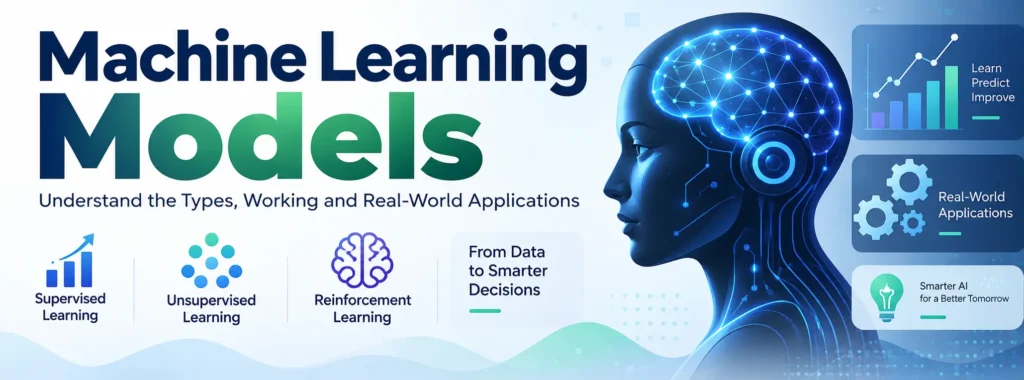
Machine learning approaches are broadly classified according to how the model learns from data:
- Supervised Learning
- Unsupervised Learning
- Reinforcement Learning
Each approach is designed for different types of problems, datasets, and learning objectives. Let’s explore them in more detail.
1. Supervised Learning Models
In supervised learning, a model is trained using a labeled dataset. This means that each input in the training data has a corresponding known output.
Supervised learning problems are commonly divided into two categories:
- Regression: Predicting continuous numerical values.
- Classification: Predicting discrete categories or classes.
a) Regression Models
Linear Regression
Linear Regression is one of the simplest and most widely used machine learning techniques. It is used to predict a numerical output based on one or more input variables.
For a simple linear relationship, it can be represented as:
Y = bx + c
Where:
- Y is the predicted output.
- x is the input variable.
- b is the slope or coefficient.
- c is the intercept.
For example, linear regression can be used to estimate house prices or salaries based on relevant input features.
Decision Tree
A Decision Tree uses a tree-like structure to split data into different branches and eventually arrive at a prediction. Its structure is easy to understand and interpret, making it useful for many machine learning problems.
Random Forest
Random Forest combines multiple decision trees and uses their collective results to make predictions. Because it combines several trees instead of relying on a single tree, it can provide better accuracy and greater robustness for many datasets.
Neural Networks
Neural Networks are inspired by the way biological neural systems process information. They consist of interconnected nodes, commonly called neurons, organized into layers.
Neural networks can learn complex patterns from data and form the foundation of deep learning. They are used in applications such as voice assistants, image recognition, and autonomous systems.
b) Classification Models
Classification models assign input data to predefined categories. Examples include determining whether an email is spam or not spam and identifying whether an image contains a cat or a dog.
Logistic Regression
Despite its name, Logistic Regression is primarily used for classification problems. It uses a logistic function to estimate the probability of a particular class, making it especially useful for binary classification tasks.
Support Vector Machine (SVM)
Support Vector Machine (SVM) finds an optimal decision boundary, or hyperplane, that separates data points belonging to different classes. SVMs can be particularly effective when working with high-dimensional datasets.
Naïve Bayes
Naïve Bayes is a classification technique based on Bayes’ theorem. It assumes that the features are conditionally independent of one another.
Despite this simplifying assumption, Naïve Bayes can perform effectively in applications such as spam filtering and sentiment analysis.
2. Unsupervised Learning Models
In unsupervised learning, the model works with unlabeled data. Instead of being given predefined answers, the algorithm attempts to discover hidden patterns, structures, or relationships within the dataset.
a) Clustering
Clustering involves grouping data points according to their similarities. Data points within the same cluster are generally more similar to one another than to data points in other clusters.
Popular clustering algorithms include:
- K-Means Clustering
- Hierarchical Clustering
- DBSCAN
Clustering can be used for applications such as customer segmentation, anomaly detection, and image compression.
b) Association Rule Learning
Association Rule Learning identifies relationships and patterns between variables or items in large datasets. One common application is Market Basket Analysis.
For example, if customers frequently purchase chips after purchasing soda, an e-commerce or retail system could use this relationship to recommend chips to customers who buy soda.
Common association rule algorithms include:
- Apriori
- FP-Growth
c) Dimensionality Reduction
Datasets containing a large number of features can become difficult to visualize, process, and model. Dimensionality reduction techniques reduce the number of features while attempting to preserve the most important information.
Common techniques include:
- Principal Component Analysis (PCA)
- Singular Value Decomposition (SVD)
3. Reinforcement Learning
Reinforcement learning is a feedback-based machine learning approach. In this setting, an agent interacts with an environment, takes actions, receives rewards or penalties, and learns to improve its future decisions.
Some popular reinforcement learning algorithms include:
Q-Learning
Q-Learning is a model-free reinforcement learning algorithm that attempts to learn the best action for different states by estimating their expected rewards using Q-values.
SARSA (State-Action-Reward-State-Action)
SARSA is an on-policy reinforcement learning algorithm. Its learning process depends on the actions selected by the current policy.
Deep Q-Network (DQN)
Deep Q-Network (DQN) combines Q-learning with neural networks. It is useful for environments with large or high-dimensional state spaces, including applications such as video games and robotics.
Training Machine Learning Models
Training a machine learning model involves providing it with a suitable dataset so that it can learn useful patterns. Before training, data often needs to be cleaned, normalized, transformed, and pre-processed.
The quality of training data has a major impact on model performance. Poor-quality, incomplete, or improperly prepared data can result in inaccurate predictions, which is why data preparation is an important part of machine learning.
How to Choose the Right Model?
With many machine learning models available, choosing the right one depends on the requirements of the problem. Important factors include:
- The type of data, such as labeled or unlabeled data.
- The business or project goal, such as prediction, classification, or clustering.
- The size and quality of the dataset.
- The required balance between speed, accuracy, and complexity.
A practical approach is to start with simpler models and establish a baseline. You can then experiment with more complex models, tune their parameters, and evaluate them using suitable validation techniques such as cross-validation.
ML Models vs. Algorithms: What’s the Difference?
Machine learning models and algorithms are closely related, but they are not the same thing.
- Algorithm: The process or method used to learn patterns from data.
- Model: The trained result produced after an algorithm learns from data.
In simple terms:
Machine Learning Model = Learning Algorithm + Training Data
Download New Real-Time Projects: Click here
Conclusion
Machine learning models are the engines behind many modern AI systems. From predicting customer preferences to supporting autonomous systems, these models are used across a wide range of applications.
Understanding the three major learning approaches—supervised learning, unsupervised learning, and reinforcement learning—helps you select an appropriate approach for a particular project or research problem.
Ultimately, the performance of a machine learning model depends not only on the selected algorithm but also on the quality of the data, the training process, and how effectively the model is evaluated.
Stay tuned for more tutorials and practical guides on data science, machine learning, and emerging technologies.
Keywords
machine learning models, machine learning models examples, machine learning models types, machine learning models for prediction, machine learning models in Python, machine learning models cheat sheet, supervised machine learning models, unsupervised machine learning models, reinforcement learning models, machine learning algorithms, machine learning models in AI, machine learning tutorial, machine learning algorithms examples