What is a Data Evangelist
In today’s fast-paced, data-driven business environment, success increasingly depends on an organization’s ability to use data effectively. This is where a Data Evangelist plays an important role.
Data evangelism represents a shift in how organizations think, work, and make decisions. It promotes a culture where data is not simply a byproduct of business operations but a strategic asset that supports growth, innovation, and better decision-making.
Introduction to Data Evangelism
Data evangelism focuses on encouraging organizations to adopt data-driven practices across different teams and departments. A Data Evangelist helps people understand the value of data and shows them how data can support better business outcomes.
They work at the intersection of technology and business, helping teams understand analytical insights and use them effectively in their everyday decisions.
Complete Advance AI Topics: Click Here
SQL Tutorial: Click Here
Who is a Data Evangelist?
A Data Evangelist is a passionate advocate for data-driven decision-making. They help businesses adopt and integrate data into their strategies, processes, and organizational culture.
One of their key responsibilities is bridging the communication gap between technical teams, such as data scientists and analysts, and business stakeholders. They make sure that valuable data insights are communicated clearly and are not lost because of technical complexity.
Data Evangelists also encourage innovation through analytics and help teams move from instinct-based decisions toward evidence-based actions. In many organizations, they act as cultural change agents who help employees understand that data is an important part of modern business.
The Core Concept of Data Evangelism
At its core, data evangelism is more than a technical concept. It is a mindset focused on promoting the strategic use of data across an organization.
Instead of depending only on assumptions or intuition, data evangelism encourages decisions supported by reliable evidence and meaningful insights.
A Data Evangelist does not simply work with data. They help shape organizational behavior around data. They promote data literacy, simplify analytics for non-technical teams, and encourage an environment where curiosity and experimentation are welcomed.
This approach can help organizations become more adaptable and better prepared to compete in a data-centric business environment.
Why Data Evangelists Matter in Modern Business
Digital transformation, artificial intelligence, and changing customer expectations have made data an important part of modern business strategy. Organizations that successfully integrate data into their decision-making processes can identify opportunities, improve efficiency, and respond more effectively to market changes.
Data Evangelists contribute to this transformation by:
- Making data accessible and actionable for employees.
- Connecting data insights with strategic business objectives.
- Helping teams develop stronger data skills and data literacy.
- Encouraging employees to use evidence when making decisions.
In simple terms, Data Evangelists help organizations build better and more reliable decision-making processes.
Key Responsibilities of a Data Evangelist
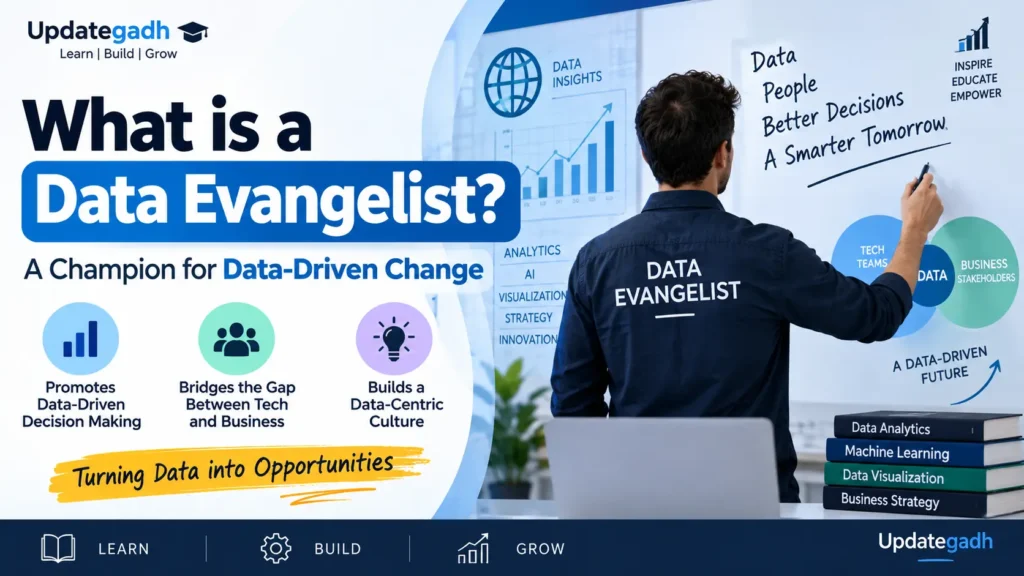
1. Promoting Data-Driven Decision Making
A Data Evangelist encourages teams to use data analytics and insights when making business decisions. This can include areas such as marketing, customer experience, sales, and operational improvements.
The goal is to make data a natural part of the decision-making process rather than something used only by technical teams.
2. Bridging the Gap Between Tech and Business
Data and analytics can sometimes be difficult for non-technical stakeholders to understand. Data Evangelists translate complex analytical findings into simple, business-friendly language.
Whether they are communicating with a marketing manager, business leader, or CFO, they help stakeholders understand what the data means and why it matters to the business.
3. Fostering a Data-Centric Culture
Data Evangelists encourage employees to use data in their daily work. They may organize workshops, training sessions, internal campaigns, and educational programs to improve data awareness.
Over time, these activities can create a workplace where data is viewed as a tool for innovation and better decision-making rather than simply a compliance requirement.
Tools and Technologies for Data Evangelists
Data Evangelists may work with a wide range of tools and technologies related to data visualization, analytics, artificial intelligence, databases, and data integration.
1. Data Visualization Tools
Tools such as Tableau, Power BI, and QlikView can transform complex datasets into understandable visualizations.
These visualizations support data storytelling by helping stakeholders quickly understand trends, patterns, anomalies, and opportunities.
Use Cases:
- Real-time KPI dashboards
- Customer journey analysis
- Executive reports
2. Analytics Platforms
Platforms such as Google Analytics, Adobe Analytics, and IBM Watson Analytics can be used to analyze behavioral data, business metrics, and performance trends.
These platforms support activities ranging from basic reporting to more advanced analytical tasks.
Use Cases:
- Market segmentation
- Performance forecasting
- Campaign analysis
3. Machine Learning & AI Applications
Machine learning and AI technologies such as TensorFlow, Amazon SageMaker, and scikit-learn can help organizations generate predictive insights and automate certain decision-making workflows.
Use Cases:
- Customer churn prediction
- Fraud detection
- Personalized customer recommendations
Complementary Skills and Tools
Along with analytics and visualization technologies, a successful Data Evangelist can benefit from knowledge of several other areas:
- Databases: MySQL, PostgreSQL, MongoDB, Cassandra
- ETL & Integration: Talend, Informatica, Apache NiFi
- Programming: Python, R, and SQL for analytics and automation
- Data Governance: Data quality, security, and compliance
The combination of technical knowledge, communication skills, and business understanding allows Data Evangelists to turn data insights into meaningful business impact.
Download New Real Time Projects :- Click here
Conclusion
In an increasingly data-driven world, the role of a Data Evangelist can be highly valuable for organizations that want to build a strong data culture. They help break down communication barriers, make data more accessible, and encourage teams to use insights when making decisions.
By integrating data into everyday business processes, Data Evangelists help organizations become more informed, adaptable, and prepared for the future.
At Updategadh, we believe that empowering professionals with the right knowledge, mindset, and tools can contribute to meaningful transformation across the technology and business landscape.
Stay ahead. Stay data-driven. Follow for more insights on the evolving world of data and technology.
Keywords
What is a Data Evangelist, Data Evangelism, Data Driven Decision Making, Data Culture, Data Literacy, Data Analytics, Data Science, Business Analytics, Data Strategy, Data Visualization, Machine Learning, Artificial Intelligence, Data Governance