GPT-6 vs Cloud AI: Why Is GPT-6 Better
Artificial intelligence is moving beyond simple question-answering systems. Modern AI models can now reason through difficult problems, write software, search information, work with files, use tools, and assist with complete digital workflows. One of the latest examples is GPT-6 Astra, OpenAI’s flagship model for demanding end-to-end work.
This raises an important question: GPT-6 vs Cloud AI — what is the difference, and why is GPT-6 Astra considered more capable for complex tasks?
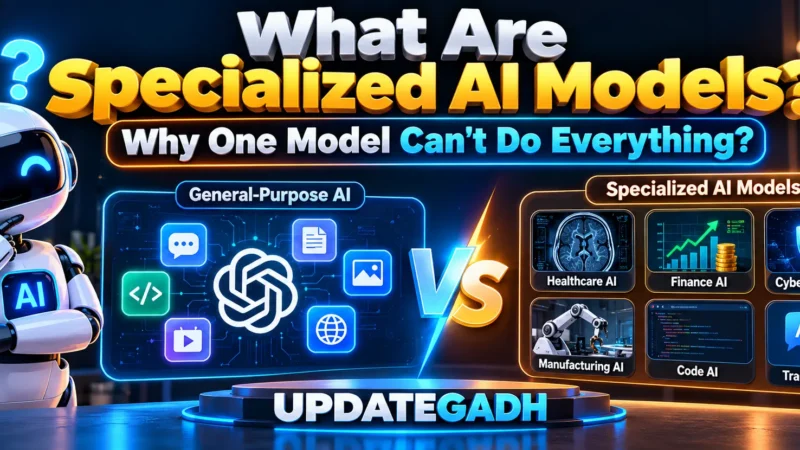
The comparison can be confusing because GPT-6 Astra itself can be accessed through cloud-based APIs. Therefore, GPT-6 and Cloud AI are not two completely separate technologies. GPT-6 is an AI model, while cloud AI generally describes AI services and infrastructure delivered through remote cloud platforms.
Table of Contents
What Is GPT-6 Astra?
GPT-6 Astra is OpenAI’s latest flagship model designed for complex reasoning, coding, computer use, research, and professional workflows. OpenAI describes Astra as its most capable model and reports state-of-the-art performance across areas such as software engineering, browsing, computer use, science, and professional work.
For developers, the model is available through the OpenAI API using the model identifier gpt-6-astra. It supports a context window of up to 1.05 million tokens and a maximum output of 128,000 tokens.
What Is Cloud AI?
Cloud AI refers broadly to artificial intelligence services that run on remote computing infrastructure. Instead of installing and operating a powerful AI system entirely on a personal computer, developers can send requests to cloud servers through an API or other cloud service.
Cloud-based AI can provide access to large computing resources without requiring users to purchase and maintain specialized hardware. It is commonly used for applications such as chatbots, recommendation systems, data analysis, automation, image processing, and machine learning.
However, Cloud AI is a broad category, not one specific AI model. Its performance depends on the particular model and service being used.
GPT-6 vs Cloud AI: What’s the Difference?
| Feature | GPT-6 Astra | General Cloud AI |
|---|---|---|
| Technology type | Advanced AI model | Broad cloud-based AI category |
| Complex reasoning | Designed for demanding reasoning tasks | Depends on the selected model |
| Coding | Strong software engineering capabilities | Varies by model and platform |
| Computer use | Supported | Depends on the service |
| Web search | Supported through tools | Depends on the platform |
| Context window | Up to 1.05 million tokens | Varies by model |
| Tool calling | Supported | Depends on implementation |
| API access | Available | Commonly available |
Why Is GPT-6 Astra Better for Complex AI Work?
Rather than saying that GPT-6 is universally better than every cloud AI service, it is more accurate to look at the capabilities that make Astra suitable for difficult workloads.
1. Advanced Reasoning
GPT-6 Astra is designed for tasks that require multiple reasoning steps instead of only generating a quick response. Its API provides different reasoning-effort levels, including low, medium, high, xhigh, and max.
This allows developers to adjust the model’s reasoning effort according to the requirements of an application. A simple request can use less reasoning, while a complicated programming or research task can use a higher level.
2. Strong Software Engineering
Software development is one of the areas where GPT-6 Astra is particularly useful. It can assist with understanding code, developing applications, debugging problems, testing software, and handling larger development workflows.
This makes the model useful for projects involving Python, Java, JavaScript, PHP, Django, databases, APIs, and other programming technologies.
OpenAI’s developer guidance specifically recommends GPT-6 Astra for complex reasoning and coding workloads.
3. Computer Use
A major difference between modern AI models and traditional text-only assistants is their ability to interact with software environments.
GPT-6 Astra supports computer use through the Responses API. This allows applications to build workflows where the model can work with computer interfaces and use available tools instead of simply returning text instructions.
For example, an AI workflow could potentially follow a sequence such as:
Understand the task
        ↓
Plan the workflow
        ↓
Use available tools
        ↓
Inspect the result
        ↓
Correct problems
        ↓
Complete the task
This type of workflow can be useful for software testing, research, automation, and other computer-based activities.
4. Large Context Window
GPT-6 Astra provides a context window of up to 1.05 million tokens. This is useful when an application needs to work with large amounts of information in a single workflow.
Developers can use a large context window for tasks involving:
- Large software projects
- Long technical documents
- Research material
- Business information
- Multiple files
- Large application specifications
The official API documentation lists a maximum output size of 128,000 tokens in addition to the 1.05 million-token context window.
5. Multiple Tools in One Workflow
GPT-6 Astra supports several tools through the Responses API, including web search, file search, computer use, code interpreter, image generation, hosted shell, and other capabilities.
This allows developers to build applications where the AI can combine reasoning with external tools instead of depending only on information contained in a generated response.
GPT-6 and Cloud AI Can Work Together
One of the most important points to understand is that GPT-6 Astra does not replace cloud computing. In fact, GPT-6 Astra is itself available through cloud-based services.
OpenAI provides GPT-6 Astra through its API and also lists availability through Microsoft Azure and Amazon Bedrock. This means developers can use cloud infrastructure to integrate GPT-6 capabilities into their own applications.
A better way to understand the relationship is:
Cloud Infrastructure
        ↓
AI Model
        ↓
GPT-6 Astra
        ↓
Application
        ↓
User
The cloud provides the infrastructure and access layer, while GPT-6 Astra provides the underlying AI capabilities.
GPT-6 Astra for Developers
Developers can access GPT-6 Astra through the OpenAI API by specifying gpt-6-astra as the model. The API supports features such as function calling, structured outputs, streaming, web search, file search, computer use, and other tools.
A basic API request can be structured around the model identifier like this:
from openai import OpenAI

client = OpenAI()

response = client.responses.create(
    model="gpt-6-astra",
    input="Explain how an AI-powered application works."
)

print(response.output_text)
The exact API configuration can vary depending on the tools and workflow required by an application. Developers should use the current OpenAI API documentation when implementing production systems.
Complete Advance AI Topics: Click Here
SQL Tutorial: Click Here
YT:- DecodeIT
Is GPT-6 Always the Right Choice?
Not necessarily. Choosing an AI model depends on the application’s requirements.
GPT-6 Astra is positioned for difficult reasoning, coding, research, computer use, and professional workflows. However, applications that prioritize very low cost, high-volume processing, or simpler tasks may benefit from a smaller model.
OpenAI’s model-selection guidance recommends considering accuracy first and then optimizing for cost and latency.
GPT-6 vs Cloud AI: Final Thoughts
GPT-6 Astra and Cloud AI should not really be viewed as two competing technologies. Cloud AI describes the infrastructure and service model, while GPT-6 Astra is a specific advanced AI model that can operate through that infrastructure.
The main strength of GPT-6 Astra is its combination of reasoning, coding, computer use, large-context processing, web access, file handling, and tool-based workflows. These capabilities make it suitable for applications that require more than a simple text response.
For students, developers, researchers, and businesses, the important change is the move toward AI systems that can work through complete tasks rather than simply answer individual questions. As AI development continues, models with stronger reasoning and tool-use capabilities are likely to become an increasingly important part of modern software applications.
Keywords: GPT-6 vs Cloud AI, GPT-6 Astra, GPT-6, Cloud AI, GPT-6 features, GPT-6 coding, GPT-6 reasoning, GPT-6 API, GPT-6 computer use, AI cloud computing