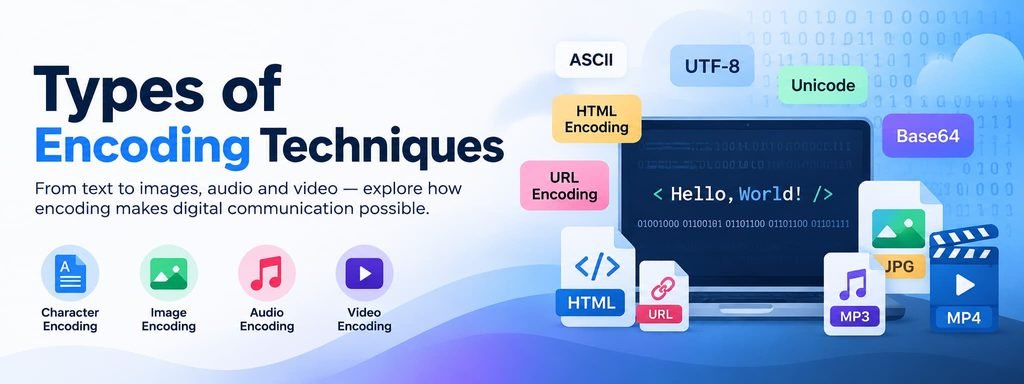
Types of Encoding Techniques
In the digital world, encoding plays an important role in making data easier to store, process, transmit, and interpret across different systems and devices. In simple terms, encoding is the process of converting data from one format into another while preserving the original information.
Encoding is commonly used in two major areas:
- Electronics: Converting analog signals into digital representations.
- Computing: Converting data into standardized formats so that different systems can process and transmit it efficiently.
Note: Encoding is different from encryption. Encoding changes data into another format for compatibility or transmission, while encryption is designed to protect information by making it unreadable without the appropriate key.
In this article, let’s explore the different types of encoding techniques used in computing, along with examples and common applications.
Table of Contents
Complete Advance AI Topics: Click Here
SQL Tutorial: Click Here
Character Encoding
Character encoding defines how characters such as letters, numbers, and symbols are represented using binary data. Computers work with binary values, so encoding provides a standard way to represent and interpret text.
Without a compatible character encoding, text can be displayed incorrectly or become corrupted when transferred between systems.
HTML Encoding
HTML encoding is used to represent special characters safely within HTML documents. Characters such as <, >, and & can otherwise be interpreted as part of HTML markup.
For example, the less-than symbol can be represented using the HTML entity <.
URL Encoding
URL encoding, also known as percent-encoding, converts characters into a format that can safely be used within URLs. Characters that are not suitable for direct use are represented using a percent sign followed by hexadecimal digits.
For example, a space is commonly represented as %20.
Unicode Encoding
Unicode provides a universal system for representing characters from languages and writing systems around the world. Unicode assigns characters unique code points, which can then be represented using different encoding formats.
Common Unicode encoding formats include:
- UTF-8: A variable-length encoding that uses 1 to 4 bytes per Unicode code point. It is the most widely used character encoding on the web.
- UTF-16: Uses one or two 16-bit code units to represent Unicode characters.
- UTF-32: Uses a fixed 32-bit code unit for each Unicode code point.
Base64 Encoding
Base64 converts binary data into a text representation using a set of 64 characters. It is useful when binary information needs to be transmitted through systems that are designed primarily for text.
Common applications include:
- Email systems and text-based data transmission
- Embedding small images or files in HTML and CSS
- Representing credentials in HTTP Basic Authentication
Base64 converts every 3 bytes of binary data (24 bits) into 4 Base64 characters, with each character representing 6 bits of information.
Important: Base64 is an encoding technique, not an encryption method. Anyone can decode Base64 data without a secret key.
ASCII Encoding
ASCII (American Standard Code for Information Interchange) is one of the earliest widely adopted character encoding standards. It uses 7-bit values, ranging from 0 to 127, to represent English letters, numbers, punctuation marks, and control characters.
Modern encodings such as UTF-8 maintain compatibility with the original ASCII character set for the first 128 characters.
Image, Audio & Video Encoding
Encoding is not limited to text. Digital media such as images, audio, and video also use encoding techniques to represent and store information efficiently.
Media encoding can reduce file sizes while maintaining an acceptable level of quality, making files easier to store, transfer, and stream.
Audio Encoding
Audio encoding converts digital audio into a particular format. For example, a high-quality .WAV file can be converted into a compressed .MP3 file to significantly reduce its file size.
The amount of size reduction and the resulting quality depend on the encoding method and compression settings.
Image Encoding
Image formats such as JPEG, PNG, and WebP use different methods for representing and compressing image data.
- JPEG: Commonly uses lossy compression and is suitable for photographs.
- PNG: Uses lossless compression and supports transparency.
- WebP: Supports both lossy and lossless compression and is widely used for web images.
YT:- DecodeIT
Video Encoding
Video encoding converts raw or uncompressed video into a compressed format that requires less storage and bandwidth.
Common video technologies include H.264 and WebM. Efficient video encoding is essential for online video playback and streaming because it allows high-quality content to be delivered using less bandwidth.
Software and hardware components known as codecs are commonly used to encode and decode digital media. A codec helps compress media during encoding and decompress it during playback.
Final Thoughts
Encoding is an essential part of modern digital communication. Whether you are viewing a website, transferring a file, processing text, or streaming a video, encoding techniques are often working behind the scenes.
For developers, designers, and digital professionals, understanding different encoding techniques can help improve data compatibility, transmission, storage, and overall system reliability.
Understanding when and why a particular encoding method is used makes it easier to work with different types of digital data and systems.
Keywords: Types of Encoding Techniques, types of encoding techniques in machine learning, types of encoding techniques in computer networks, types of encoding techniques in communication, one hot encoding, signal encoding techniques, UTF-8 encoding, types of encoding techniques with examples, data encoding techniques, one-hot encoding in machine learning, types of encoding techniques in data science, label encoding in machine learning, what is encoding in machine learning, categorical encoding in machine learning, frequency encoding in machine learning