Derivative of Sigmoid Function
The sigmoid function is one of the most commonly used mathematical functions in machine learning. It is recognized by its smooth S-shaped curve and produces values within a limited range, which makes it useful for probability-based predictions.
Sigmoid functions are widely used in areas such as logistic regression and neural networks. Their smooth and differentiable nature makes them useful during model training. To understand how neural networks learn and update their weights, it is important to understand the derivative of the sigmoid function.
Complete Advance AI Topics: Click Here
SQL Tutorial: Click Here
What is a Sigmoid Function?
A sigmoid function takes any real-valued input and converts it into a value within a specific range. Two commonly discussed sigmoid-type activation functions are:
- Logistic Function
- Hyperbolic Tangent (tanh)
Mathematical Definition
The logistic sigmoid function is defined as:
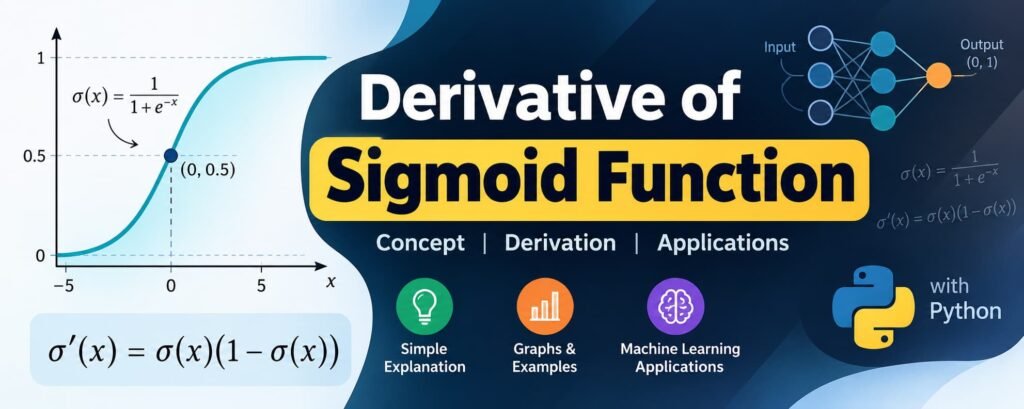
σ(x) = 1 / (1 + e-x)
This function creates an S-shaped curve and converts input values into outputs between 0 and 1.
The hyperbolic tangent function is defined as:
tanh(x) = (e2x – 1) / (e2x + 1)
The tanh function produces values between -1 and 1 and has been commonly used as an activation function in neural network hidden layers.
Key Properties of Sigmoid Functions
Output Range
- Logistic sigmoid: 0 to 1
- Tanh: -1 to 1
Smooth and Continuous
Sigmoid functions are smooth and differentiable, which makes their derivatives suitable for optimization algorithms and backpropagation.
Non-Linearity
Sigmoid functions introduce non-linearity into neural networks, allowing models to learn patterns that cannot be represented using only linear operations.
Use in Logistic Regression
The logistic sigmoid function converts a model’s output into a value between 0 and 1. This makes it particularly useful for representing probabilities in binary classification.
Why is the Derivative Important?
The derivative of the sigmoid function is important when training neural networks. During backpropagation, derivatives are used to determine how changes in the network’s weights affect the prediction error.
This information allows gradient descent to adjust the weights in a direction that can reduce the model’s error.
Derivative of Sigmoid Function: Step-by-Step
Consider the logistic sigmoid function:
σ(x) = 1 / (1 + e-x)
Step 1: Rewrite the Function
We can rewrite the function as:
f(x) = (1 + e-x)-1
Now, we differentiate the function using the chain rule:
f'(x) = e-x / (1 + e-x)2
Step 2: Express the Derivative Using Sigmoid
The derivative can be simplified by expressing it in terms of the original sigmoid function:
σ'(x) = σ(x) × (1 – σ(x))
This is one of the most useful properties of the sigmoid function because its derivative can be calculated directly from its output.
Interpretation and Importance
1. Learning Sensitivity
The derivative of the sigmoid function reaches its maximum value when x = 0. At this point, the sigmoid output is 0.5 and the curve has its greatest slope.
This means the function is most sensitive to changes around the middle of its range.
2. Vanishing Gradient Problem
When the input becomes very large or very small, the sigmoid output approaches 1 or 0. As a result, its derivative approaches zero.
This can lead to the vanishing gradient problem, where weight updates become extremely small and deep neural networks can become difficult to train.
3. Probability Calibration
The sigmoid function is useful for binary classification because it converts a model’s raw output into a value between 0 and 1. Its derivative helps the optimization process make gradual adjustments during training.
Applications in Optimization
Backpropagation
During backpropagation, activation-function derivatives are used to calculate gradients. The sigmoid derivative helps determine how much the output of a neuron changes in response to changes in its input.
Weight Adjustment
The calculated gradients are used by optimization algorithms such as gradient descent to update neural network weights. A very small gradient can result in slow learning, while excessively large gradients can make optimization unstable.
Learning Rate Regulation
The gradient produced by an activation function influences the size of weight updates. The sigmoid derivative therefore plays a role in how quickly a model learns during optimization.
YT:- DecodeIT
Types of Sigmoid Functions
| Function | Formula | Output Range | Common Application |
|---|---|---|---|
| Logistic | σ(x) = 1 / (1 + e-x) | 0 to 1 | Binary classification |
| Tanh | tanh(x) = (e2x – 1) / (e2x + 1) | -1 to 1 | Neural network hidden layers |
Real-World Use Cases
- Binary Classification: Converts model outputs into probability-like values between 0 and 1.
- Logistic Regression: Used to model binary outcomes.
- Neural Networks: Provides non-linearity and can be used in specific neural network layers, particularly binary output layers.
Advantages of Using Sigmoid Derivatives
- The derivative has a bounded value, which helps avoid excessively large gradients.
- Its smooth nature makes gradient calculations straightforward.
- It supports gradient-based optimization and backpropagation.
Limitations
- It can suffer from the vanishing gradient problem when inputs are far from zero.
- Very small gradients can slow down training in deep networks.
- Because of these limitations, functions such as ReLU are often preferred for hidden layers in modern deep learning models.
Conclusion
The sigmoid function is an important concept in machine learning, especially for understanding logistic regression and neural networks. Its smooth S-shaped curve and bounded output make it useful for probability-based predictions.
The derivative, σ'(x) = σ(x)(1 – σ(x)), is particularly important because it is used during backpropagation and gradient-based optimization. At the same time, the derivative becomes very small at extreme input values, which can cause vanishing gradients.
Although modern neural networks often use alternatives such as ReLU for hidden layers, sigmoid remains highly relevant for binary classification and for understanding the mathematical foundations of neural network training.
Keywords
derivative of sigmoid function, second derivative of sigmoid function, derivative of sigmoid function graph, sigmoid derivative python, sigmoid function in neural network, derivative of sigmoid function calculator, derivative of relu, sigmoid function in machine learning, derivative of relu function, derivative of tanh, derivative of sigmoid function range, derivative of sigmoid function python, sigmoid function, softmax function