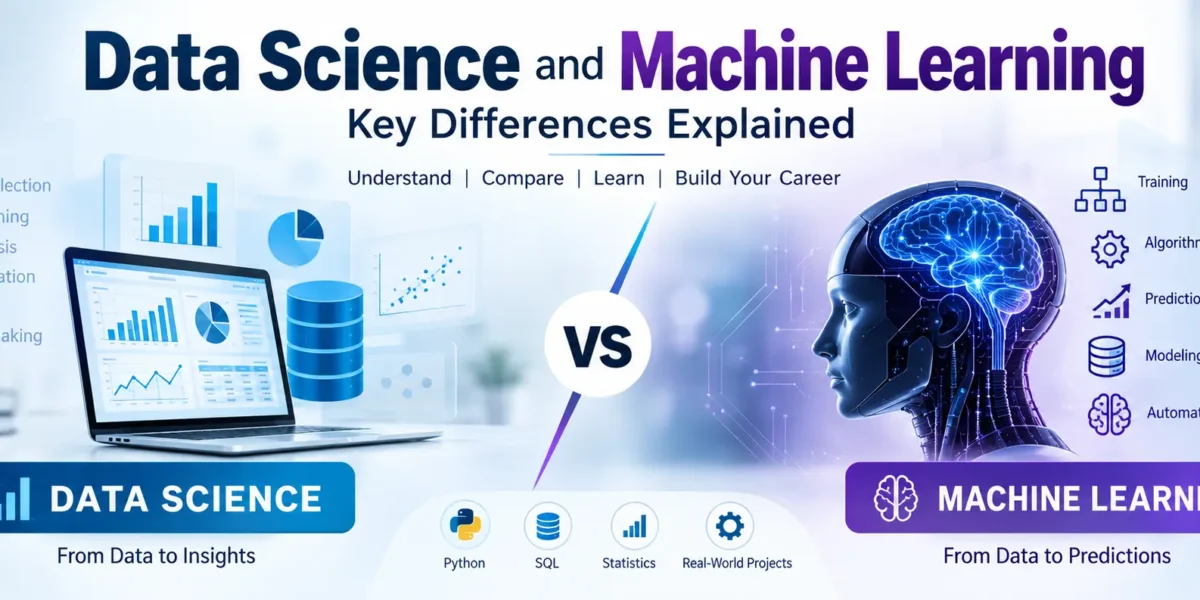
Data Science and Machine Learning are two of the most in-demand technologies in today’s data-driven world. As their popularity continues to grow, they are often discussed alongside Artificial Intelligence (AI) and Deep Learning. Because these fields are closely connected, beginners often find it difficult to understand how they differ.
In this guide, we will explore the difference between Data Science and Machine Learning, understand how they are related, and look at the skills, applications, and career roles associated with each field.
Table of Contents
Complete Advance AI Topics: Click Here
SQL Tutorial: Click Here
Data Science vs Machine Learning: A Brief Overview
Although Data Science and Machine Learning are closely related, they have different purposes and areas of focus.
- Data Science is a broad field that involves collecting, cleaning, processing, analyzing, and visualizing data to generate useful insights.
- Machine Learning is a specialized area of Artificial Intelligence that focuses on creating algorithms and models that learn from data to make predictions or decisions.
Let’s take a closer look at both concepts.
What is Data Science?
Data Science is a multidisciplinary field focused on extracting meaningful information from data. It combines statistics, programming, data analysis, visualization, database technologies, and domain knowledge to solve problems and support better decision-making.
Definition of Data Science
Data Science is a broad field that involves collecting, cleaning, processing, and analyzing data using different tools and techniques to generate actionable insights.
Real-World Example
Streaming platforms such as Netflix use Data Science to analyze viewing history, ratings, and user behavior. These insights help understand user preferences and improve personalized content recommendations.
Key Skills Required for Data Scientists
- Programming languages such as Python, R, SAS, or Scala
- Strong knowledge of Statistics and Probability
- Experience with SQL and databases
- Knowledge of Big Data technologies such as Hadoop and Hive
- Data cleaning and preprocessing
- Data visualization and data mining
- Understanding of Machine Learning algorithms
What is Machine Learning?
Machine Learning (ML) is a specialized area of Artificial Intelligence that enables computers to learn patterns from data and use those patterns to make predictions or decisions without requiring every rule to be explicitly programmed.
Definition of Machine Learning
Machine Learning is a method of data analysis that enables computers to learn from data and improve their performance as they receive more information.
Real-World Example
Email spam filters are a common example of Machine Learning. They analyze patterns from previously identified emails to classify new messages as spam or legitimate.
Key Skills Required for Machine Learning Engineers
- Strong understanding of Machine Learning algorithms
- Programming skills in Python or R
- Knowledge of Natural Language Processing (NLP)
- Understanding of Statistics, Probability, and Linear Algebra
- Data modeling skills
- Model evaluation and optimization
Where Does Machine Learning Fit in Data Science?
Machine Learning can be an important part of the Data Science lifecycle. Data Science covers the broader process of working with data, while Machine Learning provides techniques that can be used to build predictive models and automate decisions.
1. Business Understanding
The first step is to understand the problem that needs to be solved. For example, an e-commerce company may want to build a recommendation system to increase product sales.
2. Data Collection
Relevant data is collected based on the problem. This may include customer reviews, purchase history, product ratings, browsing behavior, and other useful information.
3. Data Processing
The collected data is cleaned and prepared for further analysis. Missing values, duplicate records, inconsistent formats, and other data-quality issues may need to be addressed.
4. Data Exploration
Data scientists explore the dataset to identify patterns, trends, relationships, and anomalies that can help solve the business problem.
5. Data Modeling
This is where Machine Learning can play a major role. Machine Learning algorithms can be used to:
- Build predictive models
- Train and test models
- Evaluate model performance
- Tune models for better results
- Validate predictions
6. Deployment and Monitoring
After a suitable model has been developed, it can be deployed into a real-world application. Its performance should then be monitored and improved as new data becomes available.
Data Science vs Machine Learning: Comparison
The following table highlights some of the major differences between Data Science and Machine Learning.
| Feature | Data Science | Machine Learning |
|---|---|---|
| Definition | A broad field focused on collecting, analyzing, and interpreting data | A technique that enables systems to learn patterns from data and make predictions |
| Goal | Discover insights and support decision-making | Build models that make predictions or automated decisions |
| Scope | Broad and includes data collection, analysis, visualization, and Machine Learning | More specialized and focused on model development and prediction |
| Usage | Data analysis, visualization, insight generation, and decision support | Predictive analytics, classification, automation, and forecasting |
| Skills Required | Statistics, programming, SQL, visualization, data processing, and ML | Machine Learning, mathematics, programming, modeling, and model evaluation |
| Data | Can work with structured, semi-structured, and unstructured data | Uses data to train and evaluate predictive models |
| Primary Focus | Understanding data and extracting useful information | Developing and optimizing models that learn from data |
| Example | Analyzing which product categories perform best during a particular period | Predicting which customers are likely to leave a service |
Download New Real-Time Projects: Click here
Conclusion
Data Science and Machine Learning are closely connected, but they are not the same thing. Data Science is the broader field that focuses on collecting, preparing, analyzing, and interpreting data, while Machine Learning provides techniques for building systems that can learn from data and generate predictions or decisions.
Understanding the difference between these fields is important for anyone planning a career in technology. Whether you want to become a Data Scientist or a Machine Learning Engineer, understanding their roles, skills, and responsibilities can help you choose a suitable career path.
Keep learning with more technology tutorials, project guides, and resources designed to help you build practical skills in Data Science, Machine Learning, Artificial Intelligence, and programming.
Keywords
Data Science and Machine Learning, machine learning vs data science which is easy, difference between data science and machine learning and artificial intelligence, machine learning or data science which has a better future, machine learning vs data science salary, data science and machine learning salary, difference between data scientist and machine learning engineer, difference between data science and AI, data science and machine learning course, difference between data science and data analytics, what is Data Science and Machine Learning, difference between data science and machine learning PDF, difference between data science and machine learning GeeksforGeeks