
Fake Review Detection System Using NLP
Introduction
Online product reviews play an important role in helping customers decide what to purchase. Before buying a product, users often check ratings and reviews to understand its quality and performance. However, not every online review is genuine. Fake reviews can be created to promote a product, improve its reputation, or negatively affect another product or seller.
The Fake Review Detection System, developed by UPDATEGADH, uses Natural Language Processing (NLP) and Machine Learning to classify product reviews as real or fake. The application is developed using Streamlit, providing a simple web interface where users can upload a CSV file containing product reviews.
Complete Advance AI Topics: Click Here
Real Time Projects on YouTube:- DecodeIT
Project Overview
| Project Name | Fake Review Detection System Using NLP and Machine Learning |
|---|---|
| Language/s Used | Python |
| Frontend | Streamlit |
| Machine Learning | Logistic Regression |
| NLP Technique | TF-IDF Vectorization |
| Database | Not Required |
| Project Type | NLP and Machine Learning Web Application |
What You Will Learn
- How to preprocess text-based review data.
- How NLP can be used for text classification.
- How TF-IDF converts text into numerical features.
- How to train a Logistic Regression classification model.
- How to classify reviews as real or fake.
- How to create a web interface using Streamlit.
- How to handle CSV file uploads and downloads.
Technology Stack
- Frontend: Streamlit
- Backend: Logistic Regression with TF-IDF Vectorizer
- Programming Language: Python
- Libraries: Pandas, NumPy, Scikit-learn, re, String
Available Features
- CSV review file upload
- Review data validation
- Text preprocessing
- TF-IDF text vectorization
- Machine learning-based classification
- Real review detection
- Fake review detection
- Separate real review CSV generation
- Separate fake review CSV generation
- Downloadable prediction results
- Streamlit-based user interface
Streamlit Application Flow
1. Upload the CSV File
The user uploads a CSV file containing product review information through the Streamlit web interface. The application checks whether the uploaded file contains the required columns.
2. Process the Reviews
The uploaded review text is processed using basic NLP preprocessing. The text is converted into a suitable format before being passed to the machine learning model.
3. Convert Text Using TF-IDF
TF-IDF (Term Frequency-Inverse Document Frequency) is used to transform review text into numerical vectors. These vectors can then be processed by the machine learning classification model.
4. Classify Reviews
The processed review data is passed to a Logistic Regression model. The model determines whether each review should be classified as genuine or fake according to the labels used during training.
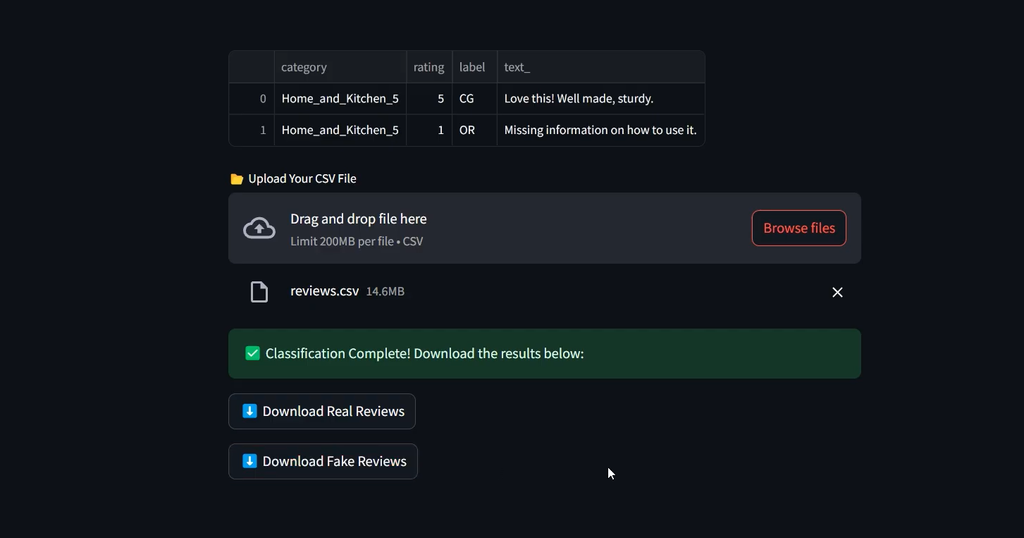
5. Download Results
After classification, the application separates the results into two files:
- real_reviews.csv – Contains reviews classified as real.
- fake_reviews.csv – Contains reviews classified as fake.
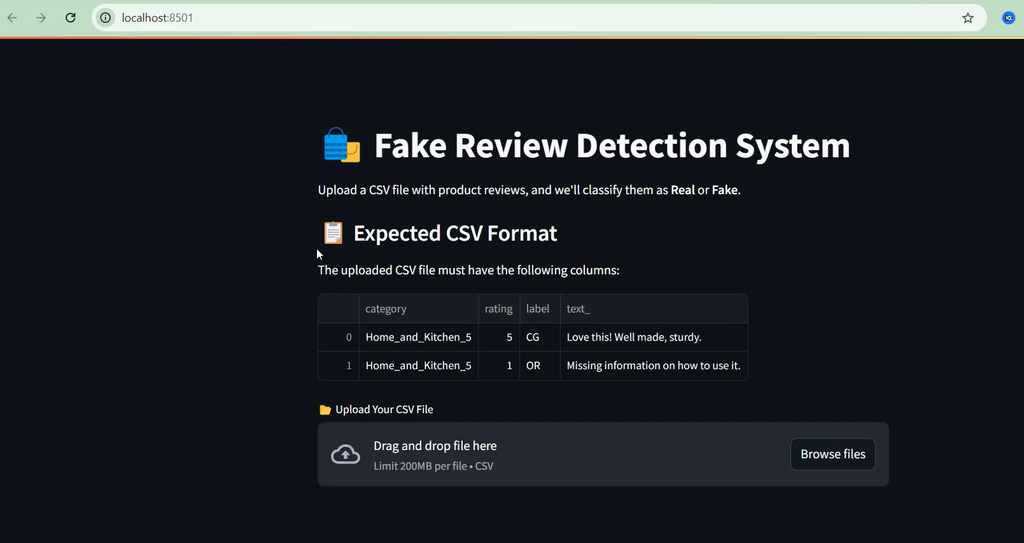
Required CSV Format
The uploaded CSV file should contain the required review-related columns in the expected format.
| Column | Description | Example |
|---|---|---|
| category | Product category | Home_and_Kitchen_5 |
| rating | Product rating | 5 |
| label | Review classification label | CG / OR |
| text_ | Review content | Love this! Well made, sturdy. |
Example data:
category,rating,label,text_
Home_and_Kitchen_5,5,CG,"Love this! Well made, sturdy."
Home_and_Kitchen_5,1,OR,"Missing information on how to use it."
How Fake and Real Reviews Are Determined
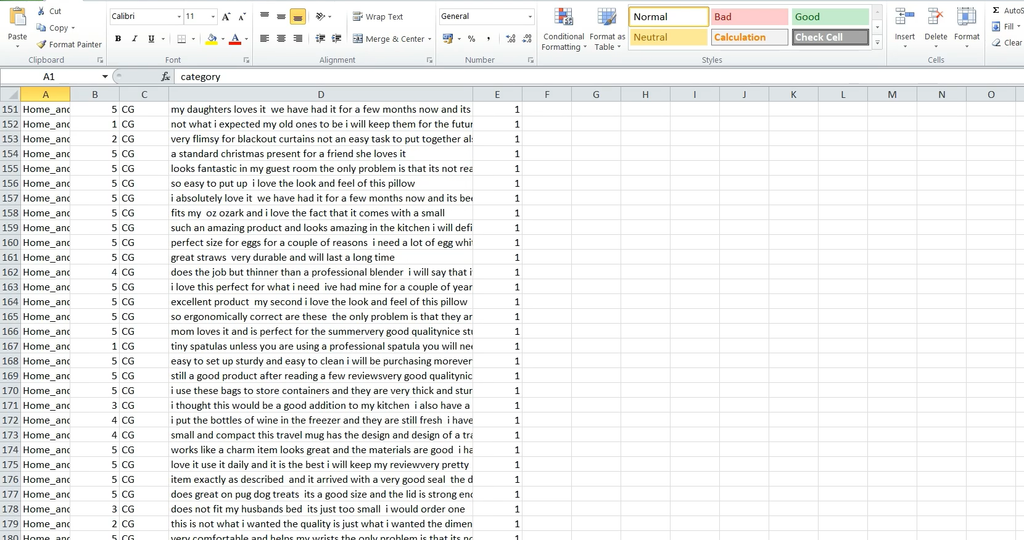
The system uses labeled review data to train the machine learning model. In the provided classification approach, the CG label is treated as a genuine review, while other labels are treated as fake for the binary classification process.
- CG: Real / Genuine Review
- Other Labels: Fake / Other Review
TF-IDF first converts the review text into numerical features. These features are then provided to the Logistic Regression model for classification.
Machine Learning Workflow
- Load the review dataset.
- Validate the required columns.
- Preprocess the review text.
- Convert text into numerical features using TF-IDF.
- Train the Logistic Regression model using labeled data.
- Process uploaded reviews.
- Generate predictions.
- Separate real and fake reviews.
- Generate downloadable CSV files.
Project Structure
The application can be implemented as a simple Streamlit project using a Python application file responsible for loading the data, training the model, processing uploaded reviews, generating predictions, and providing downloadable results.
fake_review_app.py contains the main Streamlit application and handles the complete workflow.
Software and Tools Required
- Python
- VS Code or another Python IDE
- Streamlit
- Pandas
- NumPy
- Scikit-learn
- Web Browser
How to Download
The complete package is available so you can run, study, and submit it with confidence. It includes:
- Full Source Code
Demo Video
Screenshot
Installation Guide
Step 1: Open the Project
Open the project folder in VS Code and make sure Python is installed on your system.
Step 2: Create a Virtual Environment
python -m venv venvStep 3: Activate the Virtual Environment
For Windows:
venv\Scripts\activateStep 4: Install Required Libraries
pip install streamlit pandas numpy scikit-learnStep 5: Run the Application
streamlit run fake_review_app.pyAfter running the command, Streamlit will provide a local address. Open that address in your browser to access the application.
Usage
Open the Streamlit application in a web browser and upload a CSV file containing product reviews. The application validates the uploaded file and processes the review text using the NLP pipeline.
The TF-IDF vectorizer converts the review text into numerical features, and the trained Logistic Regression model classifies the reviews. Once processing is completed, users can download separate CSV files containing the real and fake reviews.
Project Benefits
- Provides a practical example of NLP-based text classification.
- Helps students understand TF-IDF and Logistic Regression.
- Demonstrates how machine learning can process real-world review data.
- Provides a simple Streamlit-based interface.
- Supports CSV upload and downloadable classification results.
- Combines data preprocessing, machine learning, and web application development in one project.
Future Scope
The system can be further improved by experimenting with additional NLP techniques and machine learning algorithms. More advanced text-processing methods can also be introduced to improve classification performance.
The application could additionally be enhanced with better result visualization, larger labeled datasets, improved text preprocessing, and deployment as an online service.
Final Thoughts
From a student’s perspective, the Fake Review Detection System Using NLP and Machine Learning is a useful project for understanding how textual data can be processed and classified using machine learning. The project combines NLP preprocessing, TF-IDF feature extraction, Logistic Regression, CSV data handling, and Streamlit into a practical application.
Fake Review Detection System Fake Review Detection System fake review detection system project fake review detection system research paper fake review detection system github fake product review detection system detect fake reviews fake bad reviews check for fake reviews fake review detection software fake review detection project