Data Science Algorithms
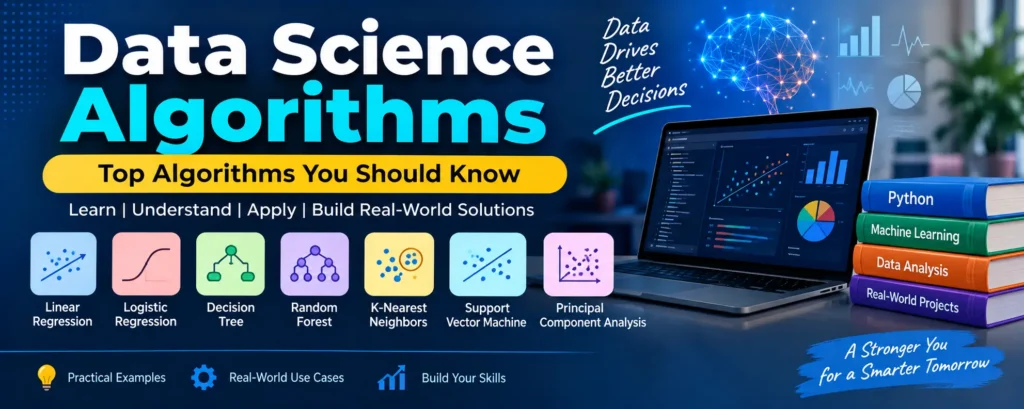
In the rapidly growing field of data science, algorithms play a crucial role in discovering patterns, making predictions, and supporting data-driven decisions. They help data scientists transform raw and complex datasets into meaningful insights that can be used to solve real-world problems.
From classification and regression to clustering and dimensionality reduction, different algorithms are designed for different types of data science tasks. Understanding how these algorithms work and when to use them is an important step toward building a strong foundation in data science and machine learning.
As data continues to grow in size and complexity, new techniques and approaches are constantly being developed. However, learning the fundamental data science algorithms remains essential for anyone who wants to build practical skills in this field.
In this guide, we will explore some of the most important data science algorithms, their applications, and why they are widely used.
Complete Advance AI Topics: Click Here
SQL Tutorial: Click Here
1. Linear Regression
Linear Regression is one of the most fundamental algorithms used in data science and machine learning. It is used to identify a linear relationship between one or more independent variables and a dependent variable.
Because of its simplicity and interpretability, linear regression is commonly used for predictive modeling and analyzing relationships between variables.
Use Case: Predicting future revenue using historical sales data.
For example, a business can use historical sales, marketing expenditure, and other relevant factors to estimate future revenue.
Why It Matters:
- Simple and easy to understand
- Highly interpretable
- Useful for predicting continuous numerical values
- Provides a foundation for understanding more advanced machine learning models
2. Logistic Regression
Logistic Regression is widely used when the target outcome is categorical. It is particularly useful for classification problems such as identifying spam emails, detecting fraudulent transactions, or determining whether an event belongs to a particular category.
The algorithm uses the sigmoid function to estimate probabilities between 0 and 1, which can then be used to determine the appropriate class.
Use Case: Detecting fraudulent transactions based on transaction amount, user behavior, and other transaction-related information.
Why It Matters:
- Useful for binary classification problems
- Can be extended to multiclass classification
- Produces probability estimates
- Uses Maximum Likelihood Estimation for parameter optimization
- Relatively simple to interpret and implement
Its combination of mathematical simplicity and practical usefulness makes logistic regression a popular choice for many classification tasks.
3. Decision Tree
Decision Trees use a tree-like structure to make predictions. They work by repeatedly splitting a dataset according to feature values until useful decision rules are formed.
The resulting structure resembles a flowchart, which makes decision trees particularly easy to understand and visualize.
Use Case: Predicting customer behavior using factors such as age, gender, purchase history, and other customer attributes.
Why It Matters:
- Easy to interpret and visualize
- Can be used for both classification and regression
- Requires relatively little data preparation
- Forms the foundation of ensemble algorithms such as Random Forest
Decision trees are especially valuable when model interpretability and transparency are important requirements.
4. Random Forest
Random Forest is an ensemble learning algorithm that combines multiple decision trees to produce a more reliable prediction. Instead of depending on a single tree, it aggregates the results of many trees.
This approach can improve predictive performance and reduce the risk of overfitting compared with using a single decision tree.
Use Case: Analyzing financial or market data using historical indicators and economic factors.
Why It Matters:
- Reduces the risk of overfitting compared with individual decision trees
- Works well with large and complex datasets
- Can be used for classification and regression
- Handles datasets containing many features effectively
- Can provide useful feature-importance information
Because of its flexibility and strong performance, Random Forest is commonly applied in areas such as finance, healthcare, and bioinformatics.
5. K-Nearest Neighbors (KNN)
K-Nearest Neighbors (KNN) is a non-parametric algorithm that can be used for both classification and regression. Instead of creating a complex model during training, KNN makes predictions by examining the data points that are closest to a new observation.
The algorithm identifies the k nearest data points and uses their values to determine the prediction.
Use Case: Image classification or recommending products based on similarities between users or items.
Why It Matters:
- Simple to understand and implement
- Useful for identifying local patterns
- Can be effective when similar observations have similar outcomes
- Can be used for both classification and regression
One limitation of KNN is that making predictions can become computationally expensive when working with large datasets. It can work particularly well when the data contains meaningful local or clustered patterns.
6. Support Vector Machine (SVM)
Support Vector Machine (SVM) is a powerful supervised learning algorithm commonly used for classification. It attempts to find an optimal decision boundary, known as a hyperplane, that separates different classes while maximizing the margin between them.
SVM can also handle complex, non-linear relationships by using different kernel functions.
Use Case: Classifying medical images or other data into categories such as benign and malignant cases.
Why It Matters:
- Works effectively with high-dimensional datasets
- Can handle linear and non-linear classification problems
- Supports kernel functions such as RBF and polynomial kernels
- Can perform well on relatively small but complex datasets
The mathematical foundation of SVM makes it a useful algorithm for classification problems where the separation between classes is complex.
YT:- DecodeIT
7. Principal Component Analysis (PCA)
Principal Component Analysis (PCA) is a dimensionality reduction technique used to simplify datasets containing a large number of variables.
PCA transforms the original features into a smaller set of new variables called principal components. These components capture as much of the important variation in the original data as possible.
Use Case: Reducing the number of features in image datasets to make analysis and visualization more efficient.
Why It Matters:
- Reduces the dimensionality of datasets
- Can improve model training efficiency
- Helps visualize high-dimensional data
- Can reduce redundant information
- Helps uncover important patterns and structures within data
By reducing a large number of variables into a smaller set of informative components, PCA can make complex datasets easier to analyze and visualize.
Final Thoughts
Learning the most important data science algorithms is an essential step toward understanding how data can be transformed into useful predictions and insights. Each algorithm has its own strengths and is suitable for different types of problems.
For example, Linear Regression is useful for predicting continuous values, while Logistic Regression is commonly used for classification. Decision Trees provide an intuitive way to make predictions, while Random Forest combines multiple trees for more robust results. KNN is useful for similarity-based predictions, SVM handles classification boundaries effectively, and PCA helps reduce the complexity of high-dimensional datasets.
As the field of data science continues to evolve, understanding these core algorithms provides a strong foundation for learning more advanced machine learning and artificial intelligence techniques.
Keep practicing, experiment with real-world datasets, and continue exploring new techniques. In data science, continuous learning is one of the most valuable skills you can develop.
Stay tuned for more in-depth technology guides, project tutorials, and learning resources!
Keywords
data science algorithms, data science algorithms list, data science algorithms pdf, data science algorithms with examples, machine learning algorithms for prediction, machine learning algorithms in data science, machine learning algorithms list, data science algorithms book, data science algorithms course, data science algorithms in Python, data science algorithms cheat sheet, data science project ideas for final year, advanced data science projects, machine learning algorithms, data science