
Data Sculpting Tutorial
In the age of digital transformation, data is often described as the “new oil.” However, just like crude oil, raw data has little value in its unprocessed form. It needs to be cleaned, organized, transformed, and refined before it can deliver meaningful value. This process is commonly referred to as data sculpting, and it plays an important role in modern data analytics.
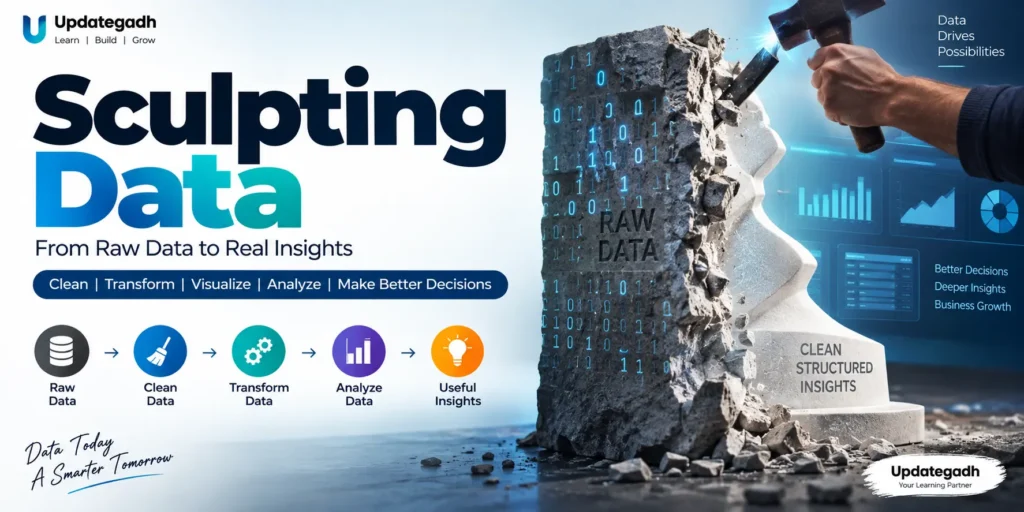
Data sculpting involves refining, transforming, and shaping raw data into a clean, organized, and usable form. By applying different data preprocessing techniques, it improves data quality, relevance, and interpretability, ultimately making it easier to extract useful insights and support better decision-making.
Complete Advance AI Topics: Click Here
SQL Tutorial: Click Here
Why Data Sculpting Matters
Data sculpting is more than just a background data preparation task. It provides the foundation for successful data-driven projects and helps ensure that the results of analysis are accurate, meaningful, and easy to understand.
1. Improving Data Quality
Raw datasets often contain missing values, incorrect entries, noise, and duplicate records. If these issues are ignored, they can lead to inaccurate analytical results. Data sculpting uses cleaning and preprocessing techniques to improve data quality and make analysis more reliable.
2. Enhancing Data Understandability
Large and complex datasets can be difficult to interpret. Data sculpting simplifies information through transformation and visualization, making important patterns easier to recognize. It helps bridge the gap between raw numbers and meaningful human interpretation.
3. Enabling Deeper Insights
Well-prepared data provides a strong foundation for advanced analytics. Clean and structured datasets allow analytical and machine learning algorithms to work more effectively, helping uncover trends, relationships, and unusual patterns that might otherwise remain hidden.
4. Supporting Informed Decision-Making
High-quality, well-prepared data gives stakeholders greater confidence when making decisions. Dashboards, reports, and visualizations can present important findings in a clear and concise way, helping organizations make evidence-based decisions.
5. Facilitating Communication
Visualizations, summaries, and reports created from sculpted data make analytical findings easier for non-technical stakeholders to understand. This improves communication and collaboration between data teams and business teams.
The Role of Data Sculpting in Insight Extraction
Data sculpting acts as an important link between collecting raw data and generating meaningful insights. The process generally involves several key stages.
Data Cleaning & Preprocessing
This stage focuses on removing duplicate records, handling missing values, correcting inconsistencies, and preparing the dataset for further analysis. Accurate analysis begins with clean and reliable data.
Data Transformation
Data transformation techniques such as normalization, standardization, and encoding modify variables into formats that are more suitable for analysis and machine learning. These techniques can also improve comparability between different features.
Data Reduction
Large datasets can sometimes contain more information than is necessary for a particular analysis. Techniques such as feature selection and Principal Component Analysis (PCA) can reduce complexity while retaining the most important information.
Data Visualization
Charts, graphs, dashboards, and other visualization methods help turn processed data into an understandable story. Visualization makes trends, relationships, and outliers easier to identify.
Core Data Sculpting Techniques
Data preprocessing techniques form the foundation of data sculpting. Some of the most commonly used techniques include the following:
1. Data Cleaning
- Missing Value Imputation: Estimates missing values using available information and existing data patterns.
- Duplicate Removal: Removes redundant records to maintain data consistency and integrity.
- Error Correction: Identifies and corrects inaccurate values caused by manual or automated data entry.
2. Data Transformation
- Normalization: Scales numerical features to a common range, such as 0 to 1.
- Standardization: Transforms data so that it generally has a mean of 0 and a standard deviation of 1.
- Encoding: Converts categorical variables into numerical representations that can be used by machine learning algorithms.
3. Data Reduction
- Feature Selection: Selects the most relevant features for analysis or modeling.
- Dimensionality Reduction: Techniques such as PCA reduce the number of variables while preserving important information.
- Sampling: Uses representative subsets of data to make analysis more efficient.
Importance of Normalization, Standardization, and Outlier Detection
Normalization
Normalization brings numerical features with different units and scales into a consistent range. This can prevent features with larger numerical values from having an unwanted influence on a model.
Standardization
Standardization is useful for many machine learning algorithms because it places features on a common statistical scale. It can improve model performance, interpretability, and convergence, particularly for algorithms that are sensitive to feature scaling.
Outlier Detection
Outliers can have a significant impact on analytical results and model performance. Detecting and handling unusual observations using statistical or machine learning-based methods helps maintain the robustness and reliability of analysis.
Embracing an Iterative Approach
Data sculpting is not necessarily a one-time process. As analysis progresses and new insights are discovered, earlier preprocessing and transformation decisions may need to be reviewed. This iterative approach allows analysts to continuously refine the dataset and keep it aligned with changing analytical requirements.
Advanced Data Sculpting Techniques
Modern data sculpting goes beyond basic cleaning and preprocessing. It can also involve advanced techniques for extracting more meaningful information from complex datasets.
1. Feature Engineering
Feature engineering involves creating or modifying features to reveal useful patterns and improve analytical or machine learning results. Dimensionality reduction techniques such as PCA and t-SNE can also help simplify complex datasets while retaining meaningful structure.
2. Data Fusion and Integration
Combining structured and unstructured information from multiple sources can provide a more complete view of a problem. Data blending and other integration approaches help bring different datasets together for deeper analysis.
3. Time Series Analysis
When data contains a time-based component, techniques such as ARIMA and LSTM networks can be used to analyze historical patterns, identify seasonality, and forecast future trends. This can support more proactive decision-making.
4. Anomaly Detection
Methods such as Isolation Forests, One-Class SVMs, and autoencoders can help identify unusual or suspicious patterns. These techniques are particularly useful in applications such as fraud detection and system monitoring.
5. Interactive Visualization
Interactive dashboards, heatmaps, and network graphs allow users to explore large and complex datasets dynamically. They make data analysis more intuitive and can improve collaboration between technical and non-technical teams.
6. GANs for Data Synthesis
Generative Adversarial Networks (GANs) can be used to generate synthetic data that resembles real datasets. This approach can be particularly useful when original data is sensitive, limited, or difficult to obtain.
7. Privacy-Preserving Techniques
Techniques such as differential privacy and homomorphic encryption make it possible to work with sensitive information while helping protect individual privacy. These approaches are especially relevant in fields such as healthcare and finance.
The Future of Data Sculpting
As artificial intelligence, the Internet of Things (IoT), and big data continue to grow, the demand for efficient, secure, and scalable data sculpting techniques is also increasing. The field is expanding into areas such as natural language processing, graph analytics, and blockchain integration, making data preparation increasingly sophisticated.
YT:- DecodeIT
Final Thoughts
At its core, data sculpting is about turning raw information into something useful and meaningful. Just as a sculptor carefully shapes a block of stone to reveal a finished creation, data professionals transform raw datasets into insights that can support innovation and better decisions.
By combining fundamental preprocessing methods with advanced data sculpting techniques, organizations can turn disorganized data into meaningful information, strengthen strategic decision-making, and remain competitive in an increasingly data-driven world.
Written by Editorial Team
For more insights on data, analytics, and emerging technologies, stay connected with Updategadh.
Keywords
Data Sculpting, Data Preprocessing, Data Cleaning, Data Transformation, Data Reduction, Feature Engineering, Data Visualization, Outlier Detection, Data Analytics, Machine Learning Keywords:
Sculpting Data, Data Sculpting, Data Preprocessing, Data Cleaning, Data Transformation, Data Reduction, Data Analytics, Data Visualization, Feature Engineering, Data Science, Machine Learning, Outlier Detection, Data Integration, Time Series Analysis, Anomaly Detection, GANs, Synthetic Data, Privacy Preserving Data, Data Insights, Big Data